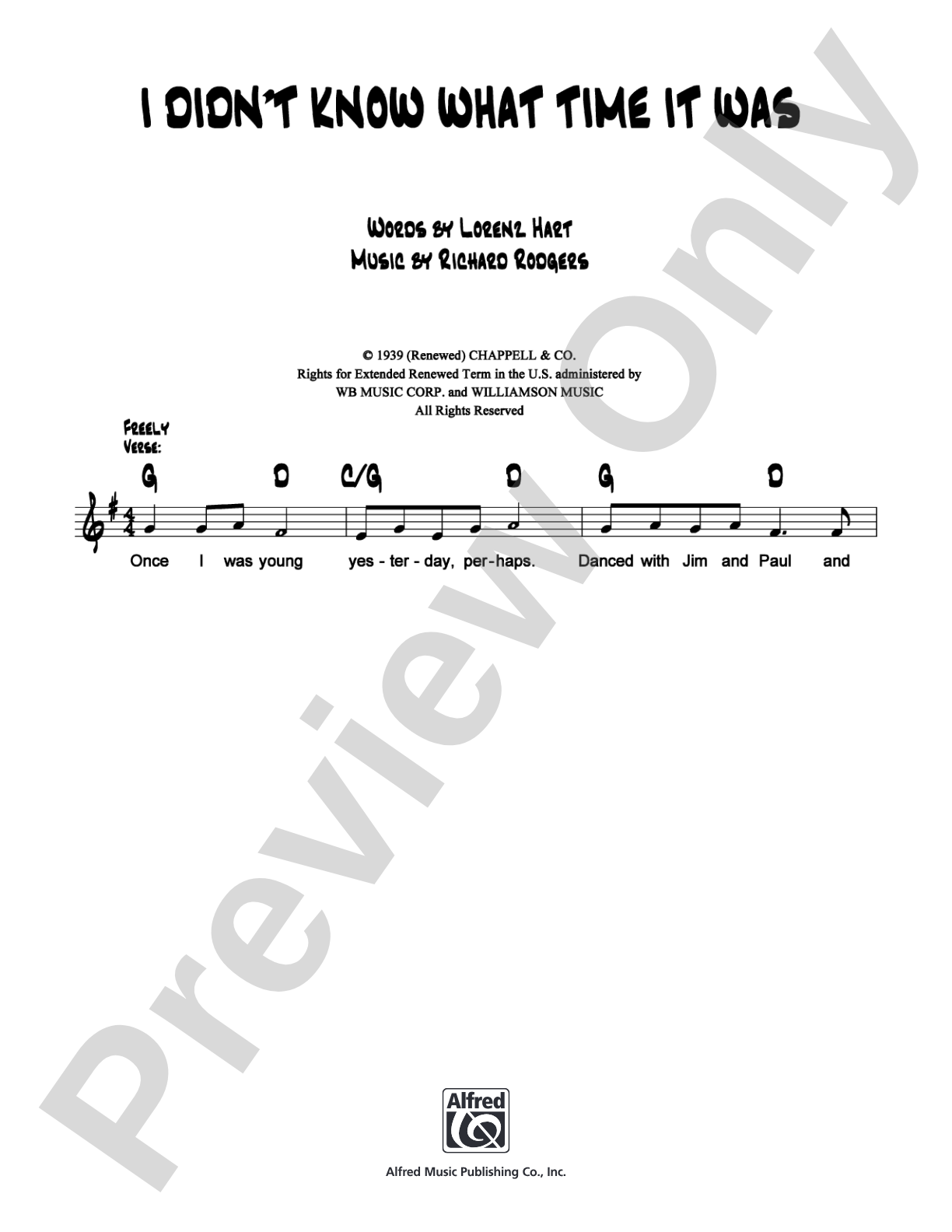
I Didn't Know What Time It Was: Lead Sheet Digital Sheet Music

I Didn't Know What Time It Was: Lead Sheet Digital Sheet Music

Richard Rodgers, Benny Goodman

Item: 00-PS-0007858

Digital Download
$1.99
Description

I Didn't Know What Time It Was: Lead Sheet Digital Sheet Music isn't in MakeMusic Cloud just yet...but it could be. Let us know you'd like to see it, and you'll help shape what comes next. In the meantime, start a free trial and dive into thousands of interactive titles your students can play along with today.

Sample Audio
No sample audio found.
Sample Video
Additional Details
SKU: 00-PS-0007858

More about this title

About the Artist: Benny Goodman

Benny Goodman (1909-1986) was a clarinetist and bandleader who became one of the most influential figures in American jazz history. His 'King of Swing' orchestra dominated the 1930s and 1940s, bringing jazz to mainstream audiences through radio broadcasts, recordings, and live performances. Goodman was also a classical musician who commissioned works from Aaron Copland and Béla Bartók, bridging the worlds of jazz and concert music in ways that shaped American musical culture for decades.

Why we love this

This standard is a touchstone for jazz musicians learning to interpret the Great American Songbook. The lead sheet format captures the essential harmonic and melodic framework without prescribing a single 'correct' interpretation, making it ideal for students who need to develop their own voice as improvisers and interpreters.

What to expect

The tune opens with a gentle, questioning quality that reflects its title. There's a nostalgic ease to the harmonic movement and melodic contour, as if recalling a forgotten moment with affection rather than melancholy. The whole piece breathes at a conversational tempo, inviting the player to linger and explore.

Who it's for

Jazz instrumentalists preparing repertoire for jam sessions, combos, or solo recitals will find this lead sheet essential. It also suits music theory or jazz history students who need a score to study how a classic standard is constructed and how improvisers build on that foundation.

How to get the most out of it

  • Study the original recording to hear how Goodman's articulation and phrasing shaped the melody, then make deliberate choices about where you'll follow his approach and where you'll depart.
  • Pay attention to the lyric phrasing even if you're playing an instrumental version; understanding where the words land will guide your breathing and musical punctuation.
  • Treat the lead sheet as a conversation starter, not a rulebook. Work out the head cleanly, but spend time exploring the harmonic space through comping, reharmonization, and melodic variation.
  • Balance transparency with personality. The tune's appeal lies in its singability, so keep your interpretation clear enough that the melody remains the anchor.

How to use it

Feature this as part of a jazz standards set in a recital, or use it as a teaching piece alongside other Rodgers and Hart compositions to explore how mid-century songwriters approached harmony and form. Its moderate tempo and accessible range make it suitable for demonstrating jazz interpretation across various ensemble configurations.

Skills your students will build

  • Reading and interpreting lead sheet notation with melody, chord symbols, and form
  • Building improvised melodies within a standard's harmonic structure
  • Analyzing song form (AABA or equivalent) and using it as a framework for soloing
  • Developing interpretive choices around phrasing, articulation, and dynamics from a minimal notation
  • Transposing and adapting the tune to fit different instruments and keys in ensemble contexts

You May Also Like