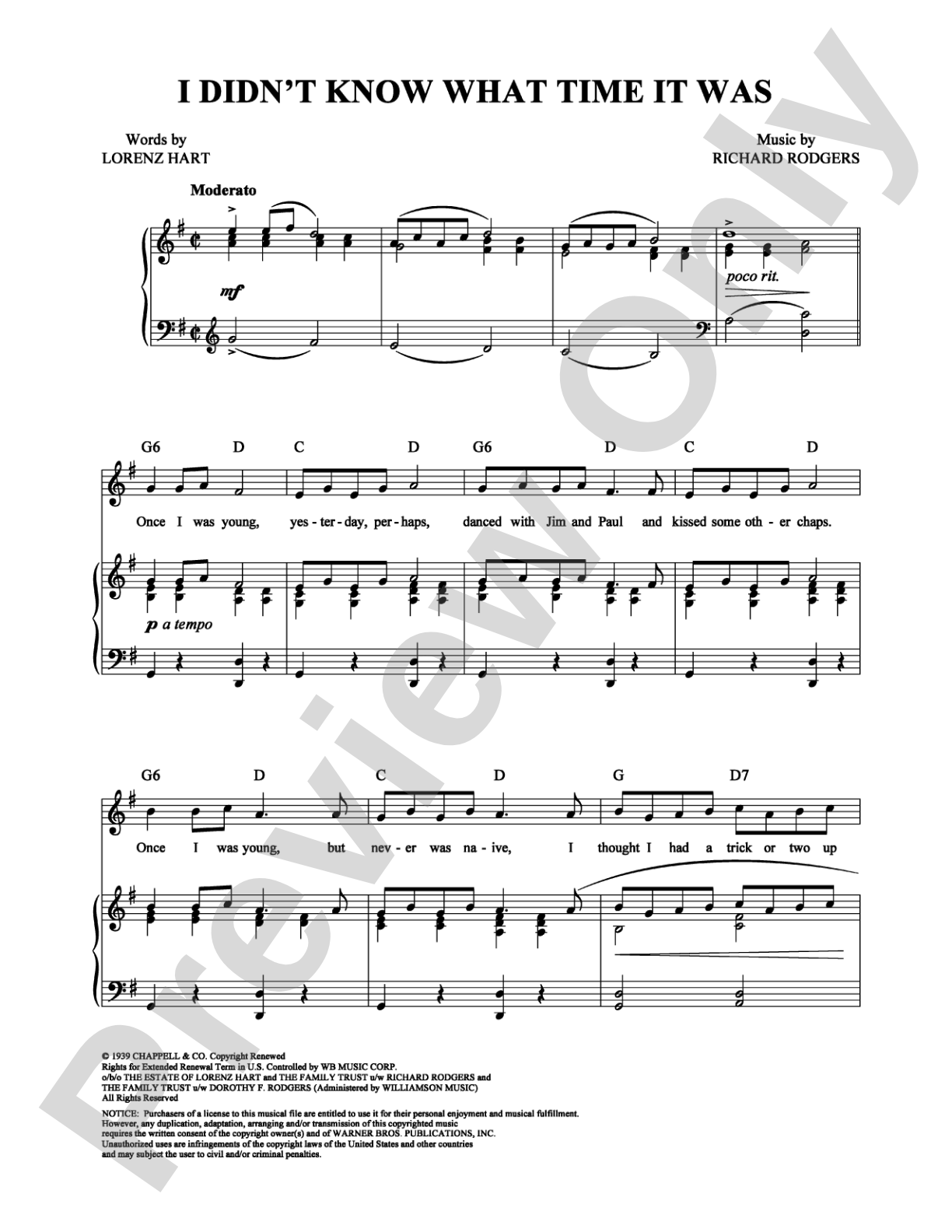
I Didn't Know What Time It Was: Piano/Vocal/Chords Digital Sheet Music

I Didn't Know What Time It Was: Piano/Vocal/Chords Digital Sheet Music

Richard Rodgers, Benny Goodman

Item: 00-PS-0001105

Digital Download
$3.99
Description

I Didn't Know What Time It Was: Piano/Vocal/Chords Digital Sheet Music isn't in MakeMusic Cloud just yet...but it could be. Let us know you'd like to see it, and you'll help shape what comes next. In the meantime, start a free trial and dive into thousands of interactive titles your students can play along with today.

Sample Audio
No sample audio found.
Sample Video
Additional Details
SKU: 00-PS-0001105

More about this title

About the Artist: Benny Goodman

Benny Goodman (1909-1986) was a clarinetist and bandleader whose electrifying swing style defined an era. As the "King of Swing," he led one of the most influential orchestras of the 1930s and 1940s, collaborating with composers and arrangers who shaped American popular music.

Goodman's impact on music education runs deep. His recordings and arrangements remain central to jazz pedagogy, and his collaborations with classical composers expanded the clarinet's repertoire. For singers and pianists, his catalog of standards offers direct access to the golden age of American song.

Why we love this

This standard distills the sophisticated harmonic language of 1940s American songwriting into a single, singable melody. The piano-vocal arrangement gives singers room to explore lyrical phrasing while pianists navigate changes that reward both technical precision and interpretive taste.

What to expect

A moment of realization wrapped in urbane charm. The melody moves with conversational ease, touching surprising harmonic territory without ever breaking stride. There's warmth here, but also sophistication; nostalgia without sentimentality.

Who it's for

Singers performing jazz standards, cabaret repertoire, or American songbook literature. Pianists working with vocalists or studying the harmonic language of swing-era composition.

How to get the most out of it

  • Treat the piano part as a conversation partner, not accompaniment. The harmonic movement supports the vocal line but has its own voice; keep both layers audible.
  • Land gently on chord changes to let the harmony speak. Rushing through the changes flattens the song's sophisticated architecture.
  • Singers should find the storytelling in the lyrics first, then let the melody serve that narrative. The tune works best when it feels lived-in, not merely executed.

How to use it

Pair this with other standards from the same era to build a jazz or American song set. It works equally well in a cabaret-style recital or as a palette cleanser between heavier contemporary pieces. The accessible melody makes it suitable for concert programs where you want to honor a significant American songbook tradition.

Skills your students will build

  • Reading lead sheet notation and chord symbols
  • Interpreting swing-era harmonic progressions
  • Coordinating vocal phrasing with piano accompaniment patterns
  • Building interpretive choices within a composed melody

You May Also Like