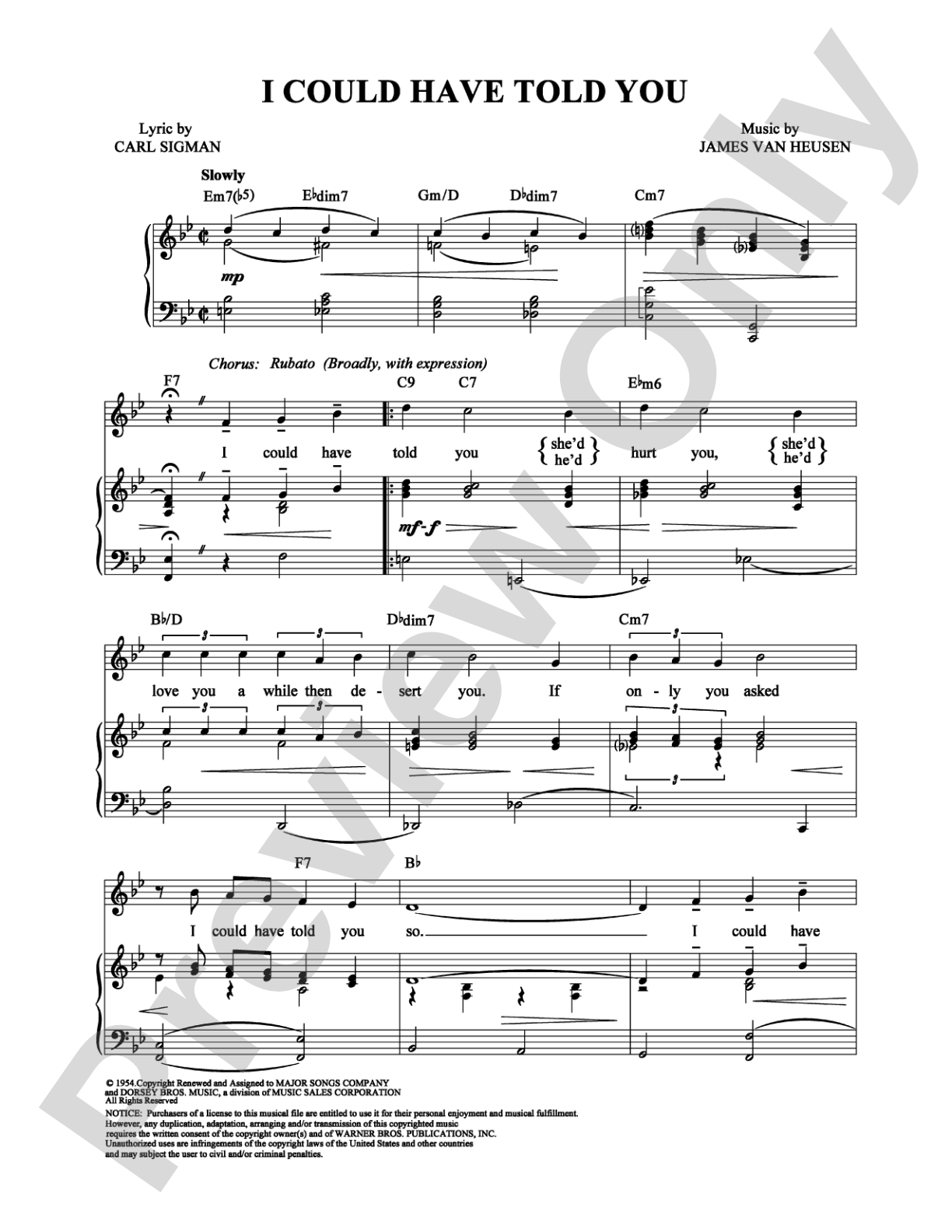
I Could Have Told You: Piano/Vocal/Chords Digital Sheet Music

I Could Have Told You: Piano/Vocal/Chords Digital Sheet Music

Frank Sinatra, James Van Heusen

Item: 00-PS-0007951

Digital Download
$2.95
Description

I Could Have Told You: Piano/Vocal/Chords Digital Sheet Music isn't in MakeMusic Cloud just yet...but it could be. Let us know you'd like to see it, and you'll help shape what comes next. In the meantime, start a free trial and dive into thousands of interactive titles your students can play along with today.

Sample Audio
No sample audio found.
Sample Video
Additional Details
SKU: 00-PS-0007951

More about this title

About the Artist: Frank Sinatra

Frank Sinatra redefined what it meant to be a popular singer, bringing orchestral sophistication and emotional depth to the American songbook. His approach to phrasing, the way he bent time, shaped dynamics, and colored each syllable, became the standard against which all subsequent vocalists are measured. For music educators, Sinatra's recordings offer masterclasses in interpretive singing, demonstrating how technical mastery serves storytelling rather than replacing it.

Why we love this

Sinatra's recorded interpretations of standards provide singers with a masterclass in lyrical storytelling and rhythmic flexibility. This particular arrangement captures the urbane sophistication and subtle vulnerability that made Sinatra's approach to ballads so compelling, offering vocalists a model for phrasing that prioritizes emotional clarity over technical display.

What to expect

A moment of quiet reflection, where restraint carries more weight than volume. The melody moves with conversational ease, supported by harmonies that shift beneath it with subtle chromaticism. There's sophistication without pretense, the sound of someone thinking out loud about what might have been.

Who it's for

Singers preparing jazz or popular music recitals, students studying American songbook interpretation, and vocalists looking to understand how Sinatra-era phrasing and accompaniment choices support storytelling in ballads. Pianists accompanying vocalists will find the chord symbols and voicings instructive for learning contemporary jazz comping techniques.

How to get the most out of it

  • Treat the melody as conversational rather than presentational; Sinatra's gift was making you feel he was singing to you alone, not performing for a crowd.
  • Map out the harmonic movement in advance so your piano voicings complement rather than fight the vocal line, restraint in the accompaniment actually increases the singer's presence.
  • Pay attention to the lyrical arc and shape your phrasing around the story's emotional trajectory, letting the music serve the words.
  • Establish a tempo that allows the rhythm section to breathe; rushing standard ballads strips away their sophistication.

How to use it

Program this alongside other classic standards from the Great American Songbook to explore how different eras and arrangers approached similar harmonic and melodic territory. It works equally well as a solo recital piece or paired with other Sinatra-associated standards to create a thematic program exploring vocal interpretation across decades.

Skills your students will build

  • Jazz phrasing and lyrical interpretation
  • Reading lead sheets and interpreting chord symbols
  • Coordination between vocal line and piano accompaniment
  • Understanding jazz harmony and voice leading
  • Developing interpretive flexibility within a composed framework

You May Also Like