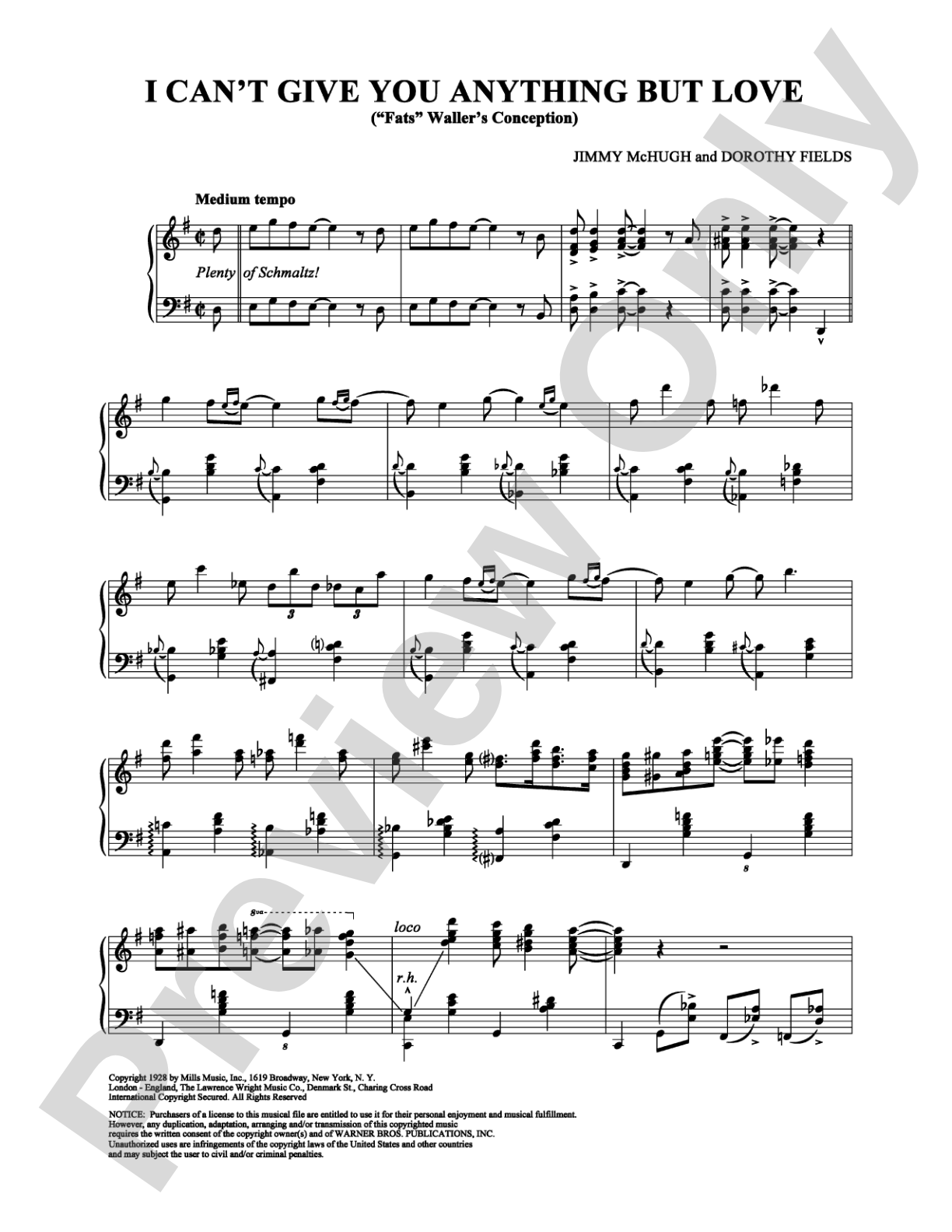
I Can't Give You Anything But Love (''Fats'' Waller's Conception): Piano Digital Sheet Music

I Can't Give You Anything But Love (''Fats'' Waller's Conception): Piano Digital Sheet Music

Jimmy McHugh, Dorothy Fields

Item: 00-PS-0000785

Digital Download
$2.95
Description

I Can't Give You Anything But Love (''Fats'' Waller's Conception): Piano Digital Sheet Music isn't in MakeMusic Cloud just yet...but it could be. Let us know you'd like to see it, and you'll help shape what comes next. In the meantime, start a free trial and dive into thousands of interactive titles your students can play along with today.

Sample Audio
No sample audio found.
Sample Video
Additional Details
SKU: 00-PS-0000785

More about this title

About the Creator: Thomas "Fats" Waller

Thomas "Fats" Waller (1904-1943) was a pianist, organist, and composer who redefined what stride piano could be. His technical command was matched only by his wit; he could bend a standard into unexpected shapes while keeping audiences laughing and moving. Waller's conception of jazz piano emphasized rhythmic drive, harmonic sophistication, and personality, qualities that made him one of the most recorded and broadcasted musicians of the swing era.

Why we love this

This arrangement captures the sophistication and swing sensibility that made Waller's piano style so influential. The voicings and rhythmic approach give pianists a genuine taste of stride piano and jazz harmony, not a simplified reduction of the original.

What to expect

Warm, witty, and deeply grounded in the stride piano tradition. The harmonic language sparkles with jazz color while the melody sits easy and conversational, inviting players to phrase with personality and swing.

Who it's for

Pianists with solid jazz harmony fundamentals and comfortable stride technique who want to explore authentic swing-era jazz piano literature. This works well for advanced students preparing recital material or teachers looking to build jazz vocabulary beyond pop standards.

How to get the most out of it

  • Establish the stride pattern early and keep it conversational rather than metronomic. The left hand should feel like it's supporting, not driving.
  • Balance the melody with the harmonic complexity underneath. This isn't a lead sheet; the inner voices matter and deserve voice leading clarity.
  • Let the swing articulation breathe. Waller's conception relies on subtle rhythmic inflection, especially in the accompaniment figures.

How to use it

Pair this with other classic jazz standards in a recital focused on early swing era piano music, or use it as a bridge between classical technique and contemporary jazz repertoire. It also serves as an excellent study piece for understanding how Tin Pan Alley melodies were reimagined by jazz pianists.

Skills your students will build

  • Stride piano left-hand pattern and independence
  • Jazz harmony voicing and reharmonization
  • Swing articulation and rhythmic inflection
  • Balancing melodic and harmonic layers
  • Style-specific phrasing in jazz standards

You May Also Like