I Can't Get You Off Of My Mind Sheet Music Preview

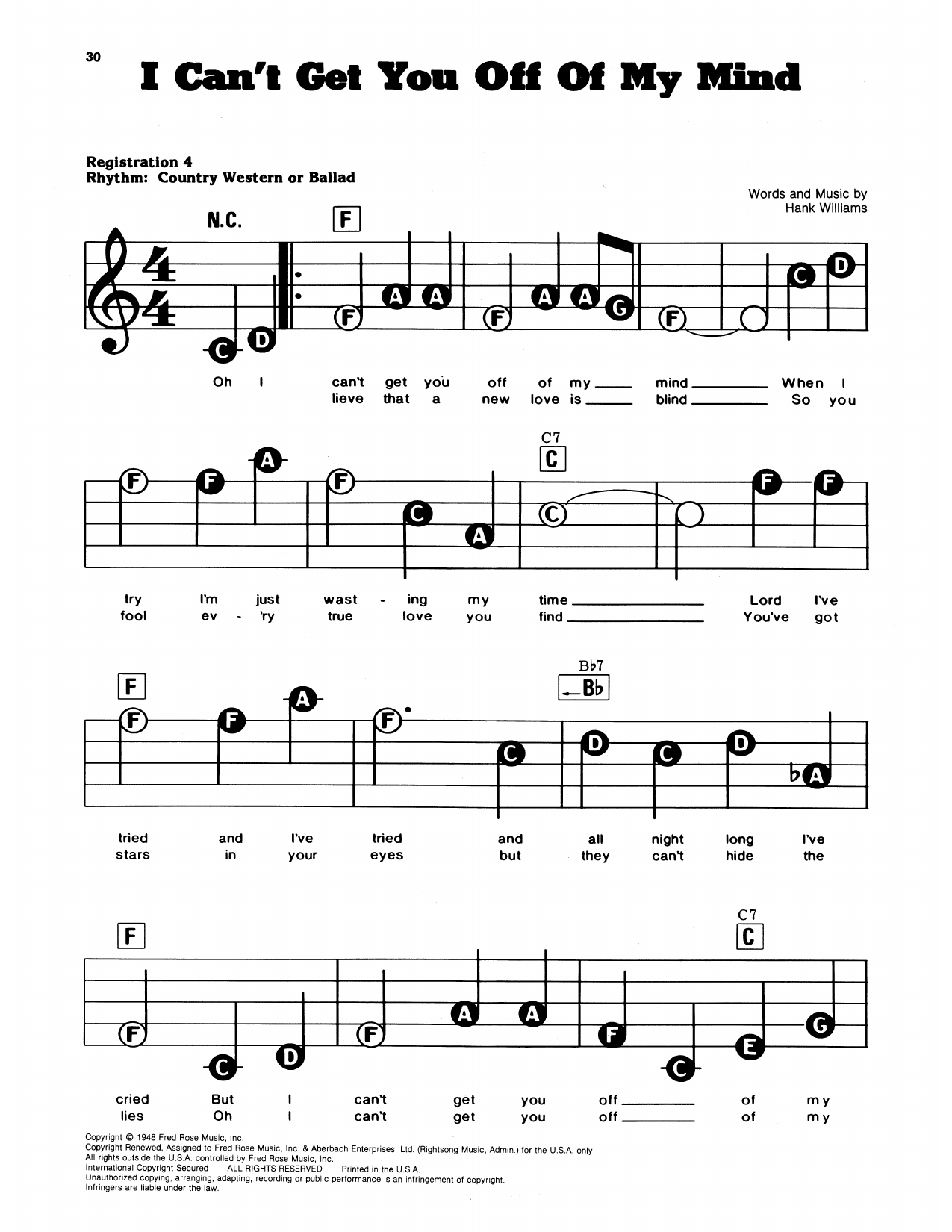
I Can't Get You Off Of My Mind: E-Z Play Today

As performed by Hank Williams

Item: 35-DS01875633

Digital Download
$4.99
Description

I Can't Get You Off Of My Mind: E-Z Play Today isn't in MakeMusic Cloud just yet...but it could be. Let us know you'd like to see it, and you'll help shape what comes next. In the meantime, start a free trial and dive into thousands of interactive titles your students can play along with today.

Sample Audio
No sample audio found.
Sample Video
Additional Details
Publisher: Hal Leonard
Page Count: 2
SKU: 35-DS01875633

More about this title

About the Artist: Hank Williams

Hank Williams (1923-1953) shaped modern country music through songs that cut straight to the emotional core of heartbreak, longing, and redemption. His melodies are deceptively simple; they lodge in your memory after one hearing and stay there. As a composer and performer, Williams proved that country music could achieve the poetic depth of any art form, influencing generations of songwriters across genres.

Why we love this

This arrangement captures the ache in one of Williams' most memorable melodies without requiring technical fireworks. Students can focus on phrasing and emotional clarity rather than navigating complex harmonic terrain, making it an accessible entry point into American songwriting canon.

What to expect

Wistful and tender. The melody wraps around you with quiet insistence, the kind of song that stays with you long after you stop playing. There's no artifice here, just the direct emotional pull of a man singing about something he cannot shake.

Who it's for

Piano students ready to explore material beyond classical repertoire and teachers seeking authentic American songwriting for recitals or cross-curricular work. This arrangement works equally well as a solo piece or as accompaniment for a vocalist.

How to get the most out of it

  • Resist the urge to rush the melody. These phrases need space to breathe; treat silence as part of the song's architecture.
  • Let the left hand sit quietly underneath the vocal line. This is support, not commentary.
  • Shape the melody by listening for the natural arc of each phrase. Where does it peak emotionally? Where does it settle?

How to use it

Pair this with other American standards to create a thematic concert segment exploring mid-century popular songwriting. It also serves as a bridge between classical study and jazz or pop contexts, showing students how melody and accompaniment work together across stylistic lines.

Skills your students will build

  • Phrasing and shaping lyrical melodic lines
  • Balance between melody and accompaniment
  • Reading and interpreting lead sheet notation
  • Understanding harmonic function in popular song structure

You May Also Like