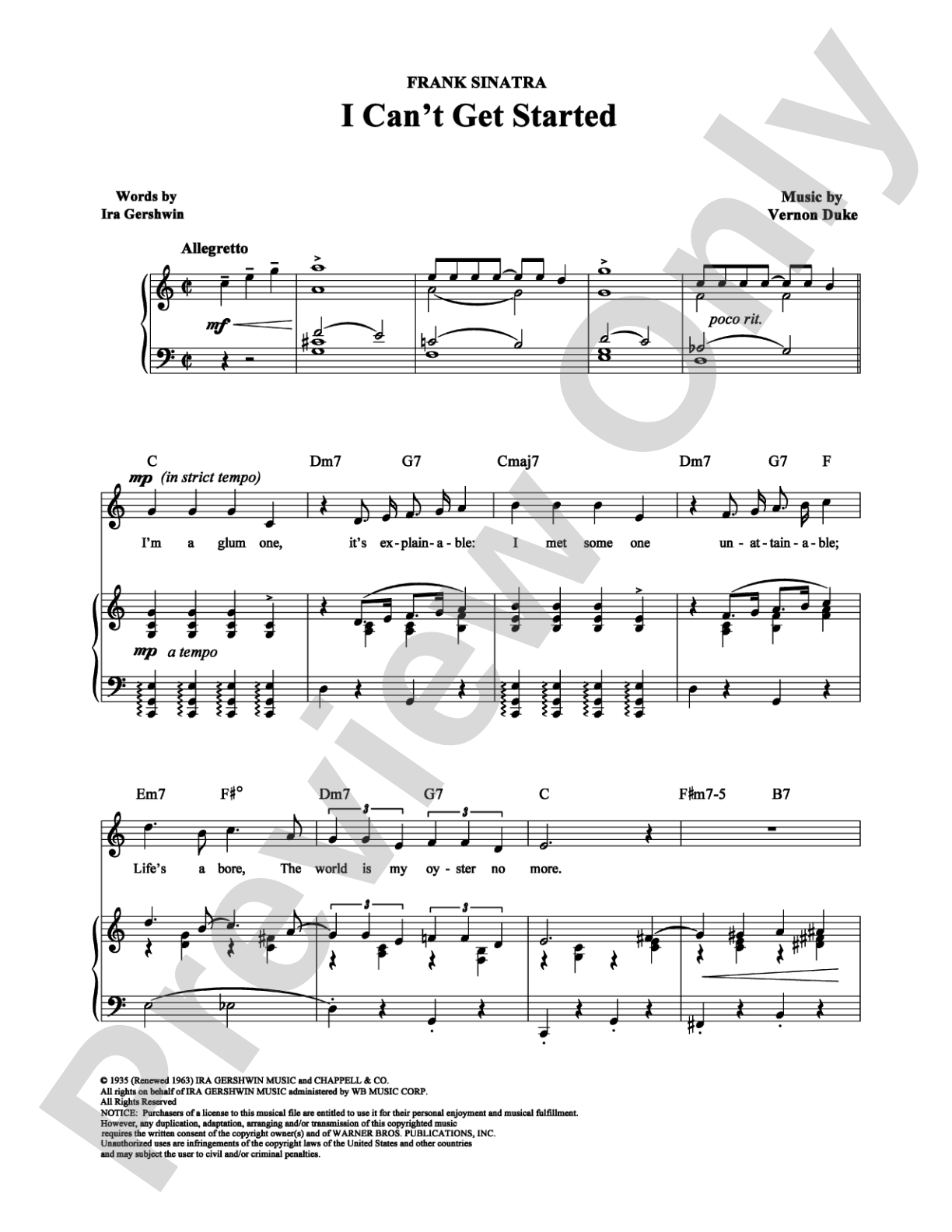
I Can't Get Started: Piano/Vocal/Chords Digital Sheet Music

I Can't Get Started: Piano/Vocal/Chords Digital Sheet Music

Vernon Duke, Frank Sinatra

Item: 00-PS-0004510

Digital Download
$3.99
Description

I Can't Get Started: Piano/Vocal/Chords Digital Sheet Music isn't in MakeMusic Cloud just yet...but it could be. Let us know you'd like to see it, and you'll help shape what comes next. In the meantime, start a free trial and dive into thousands of interactive titles your students can play along with today.

Sample Audio
No sample audio found.
Sample Video
Additional Details
SKU: 00-PS-0004510

More about this title

About the Artist: Frank Sinatra

Frank Sinatra remains one of the most influential interpreters of the American Songbook, setting the standard for vocal phrasing, diction, and emotional delivery across jazz and popular music. His approach to melody and harmony, shaped by working with top composers and arrangers, offers singers a masterclass in how to serve a song's lyrical intent while maintaining technical control.

Why we love this

Sinatra's recording of this Vernon Duke and Ira Gershwin classic captures everything that makes the standard form enduring: a sophisticated harmonic palette, a melody that rewards expressive interpretation, and a lyric that invites genuine emotional investment. Singers studying jazz phrasing and interpretation find immeasurable value in this tune's architecture and in the weight Sinatra brings to each phrase.

What to expect

"I Can't Get Started" carries a bittersweet elegance; the opening melody is wistful and conversational, drawing the listener into a confession of romantic obsession. The harmonic language is lush and occasionally chromatic, creating moments of tension that resolve into moments of tenderness, and the overall mood balances sophistication with genuine vulnerability.

Who it's for

Jazz singers and vocalists studying American Songbook repertoire will find this piano/vocal/chords arrangement essential for learning how a standard sits on the voice and how to approach harmonic sophistication in an intimate setting. Pianists accompanying jazz vocalists can use this chart as a foundation for exploring comping and voicing choices within a classic jazz standard.

How to get the most out of it

  • Study Sinatra's recorded interpretation to understand his approach to rubato and phrase shaping, but develop your own interpretive choices rather than copying his phrasing exactly.
  • Balance the piano accompaniment so it supports the vocal line without overwhelming it; this chart works best when the voice remains the focal point.
  • Pay close attention to the harmonic movement in the bridge, which contains chromatic voice leading that requires careful chord voicing and smooth transitions.
  • Approach the lyrics with specificity; this is a song about yearning and romantic frustration, and your vocal delivery should communicate that emotional arc clearly.

How to use it

This standard works beautifully as a solo feature for a jazz vocalist in a recital or concert setting, or as part of a Songbook-focused set list where it can be paired with other Duke or Gershwin compositions. It also serves well as a study piece for jazz ensembles or voice studios exploring the harmonic and interpretive demands of the standard form.

Skills your students will build

  • Reading jazz chord symbols and understanding harmonic function in standards
  • Phrasing and interpretation within a song form with clear emotional arc
  • Navigating chromatic harmony and voice leading in piano accompaniment
  • Balancing vocal expression with harmonic sophistication
  • Understanding the relationship between lyrics, melody, and harmonic support

You May Also Like