I Can't Get Started: Solo & Small Ensemble Digital Sheet Music

I Can't Get Started: Solo & Small Ensemble Digital Sheet Music

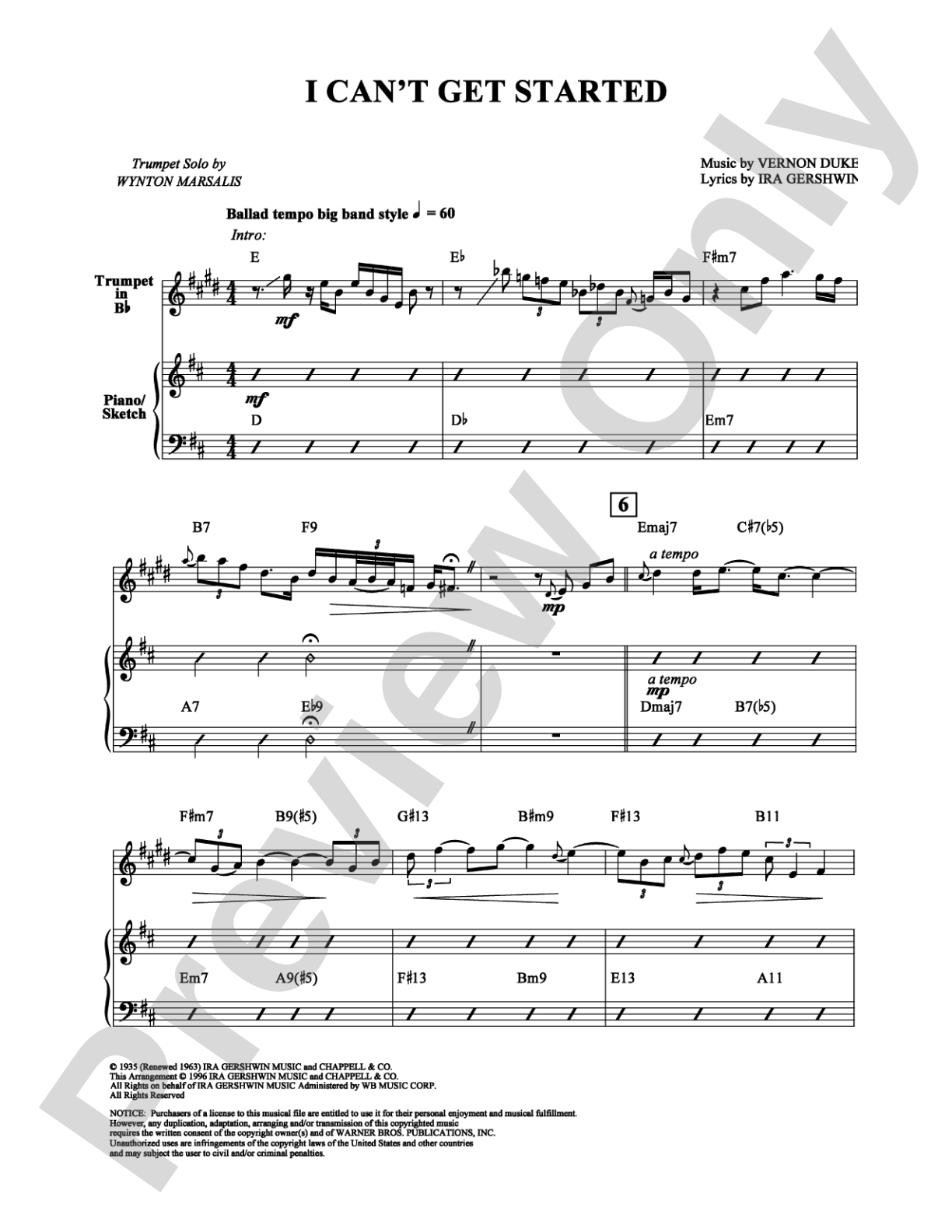
Vernon Duke, Wynton Marsalis

Item: 00-PS-0001101

Digital Download
$2.99
Description

I Can't Get Started: Solo & Small Ensemble Digital Sheet Music isn't in MakeMusic Cloud just yet...but it could be. Let us know you'd like to see it, and you'll help shape what comes next. In the meantime, start a free trial and dive into thousands of interactive titles your students can play along with today.

Sample Audio
No sample audio found.
Sample Video
Additional Details
SKU: 00-PS-0001101

More about this title

About the Artist: Wynton Marsalis

Wynton Marsalis stands as one of the most significant jazz musicians of the past four decades, equally commanding on trumpet in both classical and jazz idioms. His work as a performer, composer, and educator has shaped jazz curriculum in conservatories and universities across North America, and his compositions and arrangements demonstrate deep knowledge of jazz history alongside contemporary sensibility.

As Artistic Director of Jazz at Lincoln Center, Marsalis has championed the teaching and preservation of jazz as a living art form worthy of serious study. His arrangements and solo recordings reveal a musician steeped in the standards repertoire and comfortable navigating bebop changes, swing phrasing, and the harmonic language that defines American jazz.

Why we love this

Marsalis's interpretation of this standard carries the weight of someone who has spent decades teaching what jazz actually requires. He plays with the kind of clarity that students need to hear, every phrase shaped, every harmonic choice evident, without sounding academic. The small ensemble format lets you hear how a mature musician voices this tune and interacts with rhythm section players.

What to expect

Sophisticated and grounded. This isn't a casual jam session or a virtuosic showpiece. Marsalis treats the standard with respect while playing it like someone who knows it inside out. The pacing has real elegance, you hear the melody clearly, but always in service of the underlying harmony.

Who it's for

Jazz ensemble students and jazz combo directors seeking an arrangement by a recognized artist and educator. Trumpet students learning to navigate standards and understand how experienced players approach melody and rhythm changes. Musicians preparing for jazz recitals or combo performances.

How to get the most out of it

  • Listen closely to Marsalis's articulation and note length; the trumpet's phrasing in jazz requires a different approach to air support and release than classical playing.
  • Pay attention to the dialogue between solo voice and ensemble parts; the balance shifts and each voice must respond to what the others are doing.
  • Notice the relationship between the written melody and the harmonic framework underneath; understanding where the solo lands against the chord changes will guide your interpretation.
  • Consider the groove and feel of the ensemble section; locking into the rhythm section's time is more important than rhythmic precision alone.

How to use it

Feature this in a jazz concert or combo recital alongside other standards, or use it as a teaching tool when students study how different arrangers interpret the same material. The multiple instrumentation options make it flexible for whatever small ensemble instrumentation your program has available.

Skills your students will build

  • Interpreting chord changes and using them to guide improvisation
  • Phrasing and articulation in a swing/jazz idiom
  • Listening and responding to ensemble partners in real time
  • Understanding the balance between written melody and harmonic movement
  • Applying stylistically appropriate rhythmic flexibility and rubato

You May Also Like