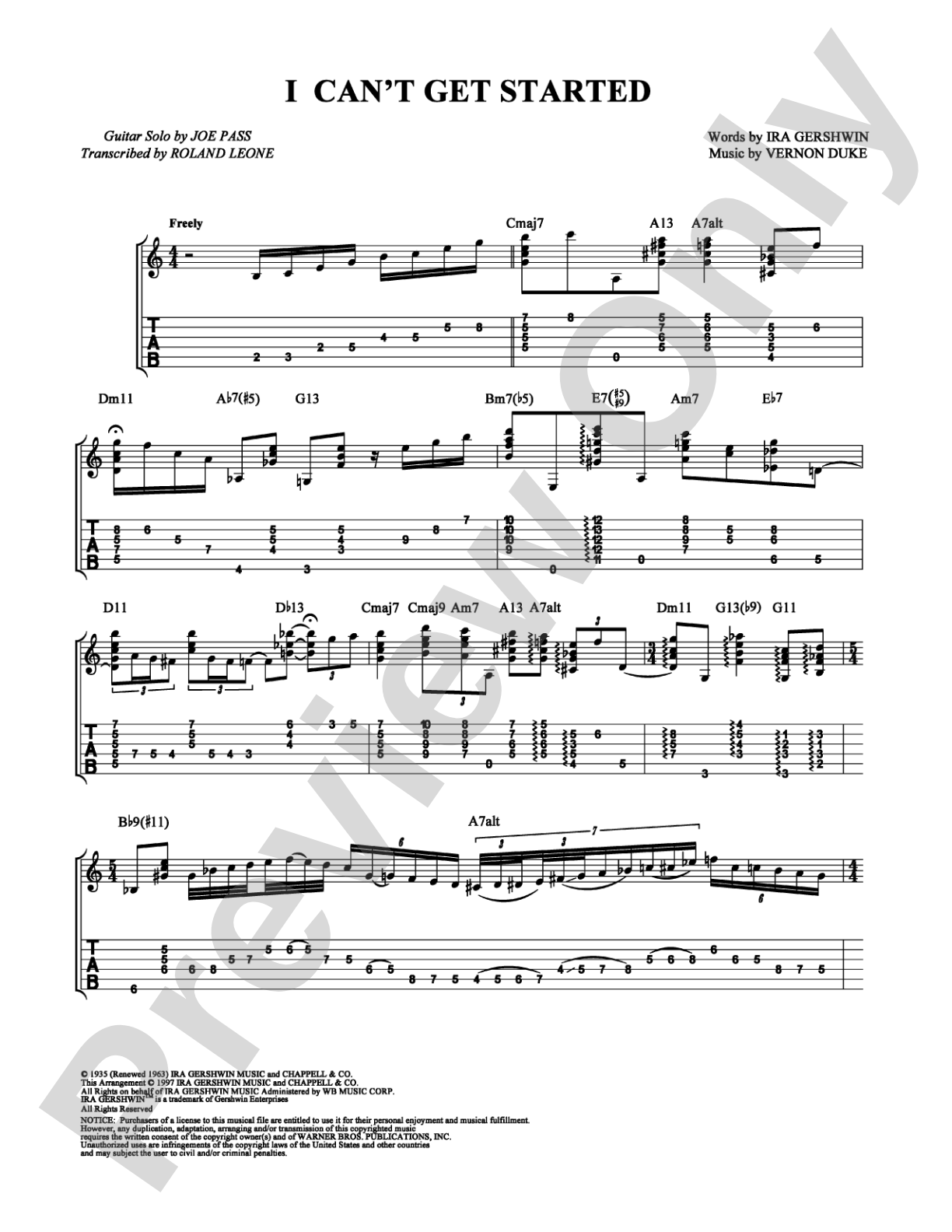
I Can't Get Started: Guitar TAB Digital Sheet Music

I Can't Get Started: Guitar TAB Digital Sheet Music

Vernon Duke, Joe Pass

Item: 00-PS-0001100

Digital Download
$2.99
Description

I Can't Get Started: Guitar TAB Digital Sheet Music isn't in MakeMusic Cloud just yet...but it could be. Let us know you'd like to see it, and you'll help shape what comes next. In the meantime, start a free trial and dive into thousands of interactive titles your students can play along with today.

Sample Audio
No sample audio found.
Sample Video
Additional Details
SKU: 00-PS-0001100

More about this title

About the Artist: Joe Pass

Joe Pass (1929-1994) was an American jazz guitarist whose technical mastery and harmonic sophistication made him one of the most influential players in jazz history. Known for his ability to accompany himself with walking bass lines while playing melody and complex chords simultaneously, Pass redefined what solo guitar could accomplish in jazz.

Why we love this

Pass's interpretation of this standard captures the essence of sophisticated jazz guitar: economical phrasing, impeccable time feel, and the harmonic awareness that lets him reharmonize familiar changes in unexpected ways. For guitarists studying jazz language, this transcription reveals how a master navigates melody, accompaniment, and improvisation in a single voice.

What to expect

Intimate and conversational. Pass's playing has a natural flow, like he's thinking aloud about the melody and changes in real time. There's warmth in his tone and clarity in every note, even at the fastest passages.

Who it's for

Jazz guitar students and intermediate to advanced players looking to deepen their understanding of solo jazz guitar vocabulary. This transcription works for players who are ready to study how a master musician voices chords, phrases over changes, and manages the technical demands of accompanying themselves.

How to get the most out of it

  • Study Pass's approach to comping (chord accompaniment). Notice where he simplifies and where he adds extensions; this restraint is what makes his sound clear rather than cluttered.
  • Pay attention to his use of space. Jazz guitar improvisation isn't about filling every moment; listen for the silence between phrases and what it contributes to the overall narrative.
  • Lock the harmonic rhythm first. Get comfortable with Pass's chord voicings and movement before worrying about the fine details of articulation or dynamics.
  • Work through the TAB slowly enough to understand how the shapes sit on the fingerboard. This isn't just reading notation; it's internalizing the geography of his approach.

How to use it

Use this as a study resource rather than a performance vehicle. Work through it in private study or small group masterclass settings where you can discuss Pass's choices bar by bar. For guitarists in jazz combos, understanding this solo builds the vocabulary and confidence they'll need for their own interpretations.

Skills your students will build

  • Solo jazz guitar accompaniment (voicing chords while playing melody)
  • Walking bass lines integrated with melody and harmony
  • Reharmonization and chord substitution
  • Phrasing and use of space in improvisation
  • Reading and interpreting jazz guitar TAB notation
  • Understanding Pass's characteristic fingerstyle technique and touch

You May Also Like