
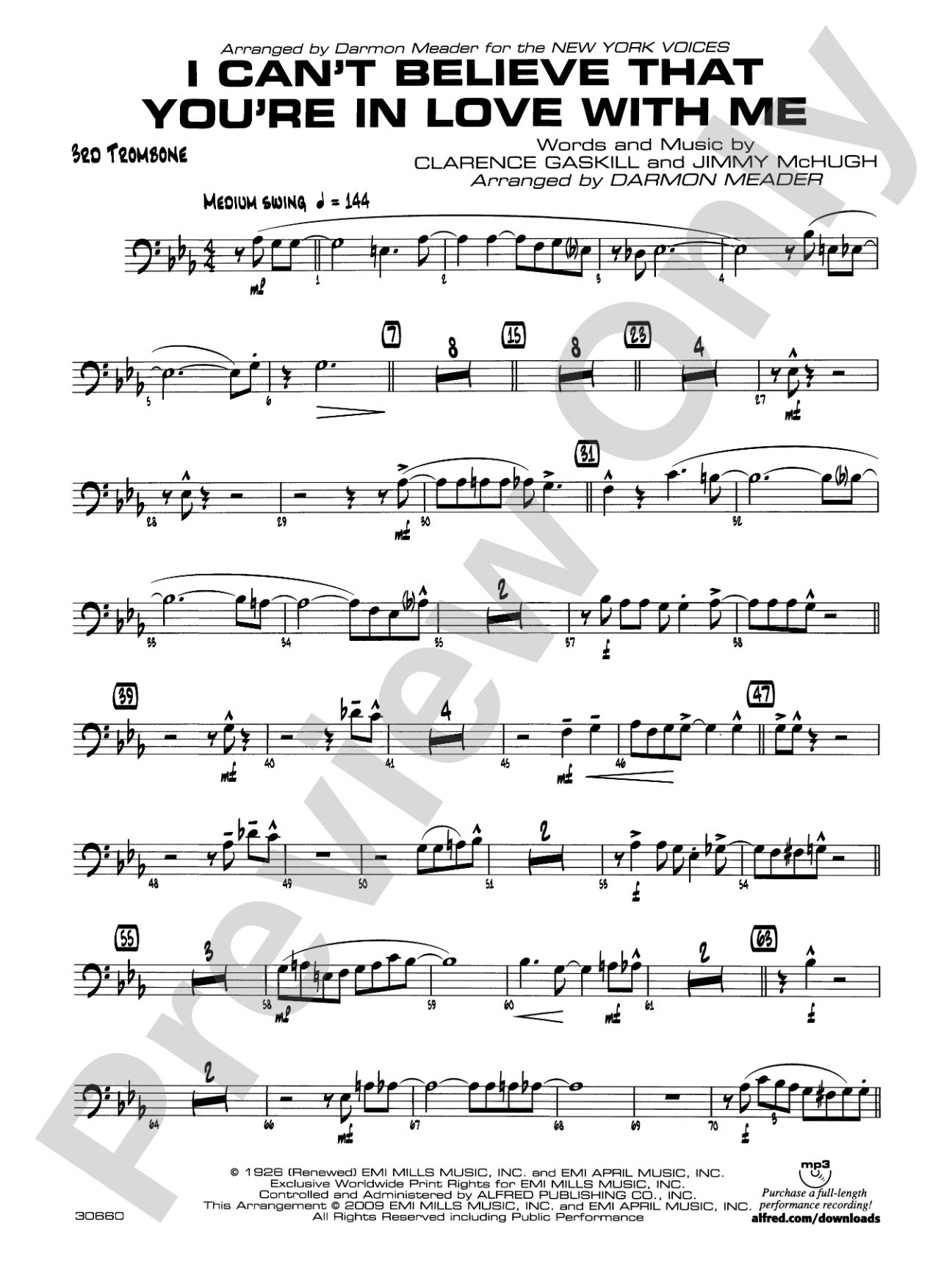

I Can't Believe That You're in Love with Me: 3rd Trombone
Words and music by Clarence Gaskill and Jimmy McHugh / arr. Darmon Meader
Grade: 4 (Medium Advanced / Difficult)
Item: 00-PC-0015721_TN3
$3.00
Pickup currently not available
Description
Jazz vocal quartets/groups are happening! Feature a soloist, vocal quartet or SATB choir with your jazz ensemble! A medium-swing arrangement by Darmon Meader, the musical director and chief arranger of the sensational jazz vocal group, New York Voices, this was arranged for the New York Voices with jazz ensemble. The solo vocal range is from G below middle C up to F top line, treble clef. Lead trumpet range is to high D above the staff. This chart includes the jazz band arrangement, four copies of the SATB part and an optional arrangement for vocal soloist. To perform with a choir, purchase additional SATB parts (item number 00-31002). (4:10)


Don't just read it, hear it, play along with it, and watch your students grow with it. In MakeMusic Cloud, I Can't Believe That You're in Love with Me: 3rd Trombone comes alive with professional accompaniment, adjustable tempo, and built-in practice tools that turn solo practice into real progress.
Open in the Player
Jump straight in and assign it today.
Start Your Free Trial
Open this title and explore the full library in minutes.
Sample Audio
1
Audio File
--:--
0:00
0:00
Sample Video
No sample videos found.
Additional Details
Series:
Jazz Vocal Series
Publisher:
Alfred Music
Page Count:
120
SKU:
00-PC-0015721_TN3
More about this title
About the Composer: Clarence Gaskill
Clarence Gaskill was a prolific songwriter and composer whose work defined much of the jazz and popular music landscape of the early 20th century. His collaborations with top arrangers and musicians resulted in standards that continue to appear in jazz repertoire today, known for their elegant melodic lines and harmonic sophistication that challenge performers while remaining accessible to audiences.
Why we love this
Darmon Meader's arrangement brings sophistication and playfulness to a standard that feels fresh every time you hear it. The writing balances the soloist's spotlight with genuine ensemble interplay, giving your jazz band real musical conversations to play rather than static comping. This is the kind of chart that makes both singers and instrumentalists sound better than they thought they could.
What to expect
Sophisticated and swinging, with a vintage charm that never feels dated. The melody unfolds with warmth and sincerity over gentle swing rhythms, giving singers room to phrase expressively while the ensemble creates a rich, modern harmonic landscape. There's an ease to this piece, like a perfect late-night set.
Who it's for
Jazz directors who want to feature a strong vocalist or vocal group without abandoning the ensemble's musical integrity. This works for high school jazz choirs, college ensembles, and mixed-age community groups where singers have solid intonation and musicality. The Grade 4 difficulty sits at a rewarding challenge for advanced ensembles.
How to get the most out of it
- Shape the vocal melody across the full arc of the song rather than phrase-by-phrase. This piece rewards a singer who thinks in long lines and saves intensity for the bridge and final chorus.
- Lock the rhythm section (bass, drums, piano) into a relaxed medium swing before rehearsing with the full ensemble. Once that pocket is solid, the horns will fall into place naturally.
- Balance the trumpet lead voice carefully against the vocal line during unison passages. The trumpet should support without overwhelming; they're duet partners, not competing soloists.
- Let the ensemble breathe with the vocalist. When the singer takes space or drops back, the band should respond with transparency rather than filling every gap with texture.
How to use it
Anchor a concert around this as your feature vocal selection, pairing it with uptempo instrumental shout choruses to showcase your band's full energy. It also sits beautifully mid-set as a palate cleanser between hard-swinging counts and complex modern works. The optional soloist arrangement makes it flexible whether you're spotlighting one voice or building a full SATB texture.
Skills your students will build
- Singing jazz phrasing and swing interpretation over a walking bass
- Trading and responding between vocals and instrumental sections
- Balancing vocal projection and ensemble blend in small group settings
- Reading chord changes and responding to harmonic movement
- Shaping jazz melody across 4-bar and 8-bar phrases with dynamic control