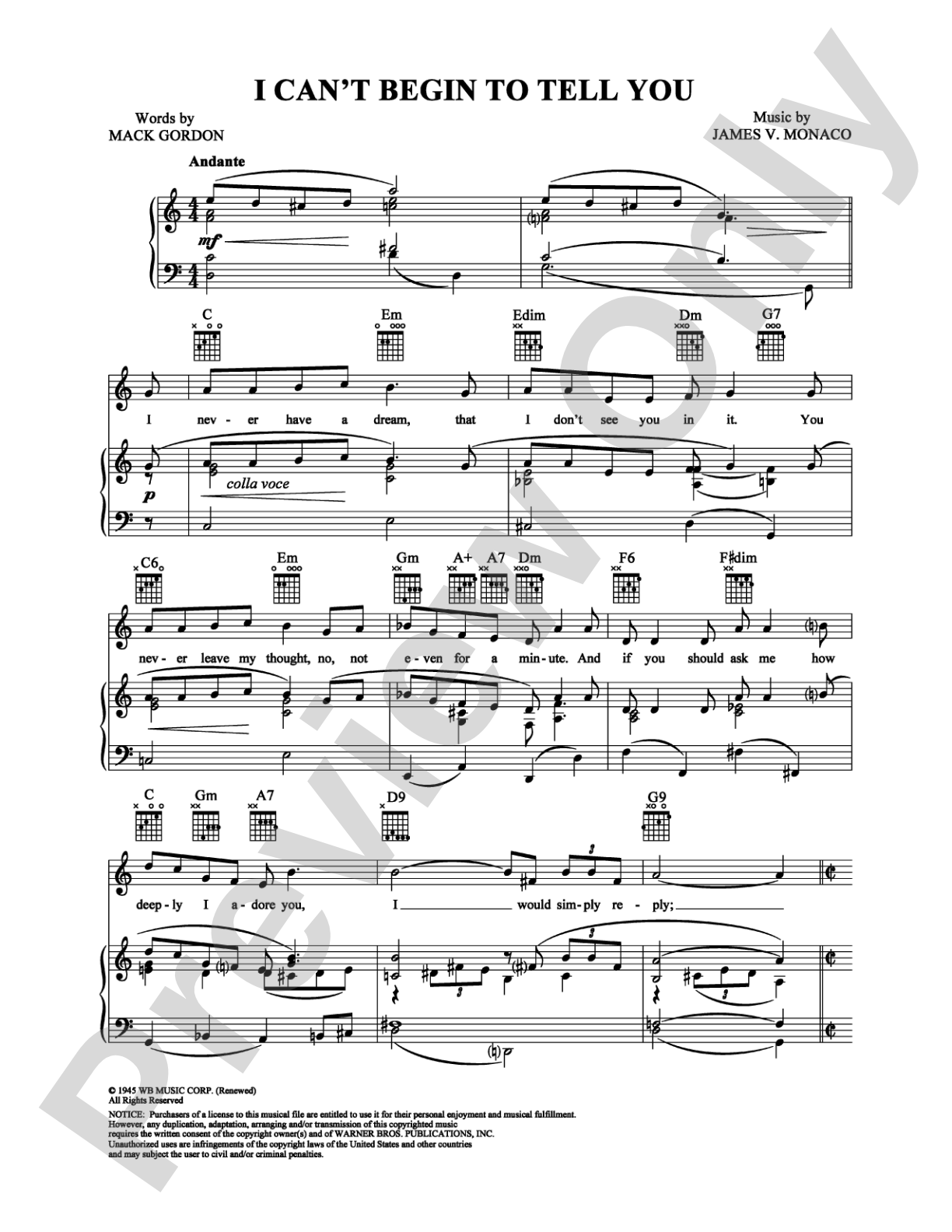
I Can't Begin to Tell You: Piano/Vocal/Chords Digital Sheet Music

I Can't Begin to Tell You: Piano/Vocal/Chords Digital Sheet Music

James V. Monaco, Bing Crosby

Item: 00-PS-0004256

Digital Download
$3.99
Description

I Can't Begin to Tell You: Piano/Vocal/Chords Digital Sheet Music isn't in MakeMusic Cloud just yet...but it could be. Let us know you'd like to see it, and you'll help shape what comes next. In the meantime, start a free trial and dive into thousands of interactive titles your students can play along with today.

Sample Audio
No sample audio found.
Sample Video
Additional Details
SKU: 00-PS-0004256

More about this title

About the Artist: Bing Crosby

Bing Crosby (1903-1977) was an American singer and actor whose smooth baritone and innovative recording techniques shaped popular music for decades. His influence extended far beyond the recording studio; his interpretive approach to melody and phrasing became a model for singers across genres, making him a valuable reference point for students learning how to shape a vocal line with restraint and sophistication.

Why we love this

This standard gives singers and pianist-accompanists a chance to work with genuine mid-century American song craft. The vocal melody sits naturally in the voice while the piano voicings reward both careful harmonic listening and intuitive comping.

What to expect

Warm and yearning, with the kind of melodic directness that makes every phrase feel inevitable. The harmonic language is rich enough to keep pianists engaged while remaining transparent enough not to overwhelm the vocal line.

Who it's for

Pianists who accompany singers, vocalists exploring the American songbook, and musicians studying how to balance melody with jazz-informed harmonic accompaniment. This works equally well for rehearsal study or informal performance.

How to get the most out of it

  • Sing the melody with conversational ease rather than formal diction; Crosby's approach was intimate, and that sensibility shapes how the tune wants to sit in your voice.
  • Pay attention to the chord symbols as a guide to harmonic color; the pianist should voice these thoughtfully rather than reducing them to root position triads.
  • Let the piano establish the song's rhythmic pocket before the vocal enters, then stay locked to that foundation without rushing.

How to use it

Include this in a recital segment exploring American standards, or pair it with other classic vocal repertoire from the same era. It also serves as an excellent teaching piece for students learning to balance vocal expression with harmonic awareness.

Skills your students will build

  • Reading chord symbols and realizing them at the keyboard
  • Balancing accompaniment texture with vocal clarity
  • Interpreting jazz-influenced harmony in a popular song context
  • Phrasing melody with natural speech-like inflection

You May Also Like