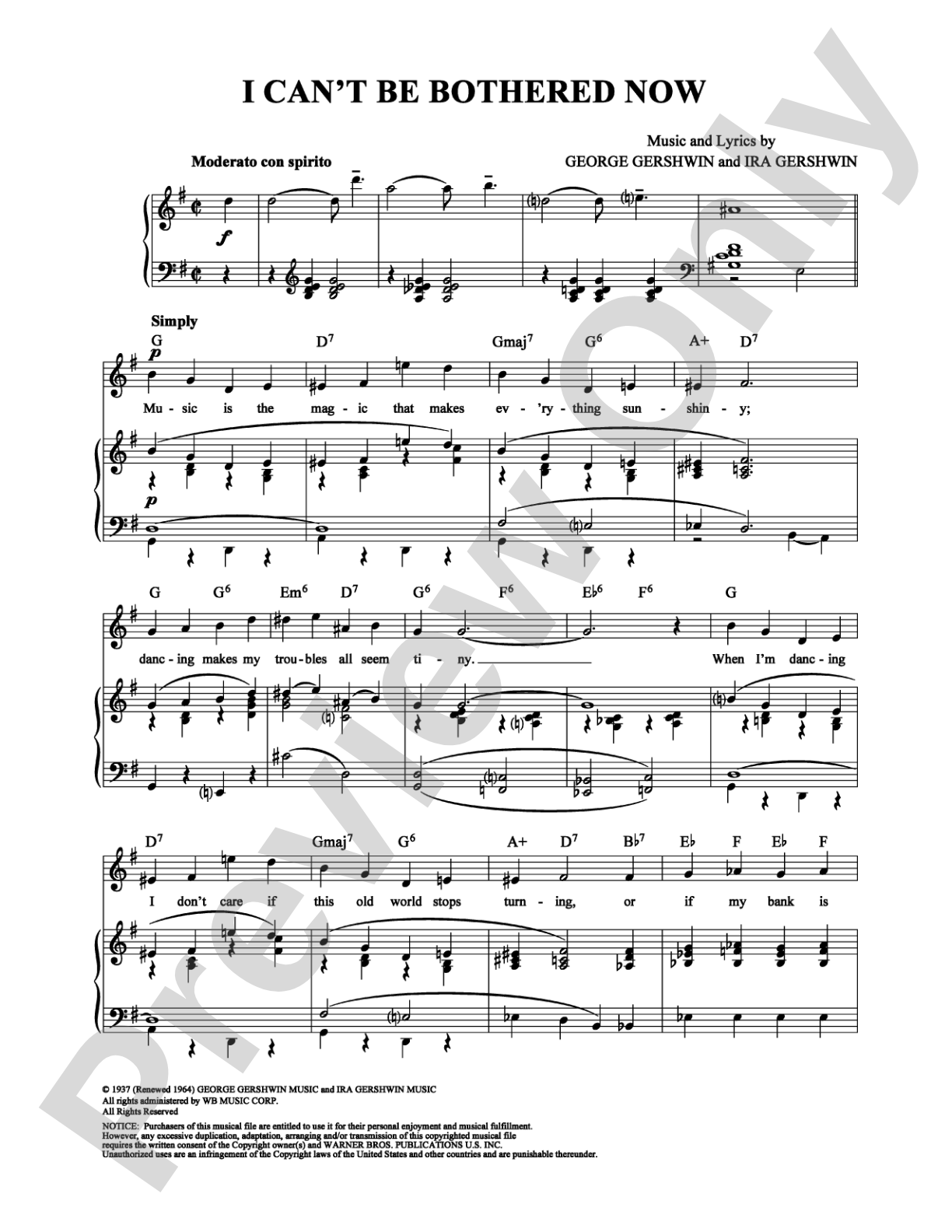
I Can't Be Bothered Now: Piano/Vocal/Chords Digital Sheet Music

I Can't Be Bothered Now: Piano/Vocal/Chords Digital Sheet Music

George Gershwin, Fred Astaire

Item: 00-PS-0001099

Digital Download
$3.99
Description

I Can't Be Bothered Now: Piano/Vocal/Chords Digital Sheet Music isn't in MakeMusic Cloud just yet...but it could be. Let us know you'd like to see it, and you'll help shape what comes next. In the meantime, start a free trial and dive into thousands of interactive titles your students can play along with today.

Sample Audio
No sample audio found.
Sample Video
Additional Details
SKU: 00-PS-0001099

More about this title

About the Artist: Fred Astaire

Fred Astaire (1899-1987) revolutionized musical theatre and film through his approach to integrating dance with song. His recordings of standards from the 1930s and 1940s remain touchstones for singers and pianists studying American popular song; his phrasing, rhythmic flexibility, and interpretive choices continue to inform how musicians approach the Great American Songbook.

As both performer and interpreter, Astaire set a standard for conversational, rhythmically sophisticated singing that prioritizes clarity and emotional directness. For music students, his recordings offer masterclasses in how to serve the lyric while maintaining technical precision.

Why we love this

This is a Cole Porter standard with genuine wit and charm, and the piano/vocal/chords format gives singers and accompanists exactly what they need to explore Astaire's interpretation alongside their own. The piece sits naturally in a singer's range while offering enough harmonic interest to keep pianists engaged through multiple verses and choruses.

What to expect

Lighthearted and sophisticated in equal measure. The song bounces with a kind of carefree rhythm while the harmonies hint at something slightly more complex underneath, creating that distinctly 1930s-40s blend of playfulness and musical substance. There's an ease to it that masks genuine compositional craft.

Who it's for

Singers performing American popular song standards, whether in recital, cabaret, or jazz contexts. Pianists accompanying singers will find the chord notation and vocal line clear enough to develop their own interpretive choices while maintaining fidelity to the original.

How to get the most out of it

  • Study Astaire's original recording to internalize his phrasing and rhythmic approach; note how he plays against the beat in subtle ways while maintaining absolute clarity of the lyric
  • Balance the vocal line with the piano accompaniment so that both the melody and harmonic movement remain audible; this isn't a piano showcase, but the chords drive the song's character
  • Shape the verses with conversational ease, allowing the rhyme scheme to guide your phrasing rather than forcing square phrasing onto Porter's sophisticated lyric
  • Treat tempo flexibly in the way the original suggests; slight rubato around key phrases makes the delivery feel natural rather than mechanical

How to use it

Pair this with other Porter standards or Great American Songbook classics in a recital or cabaret setting where audiences expect polish and wit. It works especially well as a charming opener or palate-cleanser between heavier material, and remains accessible enough for students exploring standards repertoire for the first time.

Skills your students will build

  • Interpretation of syncopated rhythms within a straightforward vocal melody
  • Phrasing conversational text with musical intelligence
  • Harmonic sophistication appropriate to 1930s-40s songwriting conventions
  • Coordination between vocal line and piano accompaniment in a song-based format
  • Understanding how to adapt a famous recording without losing the song's essential character

You May Also Like