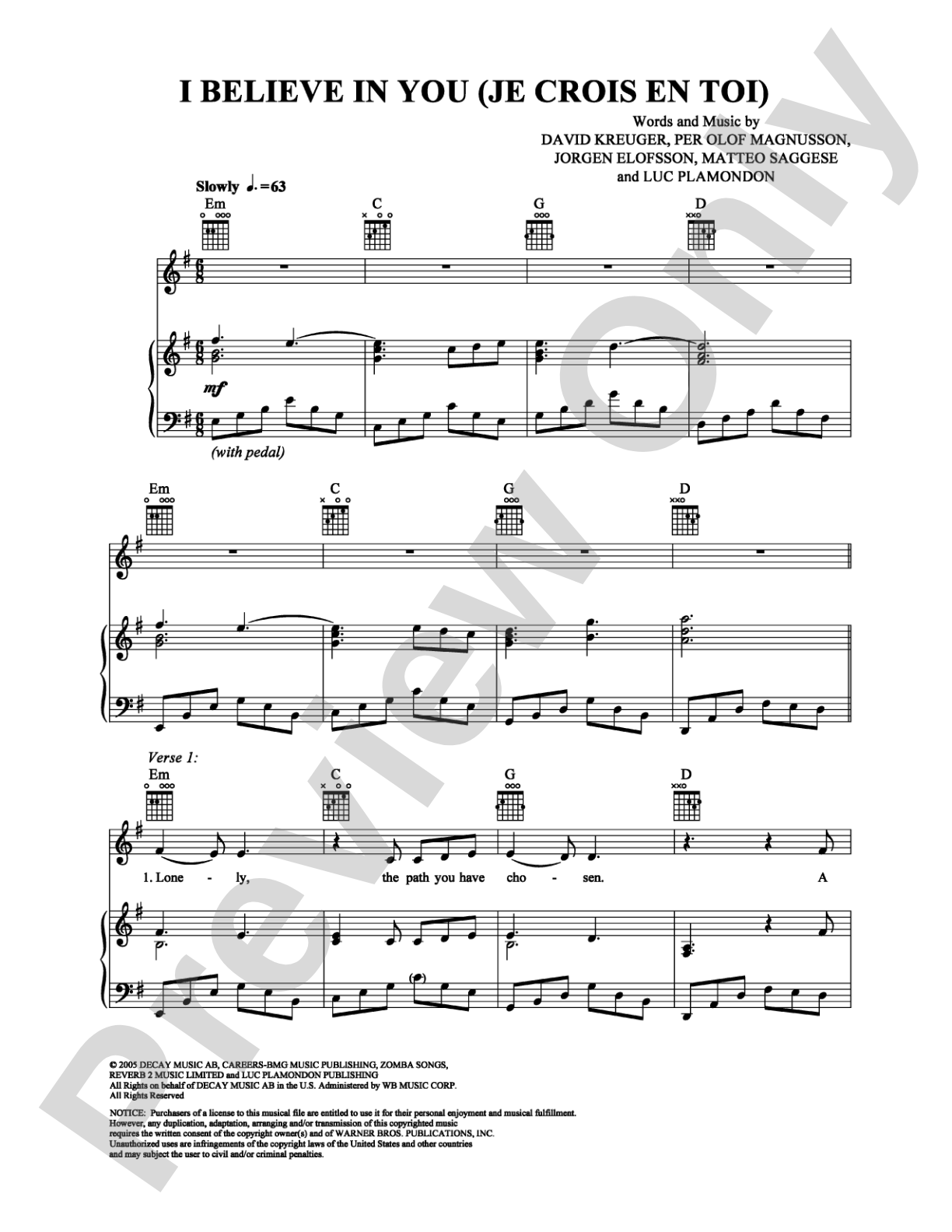
I Believe in You (Je Crois en Toi): Piano/Vocal/Chords Digital Sheet Music
Il Divo, Celine Dion, David Kreuger, Per Magnusson, Luc Plamondon, Jorgen Kjell Elofsson, Matteo Saggese
Item: 00-PS-0003900
Digital Download
$3.99
Pickup currently not available
Description
I Believe in You (Je Crois en Toi): Piano/Vocal/Chords Digital Sheet Music isn't in MakeMusic Cloud just yet...but it could be. Let us know you'd like to see it, and you'll help shape what comes next. In the meantime, start a free trial and dive into thousands of interactive titles your students can play along with today.
Explore everything that's ready to play right now.
Sample Audio
No sample audio found.
Sample Video
No sample videos found.
Additional Details
SKU:00-PS-0003900
More about this title
About the Artist: Il Divo
Il Divo is a classical crossover vocal group that brought operatic tenor voices and pop sensibility to mainstream audiences in the early 2000s. Known for their sophisticated arrangements and powerful four-part harmonies, the group redefined what was possible when classical training met contemporary repertoire. Their collaborations with artists like Celine Dion expanded the reach of their sound across genres and demographics, establishing them as bridge-builders between art song and popular music.
For music educators, Il Divo's work demonstrates how vocal excellence and technical precision can coexist with accessible, emotionally direct songwriting. Their recordings serve as models for singers interested in blending classical vocal technique with contemporary expression.
Why we love this
This duet pairs two world-class singers with distinctly different vocal colors, creating a study in complementary vocal lines and dynamic interplay. The piano/vocal/chords format gives singers and pianists room to shape the performance expressively while maintaining harmonic clarity, making it a genuine collaborative arrangement rather than a simplified transcription.
What to expect
The piece inhabits a space between intimate conviction and sweeping orchestral grandeur. Two voices intertwine over piano voicings that suggest lush string arrangements, creating a sound that feels both personal and cinematic. There's an undercurrent of emotional earnestness without sentimentality, characteristic of adult contemporary songwriting crafted for genuine connection.
Who it's for
This arrangement suits singers with solid classical training who want to explore crossover repertoire, as well as pianists seeking contemporary material with harmonic sophistication. It works for studio vocalists preparing a duet, singers building a recital program that bridges genres, or private lesson students looking to expand beyond traditional art song.
How to get the most out of it
Balance the two vocal lines so neither dominates; think of the duet as a conversation where both voices remain audible throughout. Mark phrase endings where one vocalist naturally yields focus to the other.
Treat the chord chart as a harmonic roadmap rather than a strummed accompaniment guide. The piano part likely contains specific voicings and movement that support the vocals; preserve those shapes even if improvising ornaments.
Shape the phrasing across the bar line rather than treating each measure as a unit. These artists stretch and compress phrases emotionally; practice with a partner to find moments where your vocal line naturally breathes with theirs.
How to use it
Program this as a contemporary art song in a recital that celebrates vocal partnerships across genres, or use it to explore how classical vocal technique enhances modern pop and rock idioms. It pairs well with other duet literature that crosses stylistic boundaries, offering audiences a taste of how contemporary songwriting can honor the beauty of trained voices.
Skills your students will build
Balancing two independent vocal lines in real time
Reading and interpreting a piano/vocal score with chord symbols
Sustaining legit classical tone in a contemporary pop-rock context
Collaborative phrasing and ensemble listening between vocalists
Navigating harmonic changes while maintaining expressive continuity