I Am Not There Sheet Music Preview

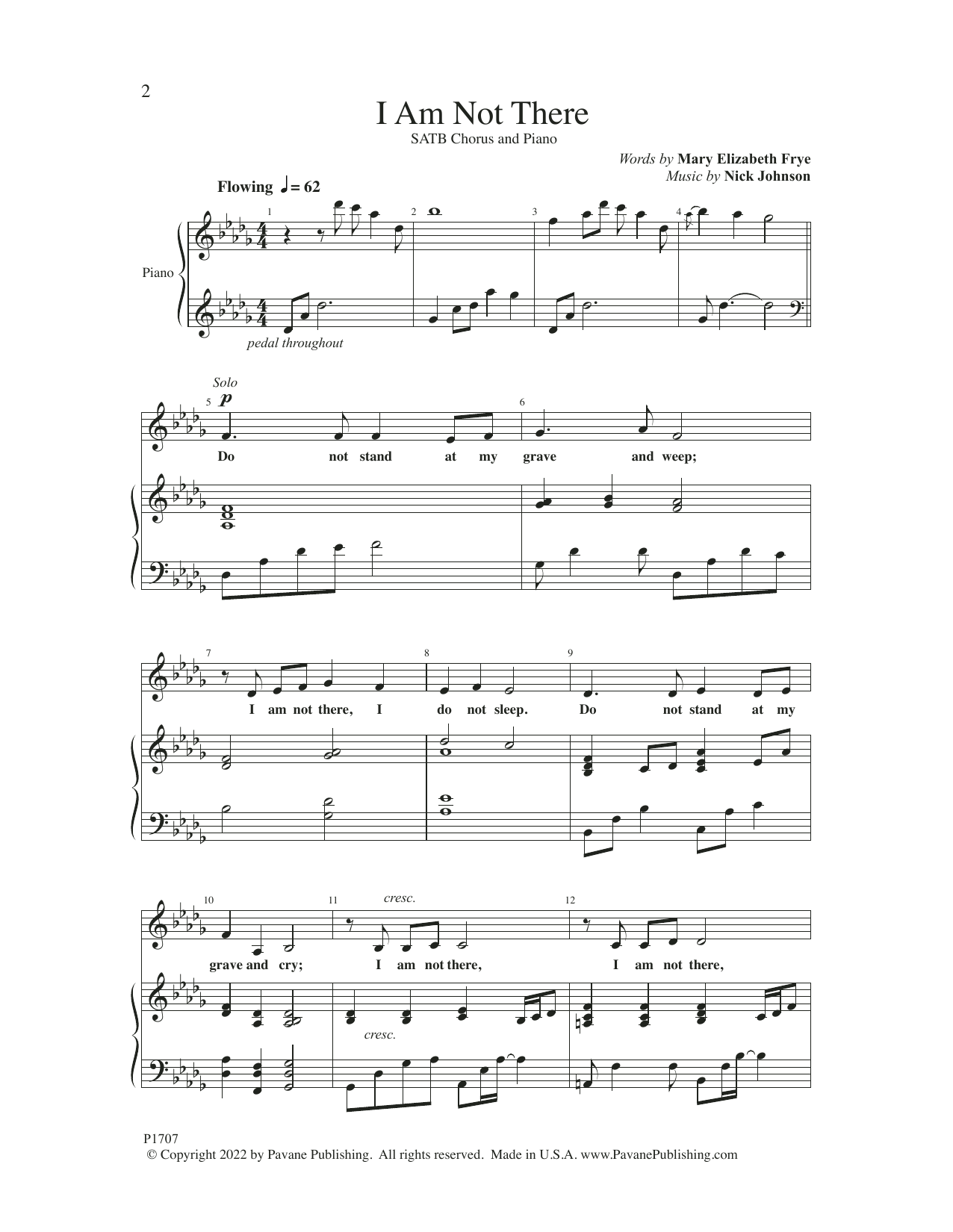
I Am Not There: SATB Choral Octavo

By Nick Johnson / By Mary Elizabeth Frye

Item: 35-DS01104101

Digital Download
$3.60
Description

I Am Not There: SATB Choral Octavo isn't in MakeMusic Cloud just yet...but it could be. Let us know you'd like to see it, and you'll help shape what comes next. In the meantime, start a free trial and dive into thousands of interactive titles your students can play along with today.

Sample Audio
No sample audio found.
Sample Video
Additional Details
Publisher: Hal Leonard
Page Count: 15
SKU: 35-DS01104101

More about this title

Why we love this

Johnson sets Mary Elizabeth Frye's meditative poem with harmonic depth and textural variety that rewards careful listening. The piece balances accessibility with genuine emotional substance, making it equally effective in concert and memorial contexts without feeling heavy-handed.

What to expect

Quiet, introspective, and grounded. Johnson's setting mirrors the reassurance in Frye's words through warm harmonies and a sense of spiritual presence that builds gradually without becoming overtly dramatic.

Who it's for

This octavo works well for intermediate to advanced choirs comfortable with four-part harmony and sustained singing. It suits programs that need repertoire with thematic weight for concert or ceremonial occasions.

How to get the most out of it

  • Pay attention to the text painting in the harmonic progressions; Johnson uses chord changes to reinforce the poem's spiritual message, so clarity of diction becomes inseparable from the music's meaning.
  • Balance the SATB texture so that no single voice dominates the emotional landscape. This piece asks for blended resonance rather than sectional independence.
  • Allow space for breath between phrases even when rests aren't explicitly marked. The contemplative nature of the text benefits from silence as much as sound.

How to use it

Pair this with other sacred or contemplative secular works to create a thematic arc within a concert. It functions especially well as a closing piece or as the centerpiece of a program exploring resilience and acceptance.

Skills your students will build

  • Sustaining legit tone across long phrase lines
  • Balancing four-part harmony with sensitivity to textural balance
  • Interpreting harmonic language to inform interpretive choices
  • Singing sustained notes with consistent intonation in shifting chord contexts

You May Also Like