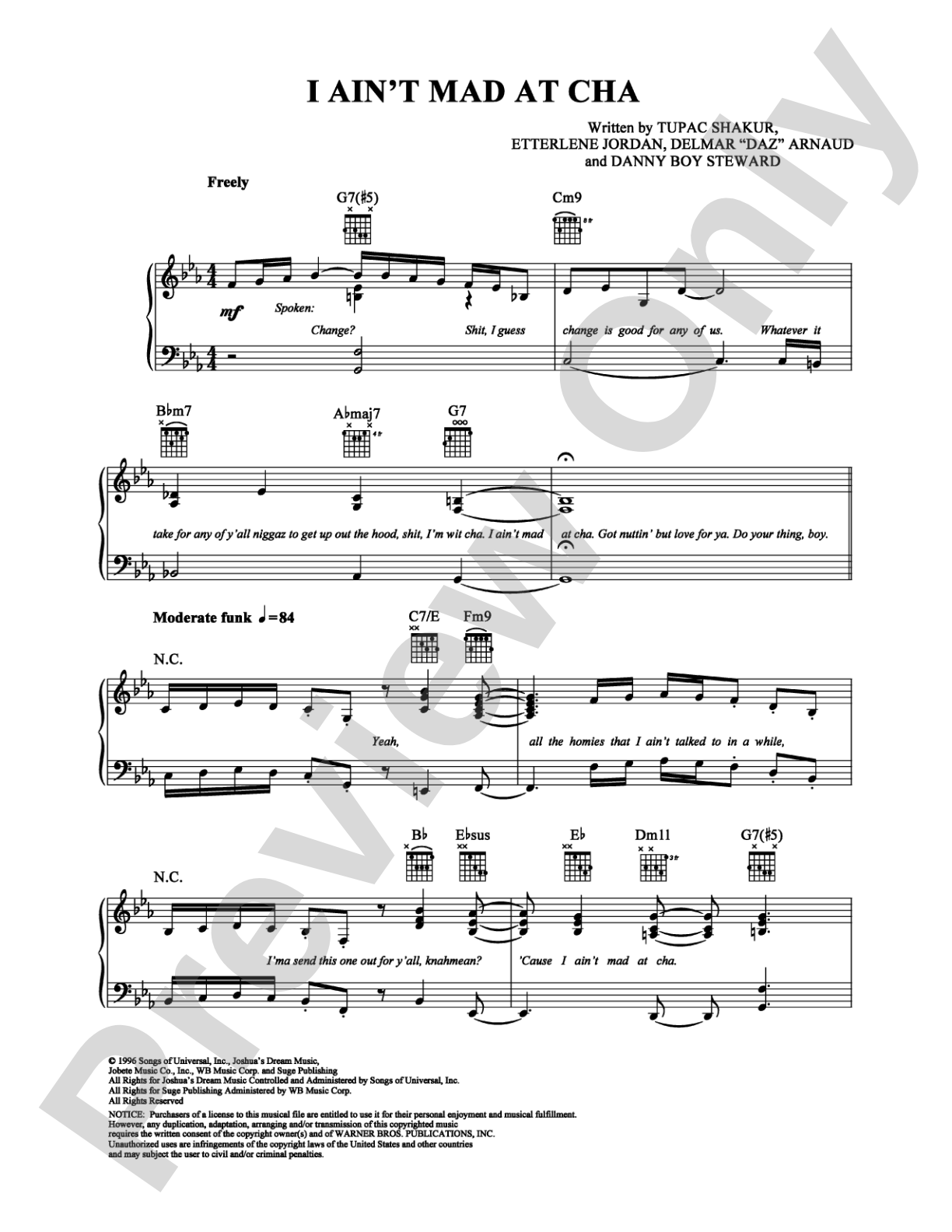
I Ain't Mad at Cha: Piano/Vocal/Chords Digital Sheet Music

I Ain't Mad at Cha: Piano/Vocal/Chords Digital Sheet Music

Tupac Shakur, Etterlene Jordan, Delmar ''Daz'' Arnaud, Danny Boy Steward

Item: 00-PS-0003327

Digital Download
$2.95
Description

I Ain't Mad at Cha: Piano/Vocal/Chords Digital Sheet Music isn't in MakeMusic Cloud just yet...but it could be. Let us know you'd like to see it, and you'll help shape what comes next. In the meantime, start a free trial and dive into thousands of interactive titles your students can play along with today.

Sample Audio
No sample audio found.
Sample Video
Additional Details
SKU: 00-PS-0003327

More about this title

About the Artist: Tupac Shakur

Tupac Shakur (1971–1996) was a rapper, songwriter, and actor whose work became central to hip-hop culture and beyond. His music addressed social inequality, systemic violence, and personal struggle with a directness and emotional depth that transcended genre boundaries. Educators and musicians recognize his compositions as culturally significant texts that shaped American music and continue to resonate across generations.

As an artist, Tupac demonstrated sophisticated narrative technique and melodic sensibility within hip-hop frameworks. His work invites serious study of songwriting craft, lyrical structure, and the relationship between poetic language and musical accompaniment. For music students and programs engaging with contemporary American songwriting, his compositions offer rich material for analysis and performance.

Why we love this

This track moves beyond hip-hop's typical programming comfort zone by offering a reflective, musically accessible arrangement that invites singers and pianists to engage with storytelling at its core. The piano/vocal/chords format creates space for students to explore a contemporary composition with genuine emotional depth, building interpretive skills through material that actually matters to young musicians. Programming this piece signals that your ensemble takes seriously the musical and literary contributions of hip-hop as a legitimate part of music education.

What to expect

Introspective and conversational, with a steady, grounded groove that invites reflection rather than aggression. The music carries both vulnerability and resilience, creating a performance space where emotional honesty can live alongside rhythmic precision.

Who it's for

Vocalists and pianists working with contemporary repertoire who want to develop interpretive skills through music that speaks to real experience and social awareness. High school and college-level singers benefit from the accessibility of the arrangement while engaging with sophisticated lyrical content and meaningful musical storytelling.

How to get the most out of it

  • Study the original recording to understand the vocal phrasing and rhythmic placement of the rap; the written notation captures the melody, but the groove lives in how you sit with or against the beat.
  • Balance the piano accompaniment so it supports rather than competes with the vocal line; this is a song where words and storytelling take priority.
  • Work the chord changes deliberately; hip-hop harmony often relies on repetition and subtle movement, so let those changes breathe and land with clarity.
  • If performing with a band or ensemble, lock the rhythm section to a consistent tempo and consider adding light percussion or drums to anchor the groove without overwhelming the arrangement.

How to use it

Include this in a concert exploring hip-hop's contributions to American songwriting, or program it alongside art songs and contemporary works to demonstrate how storytelling operates across genres. It works particularly well in contexts celebrating student choice and cultural relevance, or in curricula examining protest music and social commentary.

Skills your students will build

  • Syncopated rhythmic reading and performance in hip-hop contexts
  • Vocal phrasing and text interpretation in contemporary music
  • Understanding harmonic movement in popular and hip-hop chord progressions
  • Piano accompanying in contemporary genres
  • Connecting lyrical meaning to musical interpretation

You May Also Like