
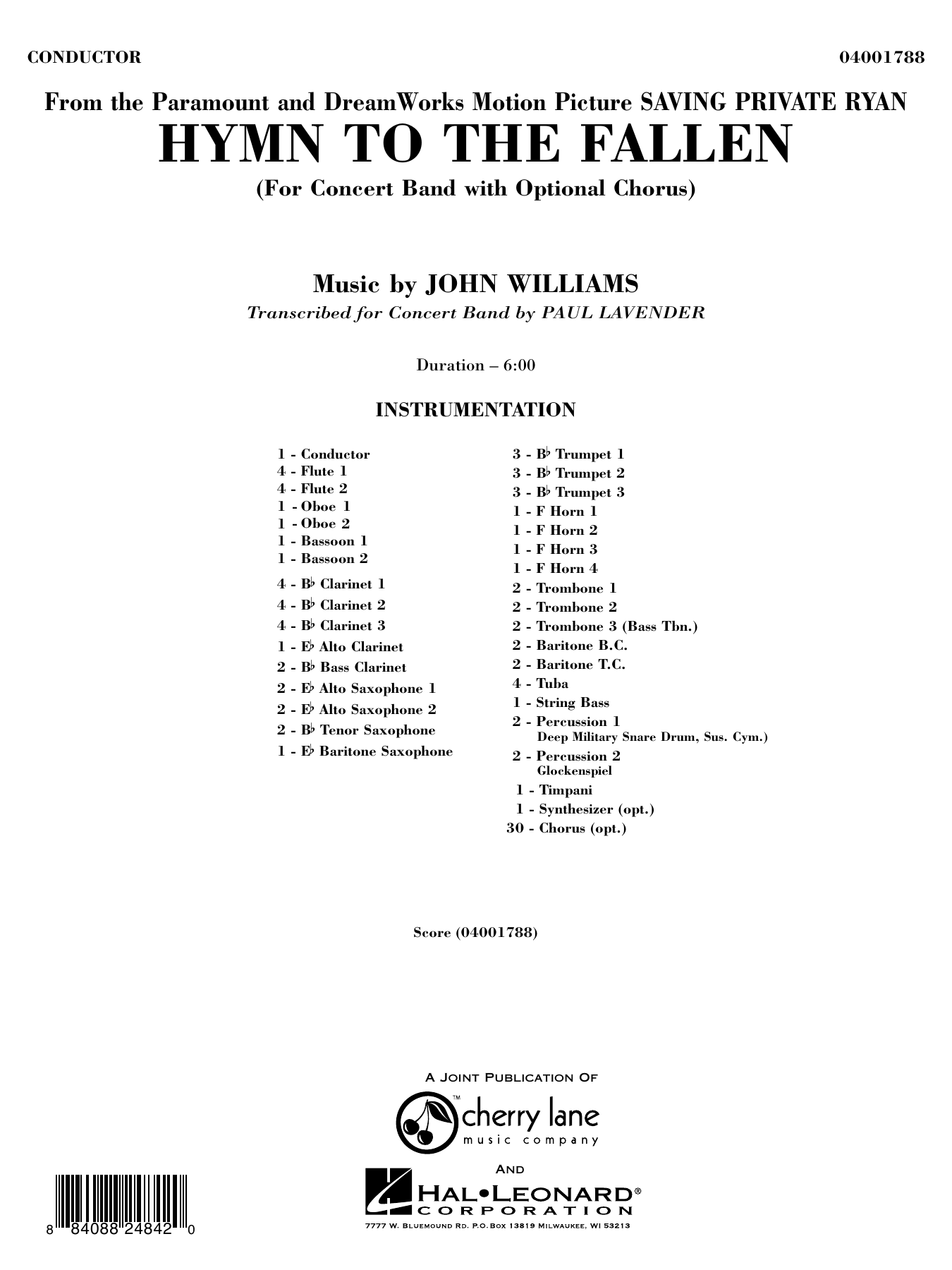

Hymn to the Fallen (from Saving Private Ryan) (arr. Paul Lavender): Concert Band Conductor Score & Parts
By John Williams / Arranged by Paul Lavender
Grade: 4-5
Item: 35-PK01925133
$85.00
Pickup currently not available
Buy Extra Parts (Digital PDF Download)
Parts Added to Cart!
Description
Steven Spielberg's twenty year association with John Williams has produced yet another powerful cinematic achievement, this time a gripping, realistic view of the horrors of WW II. Williams' score includes this simple hymn, using chorus as an instrument of the orchestra, adding a special reverence and poignancy to the simple melody. Arranger Paul Lavender brings us this edition for the concert band stage.


Hymn to the Fallen (from Saving Private Ryan) (arr. Paul Lavender): Concert Band Conductor Score & Parts isn't in MakeMusic Cloud just yet...but it could be. Let us know you'd like to see it, and you'll help shape what comes next. In the meantime, start a free trial and dive into thousands of interactive titles your students can play along with today.
Request This Title
Tell us you want it.
Start Your Free Trial
Explore everything that's ready to play right now.
Sample Audio
No sample audio found.
Sample Video
No sample videos found.
Additional Details
Publisher:
Hal Leonard
SKU:
35-PK01925133
More about this title
About the Composer: John Williams
John Williams stands as one of the most consequential film composers in cinema history, with a career spanning over six decades and encompassing some of the most recognizable scores ever written. His work across genres from science fiction to historical drama demonstrates a mastery of orchestration and thematic development that has influenced multiple generations of composers.
Williams' partnership with director Steven Spielberg has produced some of his most celebrated achievements, including scores that balance intimate character moments with sweeping narrative scope. His ability to craft memorable melodies that serve the emotional core of a story while maintaining sophisticated harmonic language makes his work particularly valuable for music educators seeking examples of accessible yet artistically substantial composition.
Why we love this
Paul Lavender's transcription captures the profound restraint of Williams' original hymn, stripping away Hollywood excess to reveal a melody that carries genuine weight and dignity. Concert bands at the 4 and 5 level can access material that feels substantial without requiring advanced technical facility, allowing students to focus on shaping phrases with maturity and reverence. This is the kind of arrangement that reminds your ensemble why they chose music in the first place.
What to expect
This hymn unfolds with quiet dignity, its simple melody suggesting both private grief and collective remembrance. The arrangement moves through understated harmonic shifts that deepen the emotional landscape without theatrical gesturing, creating space for reflection rather than demanding emotional response.
Who it's for
Concert bands at Grade 4 and 5 seeking repertoire with genuine emotional depth and cultural relevance. Directors programming commemorative concerts, patriotic programs, or selections that acknowledge significant historical events will find this arrangement both accessible and profoundly moving.
How to get the most out of it
- Shape the melody with long-line phrasing rather than section-by-section awareness. Singers and wind players alike should hear this as one continuous thought that breathes at specific moments Williams has already composed into the work.
- Resist the urge to push the tempo forward. A measured pace gives weight to every harmonic change and allows the arrangement's textural choices to register with your audience.
- Balance the choir and ensemble as equals rather than accompaniment. If you're using a choir with your band, this is a moment for both forces to share the musical storytelling without one overwhelming the other.
- Let silence matter. The spaces between musical statements are as important as the statements themselves in creating the reflective quality this arrangement demands.
How to use it
Consider programming this as a concert closer or a centerpiece of a patriotic concert rather than burying it within a longer set. Its power lies in focused attention and unrushed pacing. This also serves excellently as a teaching moment about how film music functions differently from concert music, and what it means to adapt one for the other.
Skills your students will build
- Sustaining long phrases without sectional breathing
- Balancing melody and accompaniment texture
- Playing with dynamic nuance in slower tempos
- Responding to harmonic movement that builds meaning without obvious melodic motion
- Coordinating ensemble sound across mixed instrumentation