
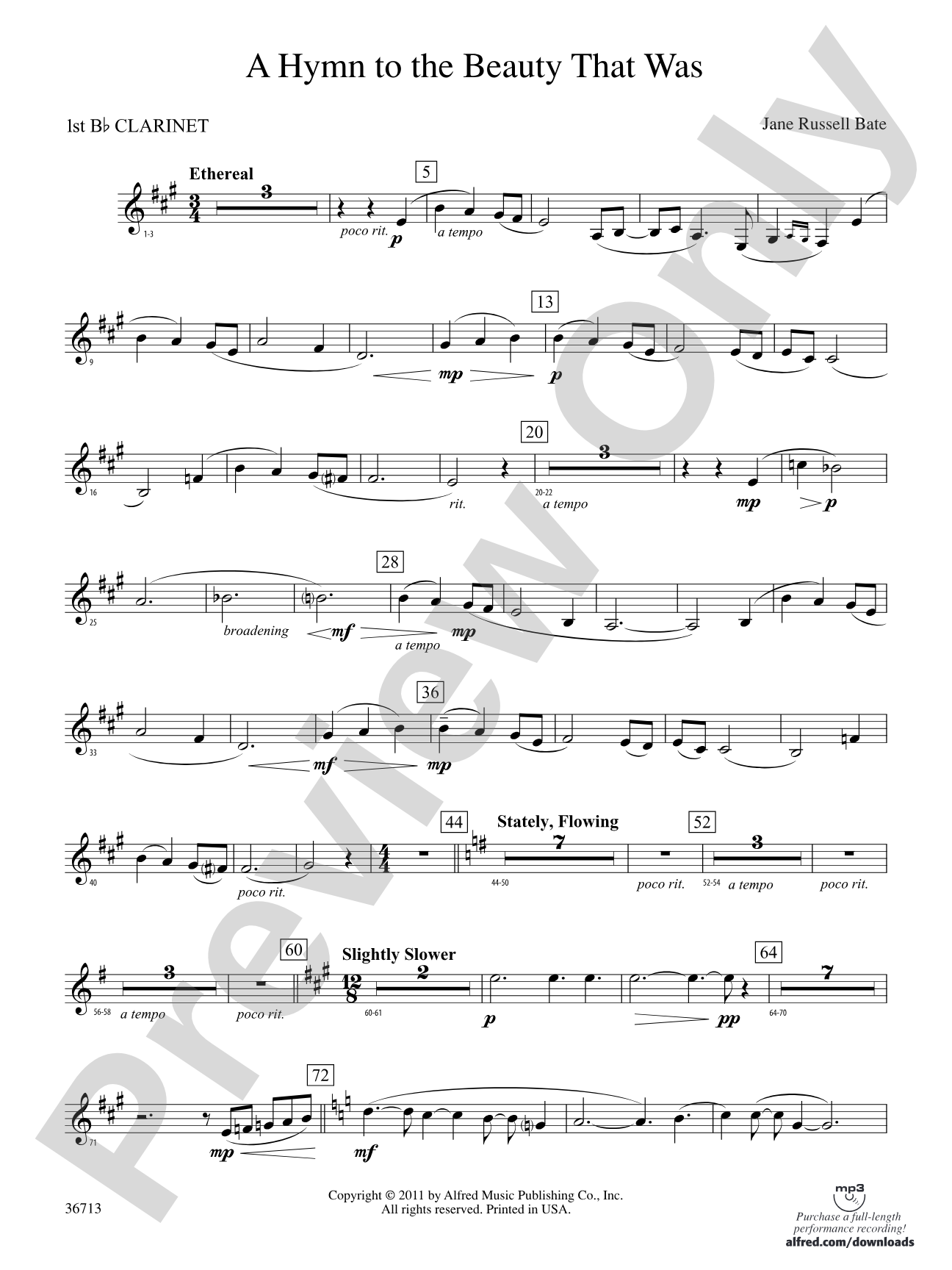

Hymn to the Beauty That Was: 1st B-flat Clarinet
By Jane Russell Bate
Grade: 4 (Medium Difficult)
Item: 00-PC-0015141_C1
$3.00
Pickup currently not available
Description
This stunning lyrical composition is truly something special. A tribute to Jennifer, Hayley, and Michaela Petit, victims of a 2007 home invasion in Cheshire, CT, Hymn to the Beauty That Was is a moving ballad which adds harp (or synthesizer) to the band, and features soloists on flute, English horn (or alto sax), and euphonium. The piece builds to a powerful and emotional climax as the three main musical elements (the women's theme, the hymn melody, and an accompanying triplet figure) are woven together.


Don't just read it, hear it, play along with it, and watch your students grow with it. In MakeMusic Cloud, Hymn to the Beauty That Was: 1st B-flat Clarinet comes alive with professional accompaniment, adjustable tempo, and built-in practice tools that turn solo practice into real progress.
Open in the Player
Jump straight in and assign it today.
Start Your Free Trial
Open this title and explore the full library in minutes.
Sample Audio
1
Audio File
--:--
0:00
0:00
Sample Video
No sample videos found.
Additional Details
Series:
Alfred Concert Band
Publisher:
Alfred Music
Page Count:
194
SKU:
00-PC-0015141_C1
More about this title
About the Composer: Jane Russell Bate

Jane Russell Bate's training spans composition, arranging, and performance across multiple disciplines. She studied arranging at the Eastman School of Music's summer Arranger's Workshops under Ray Wright and Manny Albam, pursued jazz piano privately at the Hartford Conservatory, and studied composition with Dr. Stephen Gryc at the Hartt School of Music. She holds a B.A. from Smith College and graduate degrees in Music Education from Central Connecticut State University.
Bate spent many years teaching instrumental music in the Cheshire, Connecticut public schools while maintaining an active performance career as a pianist and synthesizer player for Seven Angels Theater and other regional ensembles. She has also performed bassoon with local wind groups and accompanied countless studio and school performances. Since retiring from classroom teaching, she has devoted herself to composition and has already produced several commissions, establishing herself as a published composer with Alfred Music.
Why we love this
Bate's background as both a longtime instrumental music teacher and an active performer gives this piece an uncommon understanding of what works on the concert stage. The memorial context never overshadows the composition itself: instead, she has written a piece that honors its dedicatees through genuinely sophisticated orchestration, with the harp (or synthesizer) adding textural warmth and the three solo voices creating a natural focal point that builds toward something genuinely affecting without manipulating emotion.
What to expect
A contemplative meditation that moves through grief toward remembrance. The composition unfolds with restraint and respect, allowing silence and space to carry meaning. As the three thematic elements converge near the end, the band reaches a moment of collective emotion that feels earned rather than imposed, settling finally into quiet affirmation.
Who it's for
Concert bands at the Grade 4 level seeking repertoire with genuine emotional substance and programming flexibility. Directors programming memorial or tribute concerts will find material that honors its subject with artistic integrity rather than sentimentality. This works equally well for festival competition or concert performance.
How to get the most out of it
- Balance the three soloists (flute, English horn/alto sax, euphonium) so each theme emerges clearly during the climax, where all three musical elements interweave; mark rehearsal priorities early so section leaders understand the harmonic context beneath their parts.
- If using synthesizer instead of harp, assign someone to listen critically during early rehearsals to ensure the sound complements rather than overwhelms the band; the texture should feel lyrical, not heavy.
- Shape the triplet figure as an undercurrent that gains presence gradually; it exists to support the emotional arc, not to become rhythmically prominent.
- Conduct the hymn melody with clarity and stillness; the power comes from harmonic progression and orchestration, not from interpretive excess.
How to use it
This works as a concert centerpiece, particularly on programs exploring memory, community, or resilience. It can anchor a second half after more energetic opening selections, or serve as a meaningful closer that leaves the audience in reflective silence. The solo opportunities also make it suitable for festival competition where judges reward compositional craft and ensemble blend.
Skills your students will build
- Balance and blend across soloists and full ensemble in contrapuntal writing
- Sustaining long-phrase musicality with proper breath support and phrasing discipline
- Listening to harmonic function beneath surface melody to inform dynamic shaping
- Ensemble precision in executing triplet figures that serve as accompaniment rather than feature
- Sensitivity to text and context as drivers of interpretation in concert music