
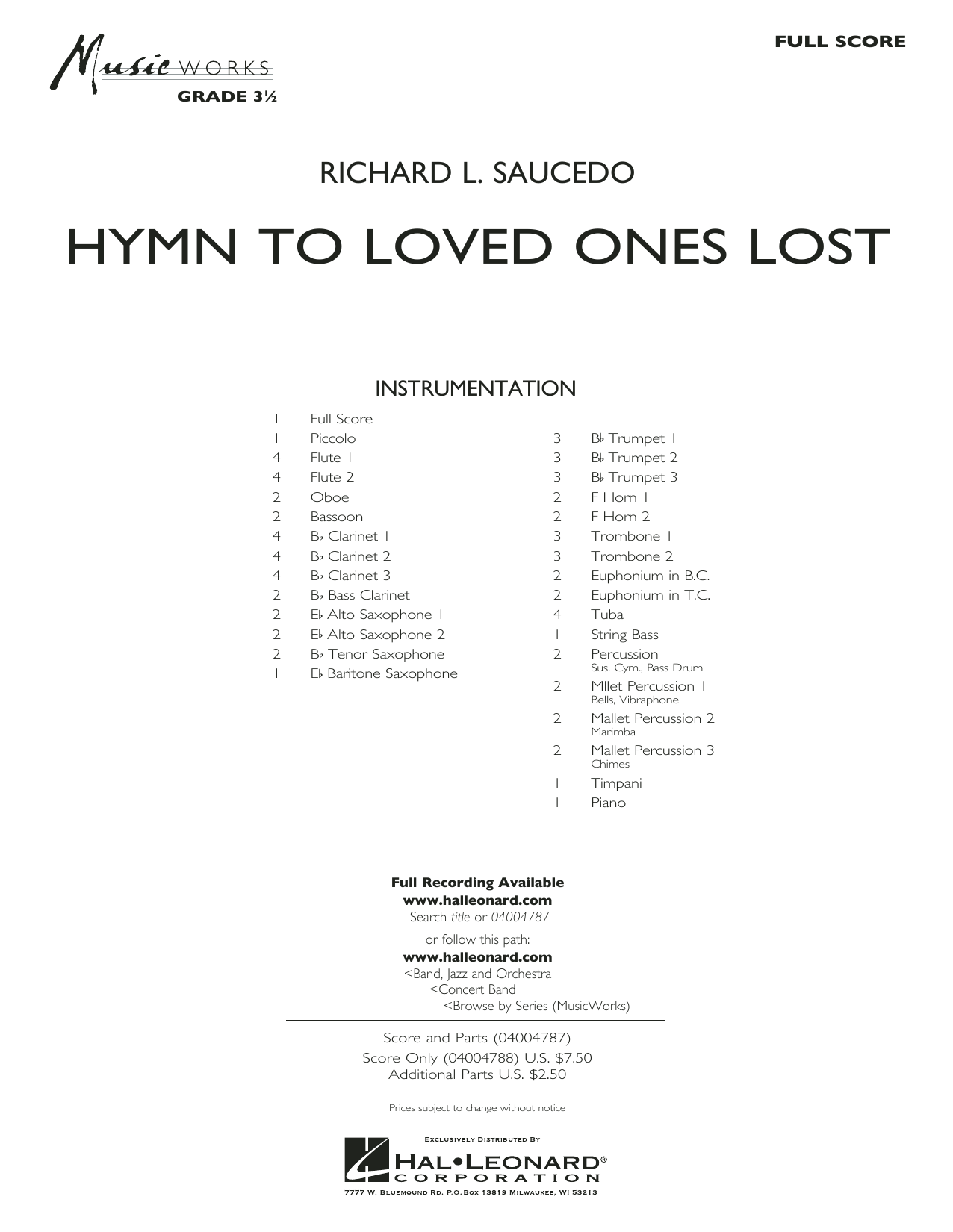

Hymn to Loved Ones Lost: Concert Band Conductor Score & Parts
By Richard L. Saucedo
Grade: 3
Item: 35-PK00336642
$75.00
Pickup currently not available
Buy Extra Parts (Digital PDF Download)
Parts Added to Cart!
Description
In this touching composition, Richard Saucedo has created a collage of feelings and emotions associated with losing someone near and dear. Along with a sense of sadness, the piece also reflects feelings of frustration and anger we often feel at these times. It's the composers hope that this musical tribute will help remind us all that "music is for everybody." Dur: 4:20


Discover MakeMusic Cloud: thousands of interactive titles your students can play along with today.
Sample Audio
No sample audio found.
Sample Video
Additional Details
Publisher:
Hal Leonard
SKU:
35-PK00336642
More about this title
About the Composer: Richard L. Saucedo

Richard L. Saucedo spent 31 years as Director of Bands and Chairman of Performing Arts at Carmel High School in Indiana, where he built a program of extraordinary reach and achievement. His ensembles earned state, regional, and national recognition across concert, jazz, and marching formats; Carmel's Wind Symphony performed at the Music for All National Concert Band Festival three times and claimed the Indiana State Championship in 2013, while the Marching Greyhounds secured BOA National Championships in 2005 and 2012 after 17 consecutive years in the national top ten.
Since retiring in 2013, Saucedo has expanded his work as a freelance composer and arranger for concert bands, choruses, marching units, and orchestras. His contributions to the Cavaliers and Blue Devils drum corps resulted in five DCI world championships. Recognized as Indiana's Bandmaster of the Year (1998-99) and Outstanding Music Educator (2010), he was inducted into the Music for All Hall of Fame in 2015 and the Drum Corps International Hall of Fame in 2022, and remains an elected member of the American Bandmasters Association. Saucedo also serves as a Senior Educational Consultant for Music for All and Bands of America.
Why we love this
Saucedo approaches memorial music without sentimentality. The piece acknowledges the full emotional landscape of loss—the grief alongside anger and frustration—and trusts your students to engage with real feelings rather than simplified ones. At Grade 3, the orchestration sits perfectly for developing bands while maintaining the emotional integrity the subject demands.
What to expect
The music unfolds with a gentle, searching quality before deepening into moments of intensity that reflect the struggle within grief. Saucedo's orchestration creates space for reflection while building passages of genuine emotional weight, making room for both the ache of memory and the complexity of what we carry after loss.
Who it's for
Concert bands at the Grade 3 level seeking meaningful repertoire beyond the purely technical or celebratory. This works equally well for spring festival programming or memorial services, and reaches students capable of handling subtle emotional expression.
How to get the most out of it
- Honor the emotional arc by attending carefully to dynamic shaping; let the climactic moments breathe without pushing them artificially.
- Rehearse the ensemble's attacks and releases with precision, as clean articulation will clarify the compositional lines during softer, introspective passages.
- Consider the recorded accompaniment as a reference for tempo and phrase architecture, then work toward releasing it during performances to build student ownership of the interpretation.
- Build ensemble balance so that inner voices and counter melodies emerge naturally rather than compete with the primary theme.
How to use it
Program this as the centerpiece of a concert program rather than a filler piece; its 4:20 duration and emotional substance command full attention. The work pairs naturally with other American concert band literature and provides a meaningful contrast to lighter festival selections, or stands effectively on its own as a complete program statement.
Skills your students will build
- Dynamic control and sustained soft playing
- Phrase shaping and emotional expression through tone production
- Balance and blend within a full ensemble texture
- Attention to articulation clarity in both legato and separated passages
- Understanding of how compositional form carries emotional narrative