Richard Crashaw (1612–1649) was an English metaphysical poet whose devotional verse stands apart for its sensory richness and emotional intensity. His religious poetry, written during a period of profound spiritual conviction, employs elaborate imagery and baroque conceits to explore faith, sacrifice, and divine love. His work influenced generations of poets and remains a touchstone for composers seeking texts that balance theological depth with lyrical beauty.
Why we love this
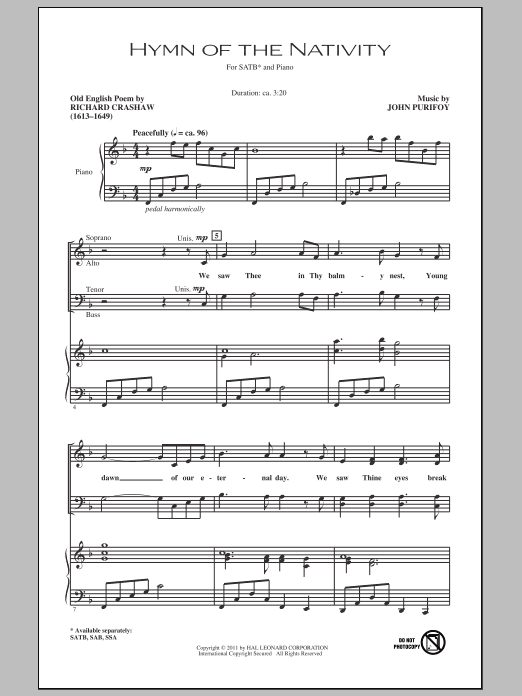
Purifoy's arrangement captures the ornamental language of Crashaw's nativity poetry while keeping the harmonic language accessible for intermediate choirs. The setting rewards careful attention to text declamation; singers discover how the music itself becomes a form of interpretation, illuminating the poem's baroque sensibility through phrase shaping and dynamic control. This is repertoire that demands genuine musicianship while remaining within reach.
What to expect
The music unfolds with the contemplative grandeur of a private devotion made public. There is reverence here, but not austerity; Crashaw's language is alive with wonder and intimate detail, and Purifoy's harmonies honor that complexity. Singing this piece feels like exploring a sacred text through sound.
Who it's for
This octavo suits advanced high school choirs, college ensembles, and community choirs with solid musicianship and comfort with text-driven interpretation. Directors programming sacred repertoire beyond the typical Christmas canon will find a piece that honors both musical and literary substance.
How to get the most out of it
Treat the text as the primary musical material. Crashaw's word choices are precise and weighted; let vowel colors and consonant articulation shape the phrasing rather than forcing alignment to regular metrical beats.
Shape long phrases through subtle dynamic variation rather than abrupt terracing. The poetry's flowing conceits benefit from a sense of continuous unfolding.
Balance the parts carefully in sections where upper voices carry the melodic line. SATB writing at this level often requires thoughtful blending to maintain independence without sacrificing blend.
Mark breath points in rehearsal where the text naturally allows them. Singers will discover that poetic punctuation (not just musical rests) guides the most musical interpretation.
How to use it
Slot this into a Christmas or Advent concert as an alternative to more frequently performed nativity settings. The 7-page length makes it substantial without overwhelming a program, and its poetic sophistication pairs well with instrumental works from the same period. Directors seeking to deepen their sacred season programming beyond the obvious choices will find real artistic reward here.
Skills your students will build
Interpreting metaphysical poetry through musical line and phrasing
Managing longer phrase shapes and breath control
Balancing independent SATB lines while maintaining choral blend
Connecting text stress to dynamic and harmonic emphasis
Singing with stylistic sensitivity to baroque devotional language
You May Also Like
Scan to Complete Your Purchase
Use your phone's camera to scan the code below
You'll log in on your phone and the order will be added to your account