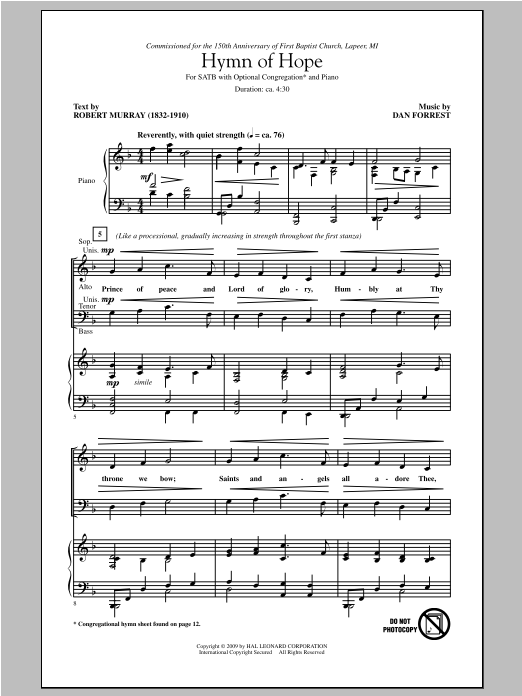
Dan Forrest has established himself as one of the most performed choral composers and arrangers in American churches and concert halls. His arrangements consistently balance musical sophistication with accessibility, allowing singers across skill levels to engage meaningfully with the material.
Why we love this
Forrest's treatment transforms a familiar hymn into something that feels both reverent and fresh without abandoning its spiritual core. The four-part writing sits comfortably for amateur and developing choirs while offering enough harmonic color and textural variety to hold an audience's attention across its 11 pages.
What to expect
The arrangement carries an uplifting, contemplative quality that invites singers and listeners into a space of earnest reflection. Moments of fuller harmonic texture emerge from quieter passages, creating a dynamic emotional landscape that feels earned rather than imposed.
Who it's for
This octavo works well for church choirs seeking quality repertoire that's neither overly simple nor prohibitively difficult. It also suits community choruses and school choral programs looking for concert material with spiritual substance.
How to get the most out of it
Establish the harmonic foundation by having your accompanist play through the full arrangement at rehearsal before singers learn their parts. This helps everyone hear how their individual line contributes to the whole.
Shape the dynamic arc deliberately rather than singing at one volume throughout. Sacred music rewards thoughtful phrasing that mirrors the text's emotional journey.
Balance the upper voices carefully in passages where sopranos and altos move in parallel motion. These moments showcase the arrangement's harmonic writing when tuned precisely.
How to use it
Consider this for a spring or winter concert program where it can anchor a set of sacred or inspirational music. Its moderate length and SATB scoring make it ideal filler between longer works while standing as a compelling piece on its own merit.
Skills your students will build
Balancing four independent melodic lines within a harmonic context
Singing in a sacred musical style with appropriate tone and phrasing
Reading ensemble arrangements where the soprano is not always the highest voice
Sustaining sustained tones while maintaining blend and intonation
You May Also Like
Scan to Complete Your Purchase
Use your phone's camera to scan the code below
You'll log in on your phone and the order will be added to your account