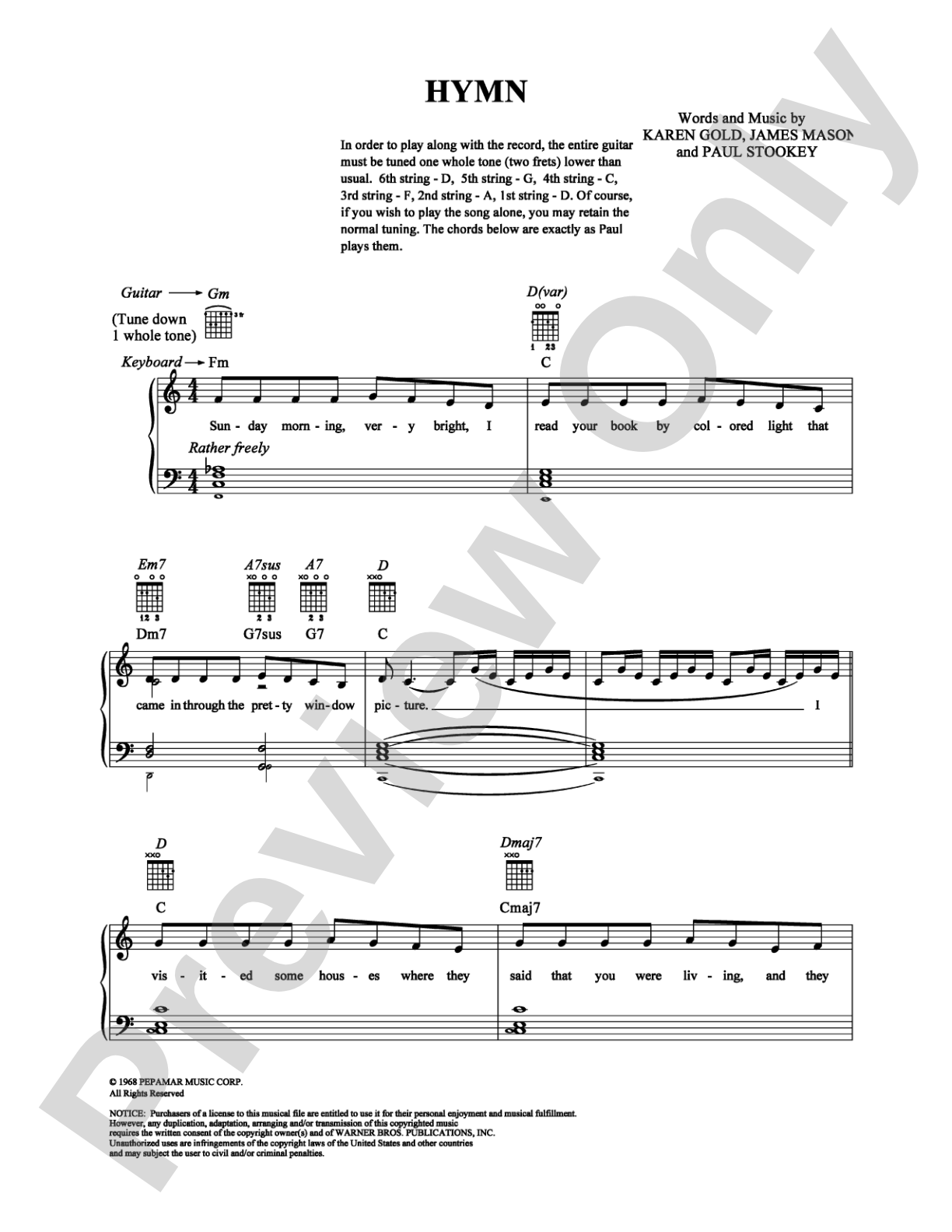
Hymn: Piano/Vocal/Chords Digital Sheet Music

Hymn: Piano/Vocal/Chords Digital Sheet Music

James Mason, Peter Paul & Mary, Noel Paul Stookey, Karen Gold

Item: 00-PS-0008772

Digital Download
$3.99
Description

Hymn: Piano/Vocal/Chords Digital Sheet Music isn't in MakeMusic Cloud just yet...but it could be. Let us know you'd like to see it, and you'll help shape what comes next. In the meantime, start a free trial and dive into thousands of interactive titles your students can play along with today.

Sample Audio
No sample audio found.
Sample Video
Additional Details
SKU: 00-PS-0008772

More about this title

About the Artist: Peter Paul & Mary

Peter, Paul and Mary emerged in the early 1960s as one of the most influential folk-pop groups in American music history. The trio—Peter Yarrow, Paul Stookey, and Mary Travers—became known for their crystalline harmonies, socially conscious songwriting, and ability to bridge folk traditions with popular appeal. Their recordings introduced millions of listeners to both traditional folk material and contemporary compositions that spoke to issues of peace, justice, and human connection.

In music education contexts, their work remains invaluable for teaching vocal blend, part independence, and the integration of acoustic guitar with vocal arrangements. Their catalog demonstrates how accessible melodies and meaningful lyrics can create songs that endure across generations, making their material particularly effective for building student engagement with ensemble singing.

Why we love this

This arrangement captures the gentle, reflective quality that made Peter, Paul and Mary's vocal work so teachable in ensemble settings. The piano/vocal/chords format gives singers and pianists the scaffolding they need to learn the arrangement while preserving the song's emotional authenticity and harmonic sophistication.

What to expect

The piece carries the warmth and intimacy characteristic of Peter, Paul and Mary's studio sound. There's a reflective quality in the harmonic movement and a gentle forward motion in the accompaniment that invites both performer and listener into quiet contemplation. The arrangement respects the song's folk roots while its piano setting gives it a more formal, concert-ready character.

Who it's for

Solo singers preparing repertoire for recitals or auditions will find this a straightforward, well-crafted arrangement. Pianists accompanying vocalists in private lessons, church settings, or informal performances will appreciate the clear chord symbols and manageable accompaniment patterns. Musicians drawn to the folk-pop tradition and familiar with Peter, Paul and Mary's body of work can use this as a starting point for exploring the group's vocal arranging techniques.

How to get the most out of it

  • Balance the vocal melody with piano accompaniment by keeping the right hand light and allowing the voice to sit naturally on top without forcing projection.
  • Use the chord symbols to explore jazz voicings at the piano if the arrangement allows; this deepens harmonic understanding for both performer and listener.
  • Pay attention to the lyrical phrasing rather than strict metric pulsing; folk-derived songs often breathe in ways that honor the text's natural cadence.
  • If performing with multiple singers, rehearse the harmony parts separately from the melody to ensure clarity before combining voices with piano.

How to use it

This works well in programs centered on 20th-century American folk and popular music, or in contexts exploring vocal ensemble traditions. A solo singer might pair this with other narrative or introspective songs from the folk canon for a cohesive recital set. Church musicians and community ensemble leaders can use it as an accessible yet musically substantial piece that audiences of varying ages recognize and appreciate.

Skills your students will build

  • Reading chord symbols and realizing harmonic accompaniment at the piano
  • Balancing melody and accompaniment in piano/vocal performance
  • Understanding phrase structure and lyrical phrasing in folk-derived song
  • Interpreting chord progressions expressively beyond the printed page

You May Also Like