
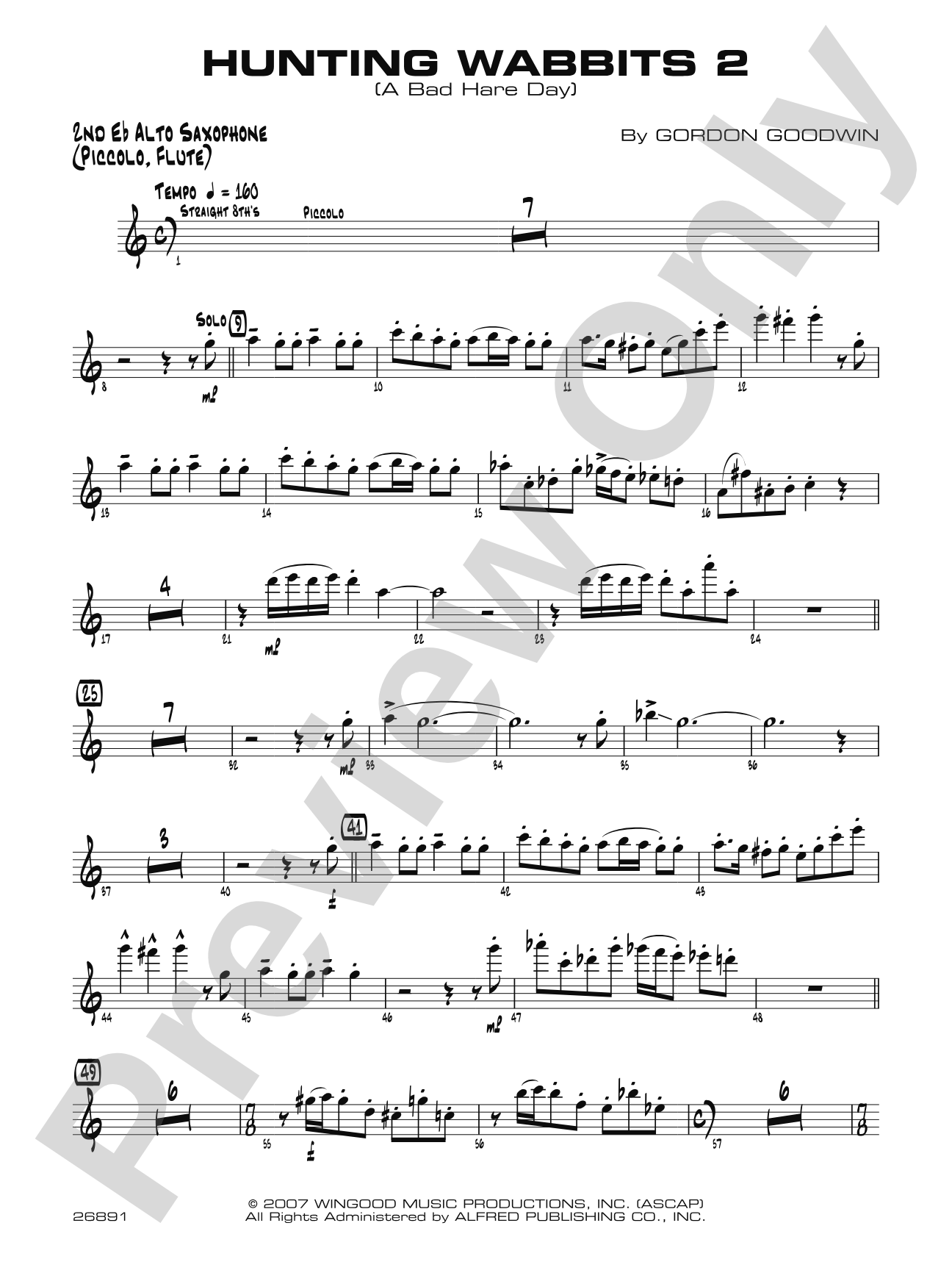

Hunting Wabbits 2 (A Bad Hare Day): 2nd E-flat Alto Saxophone
By Gordon Goodwin
Grade: 5 (Advanced / Difficult)
Item: 00-PC-0017121_AX2
$3.00
Pickup currently not available
Description
Challenging, yes, impossible, no. Gordon Goodwin's Hunting Wabbits 2 will provide all the challenge any band needs as they explore this tongue-in-cheek musical adventure that is well worth the effort. The groove is straight eighths (semi-legit) and funky. The instrumentation is flexible: saxophone parts with woodwind doubles, sax parts without doubles, and even optional string parts . . . yes, strings! Percussion parts included. Solo space for all saxes, trumpet 4 and trombones 1/2. As recorded by Gordon Goodwin on The Phat Pack CD. This is an amazing arrangement! This title is available in MakeMusic Cloud.


Don't just read it, hear it, play along with it, and watch your students grow with it. In MakeMusic Cloud, Hunting Wabbits 2 (A Bad Hare Day): 2nd E-flat Alto Saxophone comes alive with professional accompaniment, adjustable tempo, and built-in practice tools that turn solo practice into real progress.
Open in the Player
Jump straight in and assign it today.
Start Your Free Trial
Open this title and explore the full library in minutes.
Sample Audio
1
Audio File
--:--
0:00
0:00
Sample Video
No sample videos found.
Additional Details
Series:
Gordon Goodwin Series
Publisher:
Alfred Music
Page Count:
122
SKU:
00-PC-0017121_AX2
More about this title
About the Composer: Gordon Goodwin

Gordon Goodwin's compositional gifts emerged early: by age five, he was transcribing complete works from memory, and by thirteen, he had already written his first big band chart. This early fluency translated into a career spanning film, television, and concert music. His orchestrations appear in films including Bad Boys II, Con Air, Gone in 60 Seconds, and Remember the Titans, and his work has earned three Emmy Awards and multiple Grammy nominations.
As founder and leader of Gordon Goodwin's Big Phat Band (established in 2000), Goodwin channels his versatility as composer, arranger, conductor, and performer. He has written for and collaborated with artists ranging from Quincy Jones and Ray Charles to Christina Aguilera, and has conducted major symphony orchestras across North America and Europe. His albums, including the Grammy-nominated Swingin' for the Fences and XXL, showcase his command of large ensemble writing and his gift for crafting music that entertains and challenges in equal measure.
Why we love this
Goodwin's humor and musicianship are inseparable; the title alone signals that this will be entertaining without sacrificing sophistication. The flexible instrumentation means advanced ensembles at different schools can actually perform it, and the built-in solo space for multiple sections keeps ensemble members engaged beyond the written parts. Recording it as a feature on your big band concert gives audiences something genuinely fun to listen to.
What to expect
A playful romp that swings hard; the tune burrows into your head while the underlying grooves demand precision and pocket awareness. There's real musicianship in the humor, and the arrangement respects both the ensemble's intelligence and their sense of fun.
Who it's for
Advanced jazz ensembles ready to tackle sophisticated arranging, rhythmic precision, and multiple layers of ensemble writing. Directors leading Grade 5 big bands will find this especially rewarding for musicians capable of handling solo space and flexible instrumentation.
How to get the most out of it
- Lock the feel to straight eighths with a funky pocket; the groove sits between legit and loose, so rhythm section and saxophone section need to find that shared space early in rehearsals.
- Give soloists space to interpret; Goodwin's voicings and harmonic choices provide excellent support for improvisation, but horn players should have time to woodshed their choruses independently.
- Balance ensemble punch with clarity in the saxes and brass; at this level, sectional clarity often gets sacrificed for volume, but Goodwin's orchestration deserves both.
- Use the conductor score to mark form and solo entries clearly so the ensemble knows exactly where improvisation begins and ensemble figures resume.
How to use it
Program this as a concert feature or festival showcase piece; its entertainment value and recorded reference (Gordon Goodwin's version on The Phat Pack CD) give students a clear target to aim for. The flexible instrumentation also makes it accessible whether you're programming with full woodwind doubles or adapting for available players.
Skills your students will build
- Straight eighth-note funk groove and pocket playing
- Reading and executing improvisation over chord changes
- Ensemble balance between sections in complex voicings
- Flexible instrumentation adaptation and doubling combinations
- Solo phrasing and trading exchanges between saxophone and brass sections
- Conductor score reading and coordination across multiple ensemble sections