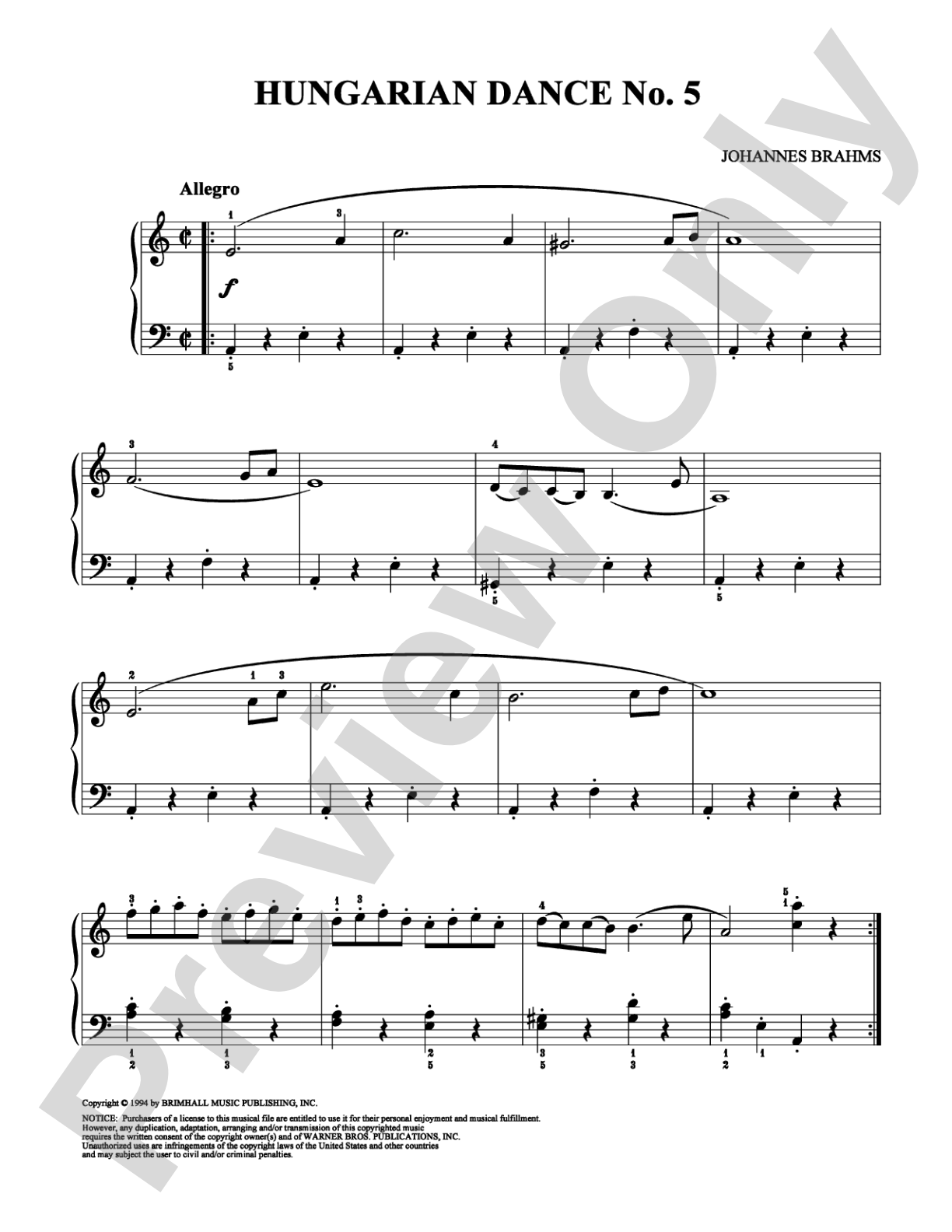
Hungarian Dance No. 5: Easy Piano Digital Sheet Music

Hungarian Dance No. 5: Easy Piano Digital Sheet Music

Johannes Brahms

Item: 00-PS-0006727

Digital Download
$3.99
Description

Hungarian Dance No. 5: Easy Piano Digital Sheet Music isn't in MakeMusic Cloud just yet...but it could be. Let us know you'd like to see it, and you'll help shape what comes next. In the meantime, start a free trial and dive into thousands of interactive titles your students can play along with today.

Sample Audio
No sample audio found.
Sample Video
Additional Details
SKU: 00-PS-0006727

More about this title

About the Creator: Johannes Brahms

Johannes Brahms composed Hungarian Dance No. 5 in 1869 as part of a collection that drew on the folk melodies and rhythmic energy of Hungarian and Romani music. The piece became one of his most performed works, celebrated for its infectious vitality and the dramatic contrast between its lyrical opening and fiery central section. Brahms arranged versions for various instruments and ensemble sizes, making the work accessible across different musical contexts while preserving its essential character.

Why we love this

This easy piano arrangement captures the piece's signature swagger without demanding advanced technique. Students get to play something genuinely exciting and recognizable, which builds their confidence and keeps them engaged with the material; there's nothing tedious about learning music that sounds this good.

What to expect

The piece opens with a sultry, almost wistful melody that immediately gives way to restless energy and rhythmic momentum. There's a playful, almost mischievous quality throughout, with syncopation that suggests the whirling movement of the csárdás without ever becoming technically overwhelming.

Who it's for

Students in early intermediate piano study will find the accessible voicing and straightforward fingering pattern make this a rewarding first encounter with Brahms. This works equally well as a showcase recital piece or as material for building confidence with a recognized classical favorite.

How to get the most out of it

  • Shape the opening melody with slight rubato; let the first phrase breathe before the accompaniment settles into its rhythm.
  • Keep the left hand steady and crisp in the accompaniment figures; rhythmic clarity here lets the right hand's ornamentation shine.
  • Lean into the dynamic contrasts between sections. The shift from the lyrical beginning to the energetic main theme needs clear textural definition.
  • Balance tempo consistency with the natural push and pull of the folk-dance character; rigid metronomic playing flattens the piece's charm.

How to use it

Slot this into a recital when you need a bridge between romantic-era salon pieces and more contemporary work; it's recognizable enough to anchor an audience but energetic enough to keep the program moving. It also pairs nicely with other keyboard arrangements of folk-inspired music, creating a small themed set.

Skills your students will build

  • Ornamentation and embellishment in melody lines
  • Maintaining steady accompaniment patterns with rhythmic precision
  • Dynamic contrast and shaping across multiple sections
  • Balancing tempo flexibility with structural integrity
  • Coordination of independent melodic and harmonic material

You May Also Like