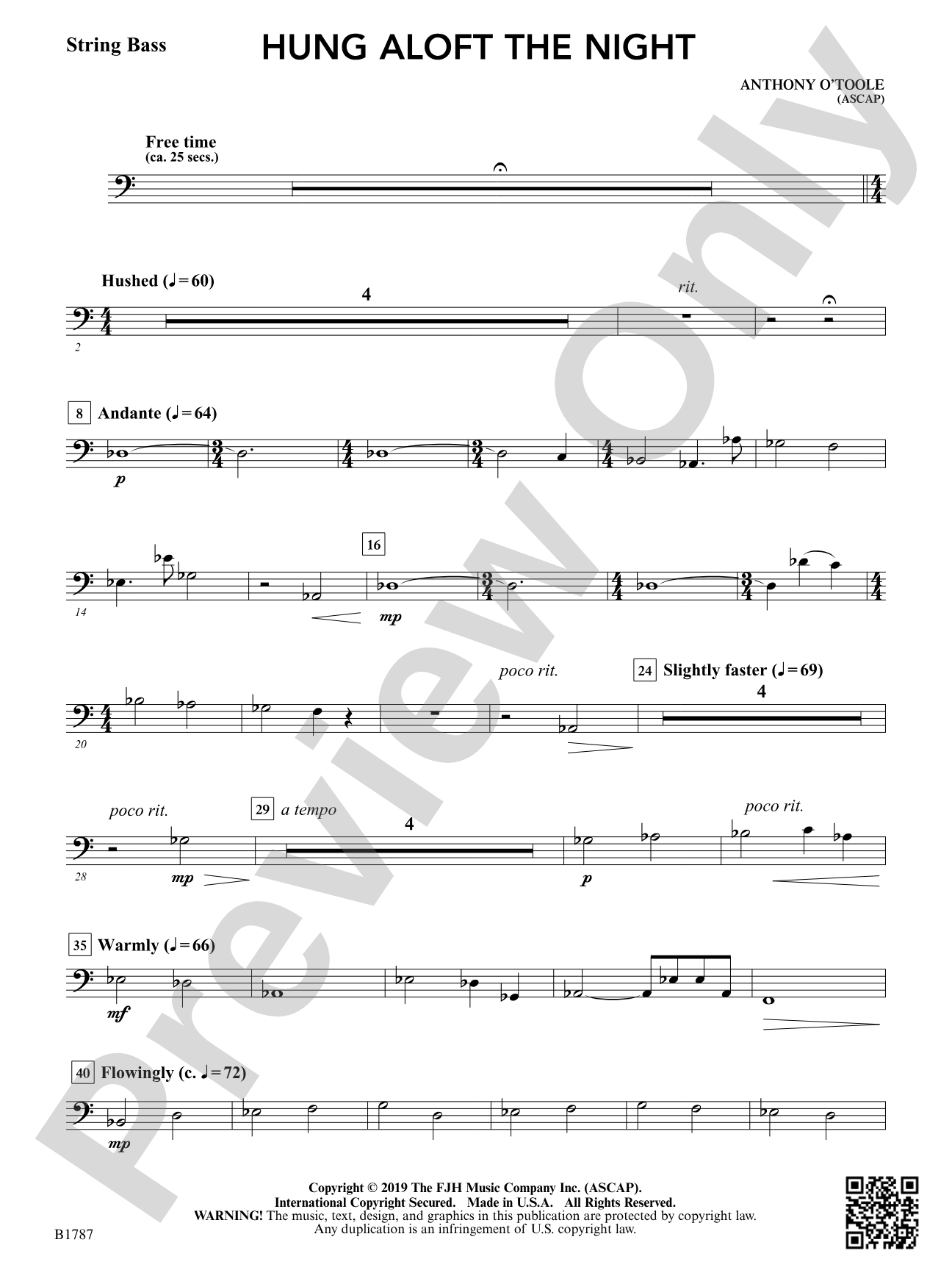
hung aloft the night: String Bass Sheet Music Preview

hung aloft the night: String Bass

By Anthony O'Toole

Grade: 4

Item: 98-PC-DB1787_SB

Digital Download
$7.00
Description
This beautiful lyrical work portrays the vivid imagery and yearning emotions described in John Keats' poem Bright Star, which captures the longing for stability amidst a world in constant flux. A lonely theme evolves through several reharmonizations, key changes, and contrapuntal settings before ending contemplatively, as if appearing in the night sky among millions of celestial bodies.

hung aloft the night: String Bass isn't in MakeMusic Cloud just yet...but it could be. Let us know you'd like to see it, and you'll help shape what comes next. In the meantime, start a free trial and dive into thousands of interactive titles your students can play along with today.

Sample Audio
0:00
0:00
Sample Video
Additional Details
Series: FJH Symphonic Band
Publisher: The FJH Music Company, Inc.
SKU: 98-PC-DB1787_SB

More about this title

Why we love this

O'Toole's approach to thematic development keeps the familiar melody front and center while shifting harmonic ground beneath it, giving your ensemble genuine compositional insight without overwhelming Grade 4 players. The piece respects Keats' emotional weight, building contemplation rather than spectacle, which sets it apart from lighter contest fare at this level.

What to expect

The music floats with quiet longing, a single thought turning over and over under changing light. Harmonic shifts arrive like clouds passing across stars, and the contrapuntal passages weave separate voices into a larger yearning before settling into the vast stillness of night sky.

Who it's for

Concert bands at the Grade 4 level seeking repertoire that balances accessibility with genuine artistic substance. Directors looking for a piece that works equally well in contest settings and concert programs will find a work that rewards careful preparation.

How to get the most out of it

  • Balance the solo line against its harmonic surroundings during the reharmonizations; the melody should remain audible even as the accompaniment grows richer.
  • Shape the key changes as genuine arrival points rather than abrupt transitions. Give each harmonic area breath and space to establish itself before moving forward.
  • Support the contrapuntal sections with clear articulation and part independence, especially in the woodwind and brass voices that share motivic material.
  • Approach the ending with restraint. The contemplative close asks for soft dynamics and patient phrasing, not rushing toward resolution.

How to use it

Program this as a centerpiece or transition in a concert exploring introspection and nature imagery, where it can follow more energetic works and create space for reflection. Its Grade 4 accessibility also makes it an excellent festival or contest selection that doesn't sacrifice musical substance for technical simplicity.

Skills your students will build

  • Sustaining lyrical phrasing across phrase arcs without forcing the line
  • Following harmonic reharmonization and hearing pitch relationships in new contexts
  • Reading and executing contrapuntal textures with part independence
  • Recognizing and executing key changes with secure intonation
  • Balancing solo material against accompaniment in various instrumental combinations

You May Also Like