

Hummingbird: 2-Part Choral Octavo
Words and music by Sally K. Albrecht
Item: 00-PO-0005762
$2.05
Minimum order quantity: 20 copies
Pickup currently not available
Description
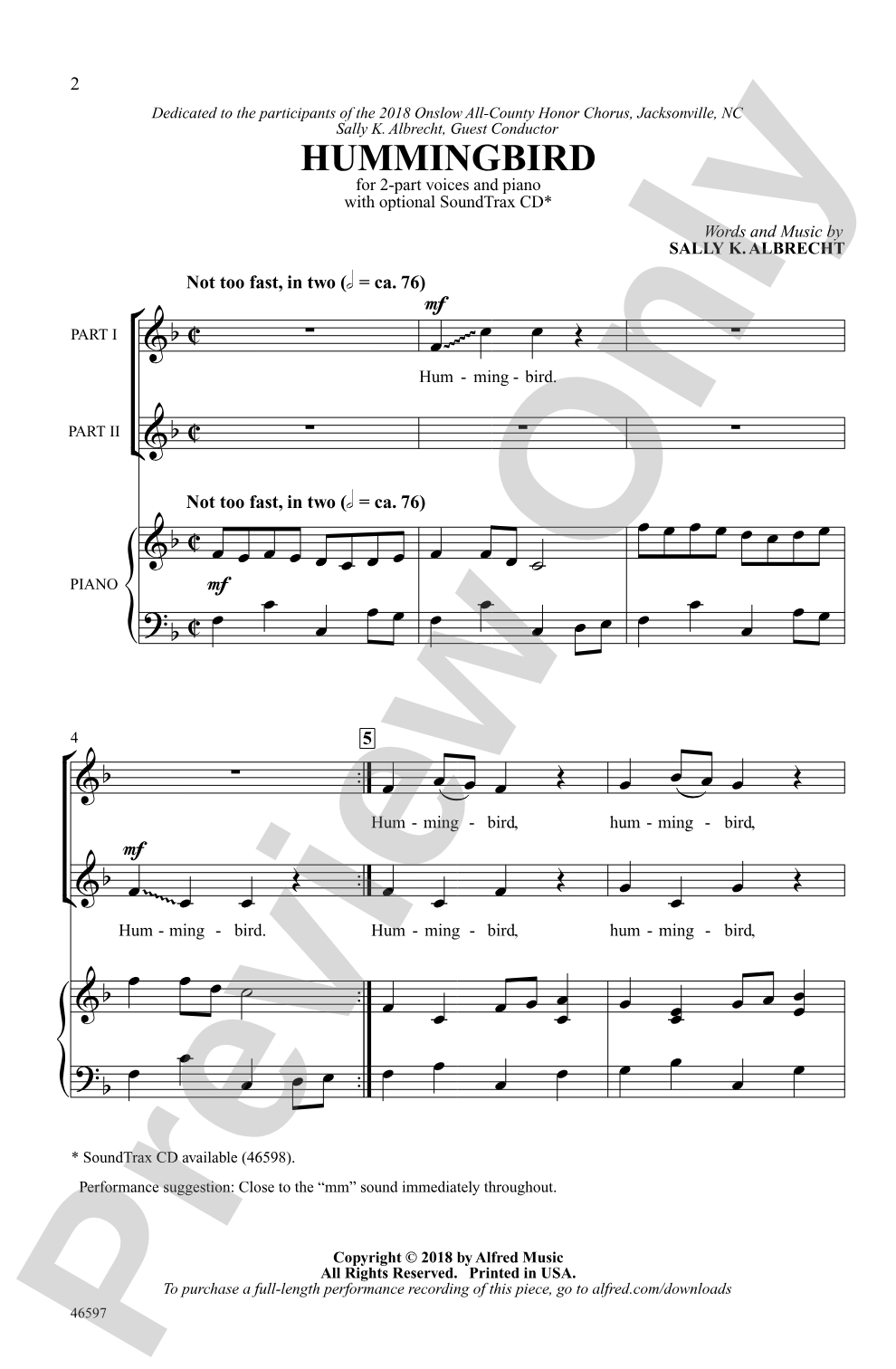
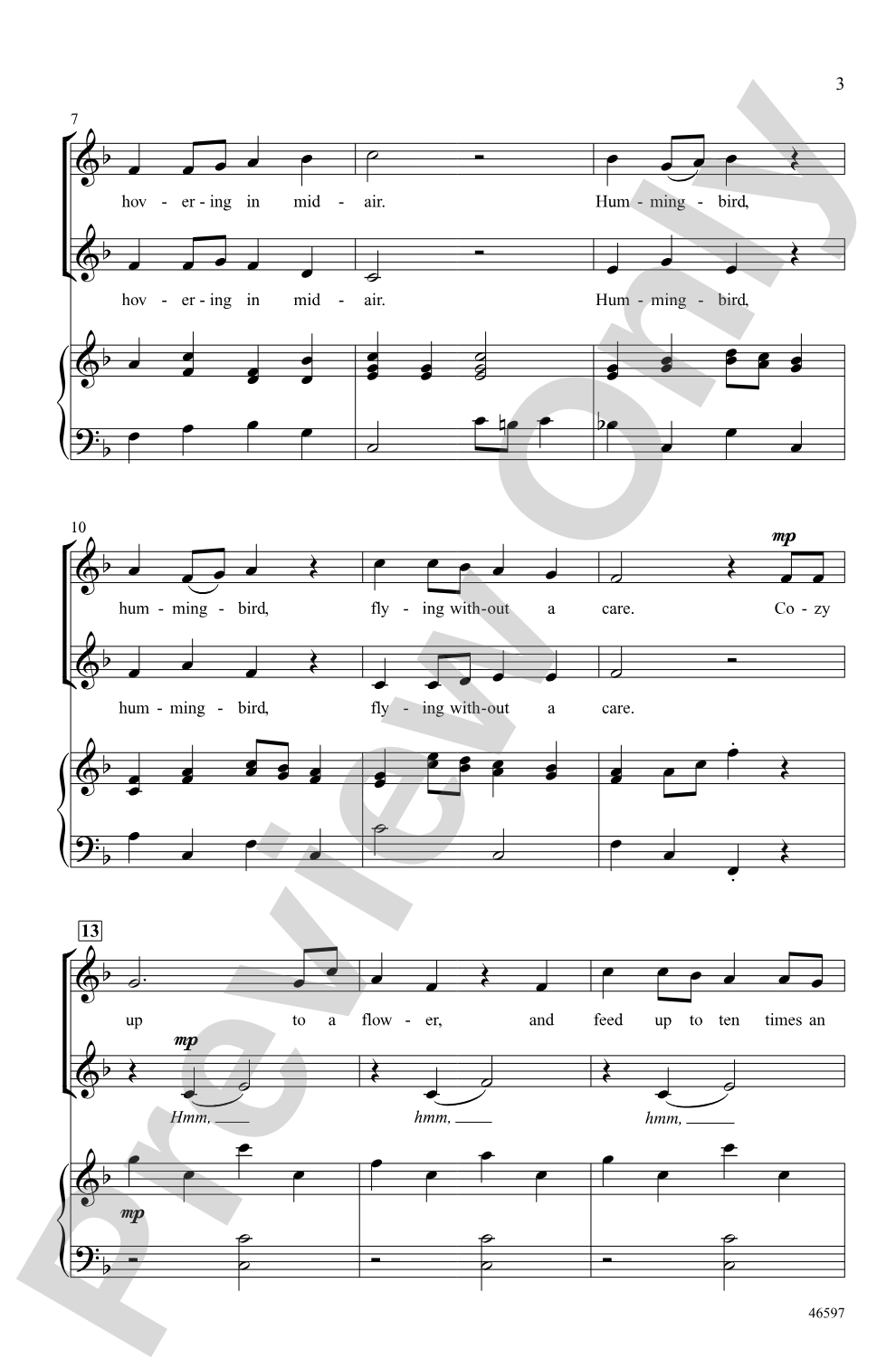
With a vocal range of just an octave and highly independent parts, this charming piece is ideal for singers new to harmony. The playful vocal lines are a delight to sing as they imitate the zigzag flight patterns of the hummingbird. Don't miss the ostinato section that stacks into an impressive, yet accessible, four parts. This one really hits the mark for outstanding children's choir repertoire.


Hummingbird: 2-Part Choral Octavo isn't in MakeMusic Cloud just yet...but it could be. Let us know you'd like to see it, and you'll help shape what comes next. In the meantime, start a free trial and dive into thousands of interactive titles your students can play along with today.
Request This Title
Tell us you want it.
Start Your Free Trial
Explore everything that's ready to play right now.
Sample Audio
1
Audio File
--:--
0:00
0:00
Sample Video
Additional Details
Series:
Alfred Choral Designs
Publisher:
Alfred Music
Page Count:
12
SKU:
00-PO-0005762
More about this title
About the Composer: Sally K. Albrecht

Sally K. Albrecht has shaped American choral music for over three decades, serving as Director of School Choral, Vocal, and Elementary Publications at major educational publishers and most recently at Alfred Music. A composer and conductor recognized annually by ASCAP since 1987, she has published more than 600 choral works and numerous larger-scale musicals; she has also conducted honor choirs at prestigious venues including Lincoln Center, Carnegie Hall, and The Kennedy Center.
Albrecht holds degrees from Rollins College (B.A. in Music and Theater, 1976), the University of Miami (M.A. in Drama, 1977; M.M. in Accompanying, 1979), and has taught at Oakland University, Jersey City State College, and Meredith College. She served as Chair of the Board of Trustees for the Omicron Delta Kappa National Leadership Honor Society and received their "Pillar of Leadership" award. In 2021, both the University of Miami Frost School of Music and Rollins College honored her with Distinguished Alumna Awards.
Why we love this
Albrecht has a gift for writing music that feels effortless to sing while remaining musically interesting, and "Hummingbird" exemplifies this balance perfectly. The ostinato section that expands into four parts rewards solid part-work practice without overwhelming singers who are new to harmony; directors will appreciate how the piece builds confidence and independence simultaneously.
What to expect
"Hummingbird" captures the energy and whimsy of its subject through music that darts and dances. The piece has a light, spirited quality that feels joyful to sing, with enough rhythmic interest and melodic independence to hold singers' attention across its 12 pages.
Who it's for
This octavo is ideal for children's choirs at the intermediate level, particularly singers encountering two-part harmony for the first time. The limited octave range removes vocal strain while the playful character keeps young singers engaged throughout rehearsal and performance.
How to get the most out of it
- Shape the vocal lines to mirror the hummingbird's movement. The zigzag flight patterns in the melody are meant to be heard; keep articulation crisp and let the rhythmic contour breathe.
- In the ostinato section, establish the foundation part first and lock it in before layering the additional voices. This prevents the stack from becoming muddy and lets singers hear exactly where their line sits.
- Balance the two independent 2-part lines so neither dominates. Since both are equally interesting, resist the urge to spotlight one section; instead, allow the interplay to create the piece's charm.
How to use it
Program this as a concert opener or a lighter contrast piece in a set of more serious choral work. It also shines at festival competition, where the clear voicing and accessible difficulty level allow judges to hear clean part-singing and genuine musicality from younger singers.
Skills your students will build
- Independent part-singing in 2-part texture
- Recognition and execution of ostinato patterns
- Rhythmic independence between vocal lines
- Awareness of melodic contour and text expression
- Listening skills and blend within the choir