
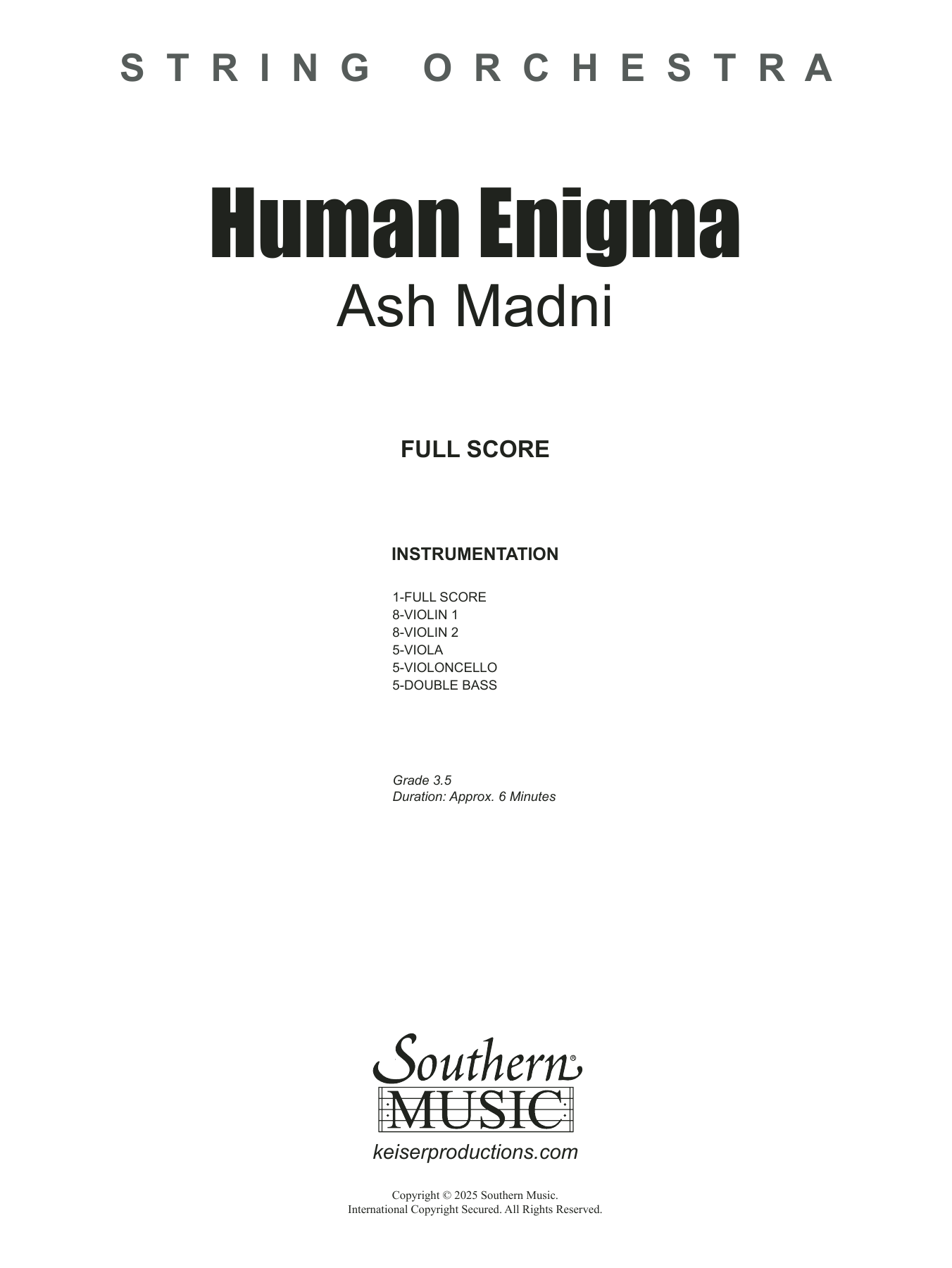

Human Enigma: String Orchestra Conductor Score & Parts
By Ash Madni
Grade: 3.5
Item: 35-PK01725889
$55.00
Pickup currently not available
Buy Extra Parts (Digital PDF Download)
| Product | Price | Quantity |
|---|---|---|
| Human Enigma - Full Score | $10.00 | |
| Human Enigma - Violin 1 | $2.50 | |
| Human Enigma - Violin 2 | $2.50 | |
| Human Enigma - Viola | $2.50 | |
| Human Enigma - Cello | $2.50 | |
| Human Enigma - Bass | $2.50 |
Parts Added to Cart!
Description
This is a piece that has seen several iterations, originally composed for the Trance genre, then modified for string quartet and finally string orchestra. I was inspired by how human beings solve complex problems. Multiple thought processes occur at the same time, all independent, or sparked off each other. The individual may dwell on these patterns for a while until finally, a single voice emerges. This is the decision or the solution to the problem we seek. Human beings are amazing and will never cease to amaze me. In short, the human being is an enigma.


Human Enigma: String Orchestra Conductor Score & Parts isn't in MakeMusic Cloud just yet...but it could be. Let us know you'd like to see it, and you'll help shape what comes next. In the meantime, start a free trial and dive into thousands of interactive titles your students can play along with today.
Request This Title
Tell us you want it.
Start Your Free Trial
Explore everything that's ready to play right now.
Sample Audio
No sample audio found.
Sample Video
No sample videos found.
Additional Details
Publisher:
Hal Leonard
SKU:
35-PK01725889
More about this title
Why we love this
Madni captures something genuinely inventive here: the piece mirrors cognitive processes through musical layering, with independent lines coalescing toward a single melodic statement. The orchestration across multiple iterations shows compositional maturity, and the Grade 3.5 accessibility means your students can execute the conceptual ambition without drowning in technical demands.
What to expect
Intricate yet focused. The piece invites you into a mind actively processing multiple pathways before arriving at clarity. You hear the cognitive friction and eventual resolution without ever feeling lost.
Who it's for
String orchestras ready to tackle pieces that marry contemporary concept with accessible technical execution. This works for groups with solid fundamentals and musicians who respond well to thematic exploration over virtuosic display.
How to get the most out of it
- Encourage each section to maintain independence during the layered passages. These aren't accompaniment figures; they're autonomous thought processes. Rehearse each voice alone first, then gradually combine.
- Watch for the emergence of the solo voice carefully. This moment needs dynamic clarity and precision from the rest of the orchestra. The surrounding parts should recede naturally, not abruptly.
- Experiment with subtle tempo flexibility in the developmental passages. The piece invites organic phrasing as different lines interact, so resist locking everything into a metronomic grid.
- Balance transparency with blend. You want listeners to hear the individual threads weaving together, but not so separated that it feels fragmented.
How to use it
This sits naturally in a concert exploring problem-solving, creativity, or human nature themes. Pair it with other contemporary works that explore internal states, or position it as a bridge between a classical standard and modern composition to show how twentieth and twenty-first century composers extend traditional forms.
Skills your students will build
- Maintaining independent voice integrity while responding to surrounding lines
- Executing dynamic shifts that support emotional progression and narrative arc
- Balancing individual melodic content with ensemble cohesion
- Interpreting compositional intent beyond notation (understanding structure as meaning)