
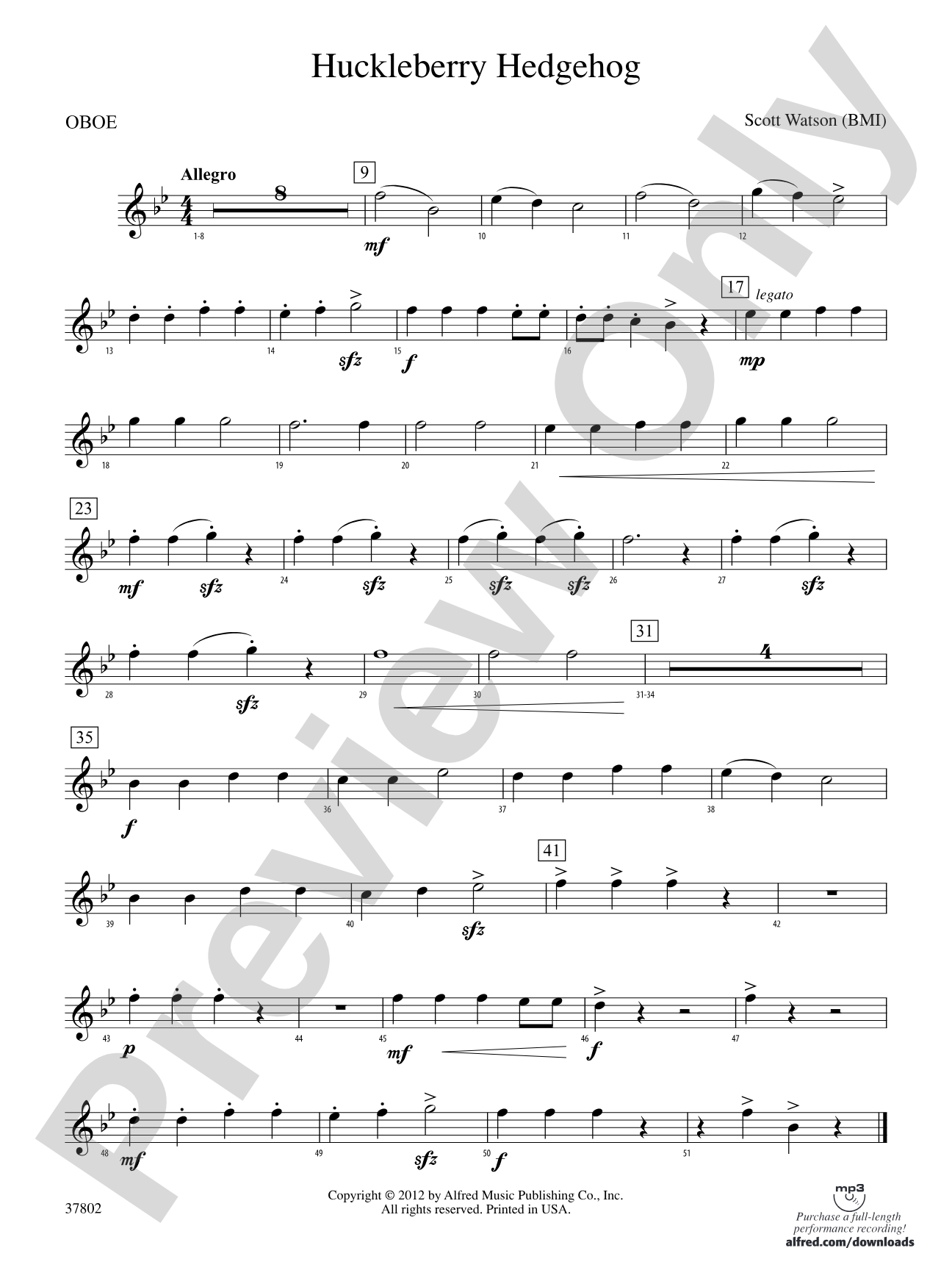

Huckleberry Hedgehog: Oboe
By Scott Watson
Grade: 1 (Very Easy)
Item: 00-PC-0015333_O1
$3.00
Pickup currently not available
Description
"Huckleberry Hedgehog" portrays the happy, but somewhat quirky, exploits of a spiny little mammal, offering beginning band students the chance to play fun, expressive music by combining a limited number of pitches typically presented in the first year of instruction with a variety of interesting articulation and dynamic markings. Everyone, including low brass and low woodwinds (always well-doubled), gets the opportunity to play important thematic material in special moments throughout the piece.


Don't just read it, hear it, play along with it, and watch your students grow with it. In MakeMusic Cloud, Huckleberry Hedgehog: Oboe comes alive with professional accompaniment, adjustable tempo, and built-in practice tools that turn solo practice into real progress.
Open in the Player
Jump straight in and assign it today.
Start Your Free Trial
Open this title and explore the full library in minutes.
Sample Audio
1
Audio File
--:--
0:00
0:00
Sample Video
No sample videos found.
Additional Details
Series:
Alfred Debut Series
Publisher:
Alfred Music
Page Count:
118
SKU:
00-PC-0015333_O1
More about this title
About the Composer: Scott Watson

Scott Watson has shaped instrumental music education across Pennsylvania for decades, first as Director of Bands at Parkland School District's high school, then building out the district's elementary band and strings program. His work as a composer draws equally from his deep engagement with contemporary concert music and his sustained connection to the band classroom, resulting in more than 120 published works that speak directly to student musicians at every level.
Now Associate Professor of Music at Cairn University, Watson remains an exclusive composer and clinician for Alfred Publications. His music has traveled from school concert halls to the Academy of Music in Philadelphia, the Midwest Clinic in Chicago, and performances at the White House. He is also the author of Using Technology to Unlock Musical Creativity (Oxford University Press, 2011) and continues to lead clinics and residencies for music educators nationwide.
Why we love this
Watson understands what beginning band students need to experience: moments of genuine musical importance. Rather than relegating low brass and low woodwinds to filler lines, he gives them thematic material that makes every section feel essential to the ensemble's sound. The piece balances limited pitch vocabulary (essential for first-year students) with articulation and dynamics that demand musicality, so students engage their ears and imagination from day one.
What to expect
Playful and unexpectedly sophisticated. The spiny protagonist's happy chaos unfolds through bouncing rhythms and unexpected accents that keep both players and listeners engaged. There's genuine personality here; students sense they're bringing a character to life rather than reading through a generic overture.
Who it's for
First-year band students working with pitch vocabulary from the first year of instruction. Directors seeking novelty literature that avoids condescension while respecting beginning players' technical boundaries. Ensembles that want students to feel like they're playing real music, not just exercises.
How to get the most out of it
- Shape the articulation markings as character choices rather than mechanical techniques. The staccatos and accents aren't just note attacks; they're part of Huckleberry's quirky personality.
- Give special attention to the dynamic contrasts. Beginning bands often play too uniformly; these markings reward students who listen and adjust.
- Balance the low voices throughout. When low brass or low woodwinds carry thematic material, bring them forward slightly in rehearsal so the section gains confidence in their musical responsibility.
How to use it
Open a concert with this piece when you want to set a warm, approachable tone and immediately signal to the audience that beginning musicians play with musicality and intent. It also works as a stand-alone work during a spring concert, or pair it with other Grade 1 selections to create a full program that showcases your youngest ensemble's capabilities.
Skills your students will build
- Reading and executing varied articulation markings (staccato, accent, legato) at beginning pitch levels
- Responding to dynamic changes and shaping phrases with appropriate weight
- Understanding thematic material and recognizing when their voice carries the melody
- Listening to ensemble balance, particularly when multiple sections play simultaneously
- Connecting simple pitch vocabulary to expressive, character-driven performance