
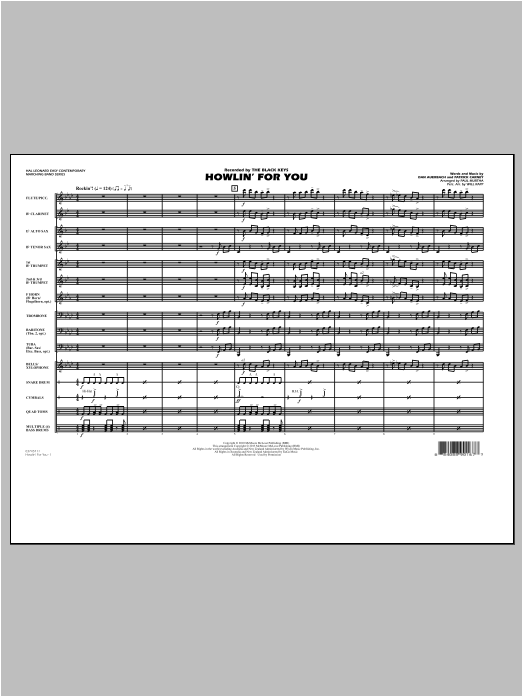

Howlin' For You: Marching Band Conductor Score & Parts
As performed by The Black Keys / Arranged by Paul Murtha
Grade: 2-3
Item: 35-PK00259432
$50.00
Pickup currently not available
Buy Extra Parts (Digital PDF Download)
| Product | Price | Quantity |
|---|---|---|
| Howlin' For You - Conductor Score (Full Score) | $6.00 | |
| Howlin' For You - Flute/Piccolo | $6.00 | |
| Howlin' For You - Bb Clarinet | $6.00 | |
| Howlin' For You - Eb Alto Sax | $6.00 | |
| Howlin' For You - Bb Tenor Sax | $6.00 | |
| Howlin' For You - Eb Baritone Sax | $6.00 | |
| Howlin' For You - 1st Bb Trumpet | $6.00 | |
| Howlin' For You - 2nd Bb Trumpet | $6.00 | |
| Howlin' For You - 3rd Bb Trumpet | $6.00 | |
| Howlin' For You - F Horn | $6.00 | |
| Howlin' For You - Bb Horn/Flugelhorn | $6.00 | |
| Howlin' For You - Trombone | $6.00 | |
| Howlin' For You - Baritone B.C. (Opt. Tbn. 2) | $6.00 | |
| Howlin' For You - Baritone T.C. | $6.00 | |
| Howlin' For You - Tuba | $6.00 | |
| Howlin' For You - Electric Bass | $6.00 | |
| Howlin' For You - Bells/Xylophone | $6.00 | |
| Howlin' For You - Snare Drum | $6.00 | |
| Howlin' For You - Cymbals | $6.00 | |
| Howlin' For You - Quad Toms | $6.00 | |
| Howlin' For You - Multiple Bass Drums | $6.00 |
Parts Added to Cart!
Description
Recorded by The Black Keys, this tune is already established as a sports anthem, in addition to being heard in films and TV. This distinctive arrangement is sure to become a favorite for rockin' the stands.


Howlin' For You: Marching Band Conductor Score & Parts isn't in MakeMusic Cloud just yet...but it could be. Let us know you'd like to see it, and you'll help shape what comes next. In the meantime, start a free trial and dive into thousands of interactive titles your students can play along with today.
Request This Title
Tell us you want it.
Start Your Free Trial
Explore everything that's ready to play right now.
Sample Audio
No sample audio found.
Sample Video
No sample videos found.
Additional Details
Publisher:
Hal Leonard
SKU:
35-PK00259432
More about this title
About the Artist: The Black Keys
The Black Keys emerged from Akron, Ohio as a blues rock duo defined by raw energy and stripped-down instrumentation. Dan Auerbach and Patrick Carney built their reputation on guitar-driven grooves that bridge classic blues with modern rock sensibilities, earning multiple Grammy Awards and a devoted international following.
Their music translates exceptionally well to ensemble settings because of its rhythmic directness and infectious groove foundation. For marching ensembles, their catalog offers arrangements that challenge students to lock in as a unit while delivering the kind of contemporary material that energizes both performers and audiences.
Why we love this
Paul Murtha has captured the swagger and propulsive drive of the original in a Grade 2-3 package that actually respects the source material. Arranging for marching band rarely means dumbing down a song; here it means translating a stadium-ready rock groove into something students can own and play with conviction. The sports anthem pedigree gives you instant crowd engagement, which matters when you're trying to build program momentum.
What to expect
Propulsive and confident, with the kind of groove that gets people on their feet. The arrangement maintains the song's bluesy edge while delivering the march precision audiences expect, creating a piece that feels current without losing its musical identity.
Who it's for
Marching bands looking for contemporary material with genuine recognition value. This works for programs at all competitive levels and is equally valuable for community and recreational ensembles seeking repertoire that connects with modern audiences.
How to get the most out of it
- Establish the groove pocket early in sectional rehearsals by isolating the rhythm section. Lock the kick drum and snare into the original recording's feel before the full ensemble joins; this prevents the piece from drifting into a march instead of sitting in its rock foundation.
- Blend the front ensemble into the brass section carefully. The arrangement likely layers articulation across different voices, so balance dynamics from day one rather than trying to fix it after the piece sounds muddy.
- Lean into the attitude without letting precision slip. A rock arrangement lives or dies on tight rhythmic execution and clean releases; sloppiness reads as careless rather than edgy.
- Use dynamics strategically to build energy across the form. This tune has natural peaks and valleys; map them early and guard against the tempo creeping or dragging during transitions.
How to use it
Lead with this during your concert season when you need to recapture audience energy or bookend a show with something high-octane. It pairs well alongside traditional marching fare as a statement of repertoire range, and works especially effectively as a stadium or exhibition piece where crowd recognition becomes part of the performance.
Skills your students will build
- Maintaining groove and subdivision in a non-march idiom
- Executing clean articulation at moderate to fast tempos
- Blending rock sensibilities with marching ensemble discipline
- Responding to dynamic contrast across extended phrases
- Locking rhythm section independence while supporting ensemble cohesion