Howdi Do Sheet Music Preview

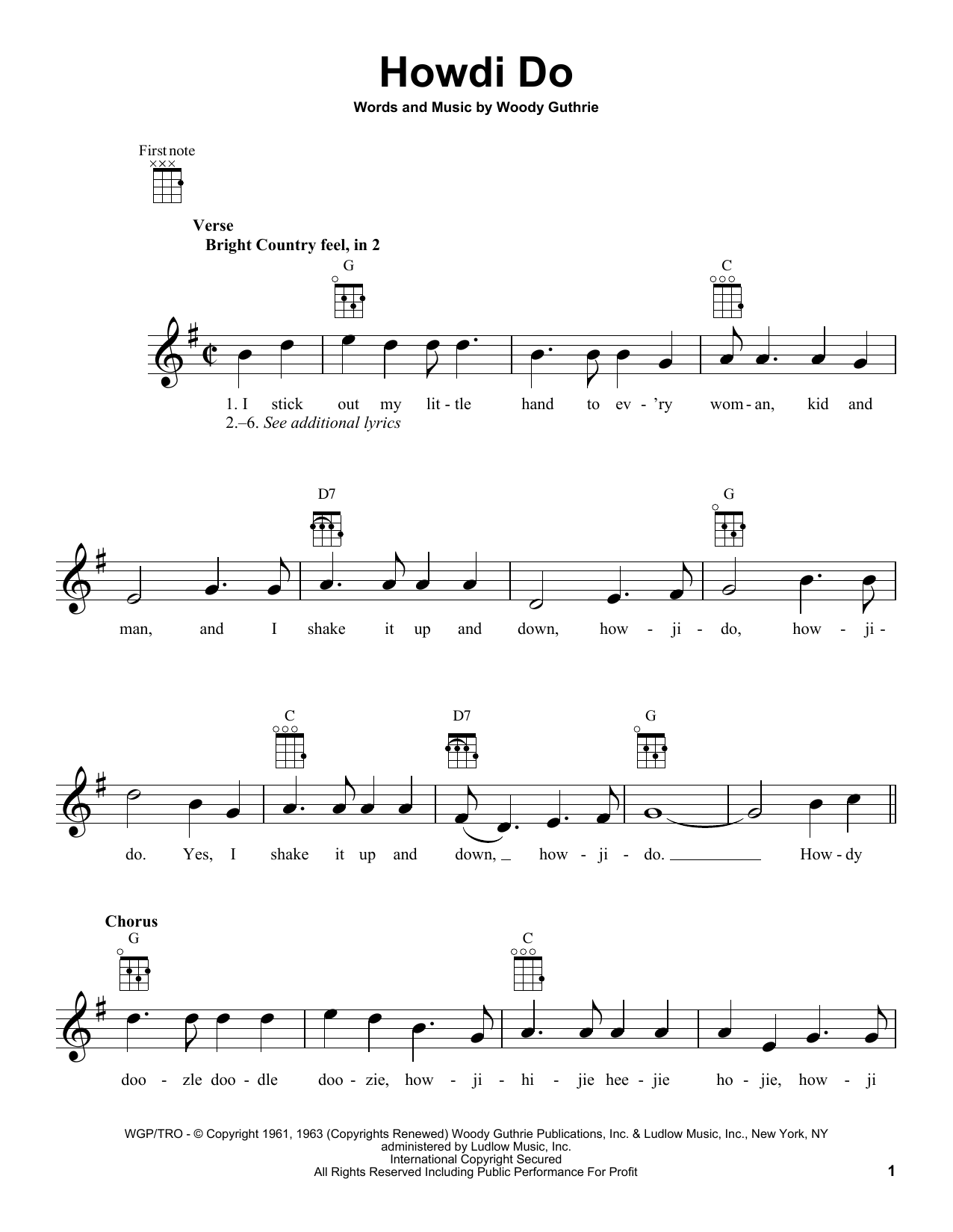
Howdi Do: Ukulele

As performed by Woody Guthrie

Item: 35-DS00293892

Digital Download
$3.99
Description

Howdi Do: Ukulele isn't in MakeMusic Cloud just yet...but it could be. Let us know you'd like to see it, and you'll help shape what comes next. In the meantime, start a free trial and dive into thousands of interactive titles your students can play along with today.

Sample Audio
No sample audio found.
Sample Video
Additional Details
Publisher: Hal Leonard
Page Count: 2
SKU: 35-DS00293892

More about this title

About the Artist: Woody Guthrie

Woody Guthrie (1912-1967) was an American folk singer, songwriter, and activist whose prolific catalog shaped American roots music for generations. His commitment to capturing the voices and stories of ordinary people, particularly during the Great Depression and Dust Bowl era, established him as a foundational figure in American folk tradition. Beyond his songwriting, Guthrie was deeply invested in music education and accessibility, believing that folk music belonged to everyone and should be played, shared, and adapted freely.

Guthrie's approach to instrumentation was practical and democratic. The ukulele, with its affordability and portability, embodied his philosophy that music-making shouldn't be limited by expense or technical barriers. His arrangements for ukulele demonstrate how folk songs thrive when stripped to their essentials, inviting players of all levels to engage with material that carries both cultural weight and human warmth.

Why we love this

This arrangement captures Guthrie's gift for writing melodies that feel both simple and memorable. The ukulele is the ideal vehicle for this folk material because it preserves the directness that makes Guthrie's work so teachable and so singable. Students get to claim a piece of American music history while developing technique on an instrument that rewards clear intention over virtuosity.

What to expect

Warm, unpretentious, and human. The melody settles comfortably under the fingers and carries the kind of straightforward joy that folk music at its best conveys. There's a conversational quality to the tune that invites players to interpret and shape it according to their own instincts.

Who it's for

Ukulele players at the beginner to early intermediate level will find this accessible and musically satisfying. Teachers introducing students to folk song traditions and American music history can use this as an entry point into Guthrie's work and the broader folk repertoire.

How to get the most out of it

  • Keep the rhythmic feel relaxed and conversational rather than metrically rigid; Guthrie's folk idiom thrives on a natural, speaking-song quality.
  • Let the melody breathe by maintaining steady but unhurried tempo; resist the urge to rush through phrases.
  • Pay attention to the lyrical content as you play, even instrumentally. The emotional subtext of the text should inform your phrasing and dynamics.

How to use it

Include this in a concert or informal performance celebrating American songwriters and folk traditions. It pairs well with other acoustic, singer-songwriter oriented material and works equally well as a solo piece or layered with other instruments. The compact length and accessibility also make it ideal for student recitals or classroom demonstrations of how folk melodies travel across instruments.

Skills your students will build

  • Playing conversational, speech-like phrasing on a melodic instrument
  • Understanding folk song structure and how melodies are built to be memorable and singable
  • Interpreting rhythmic notation in the context of folk idioms rather than classical precision
  • Making deliberate choices about dynamics and tempo to serve the emotional content of a melody

You May Also Like