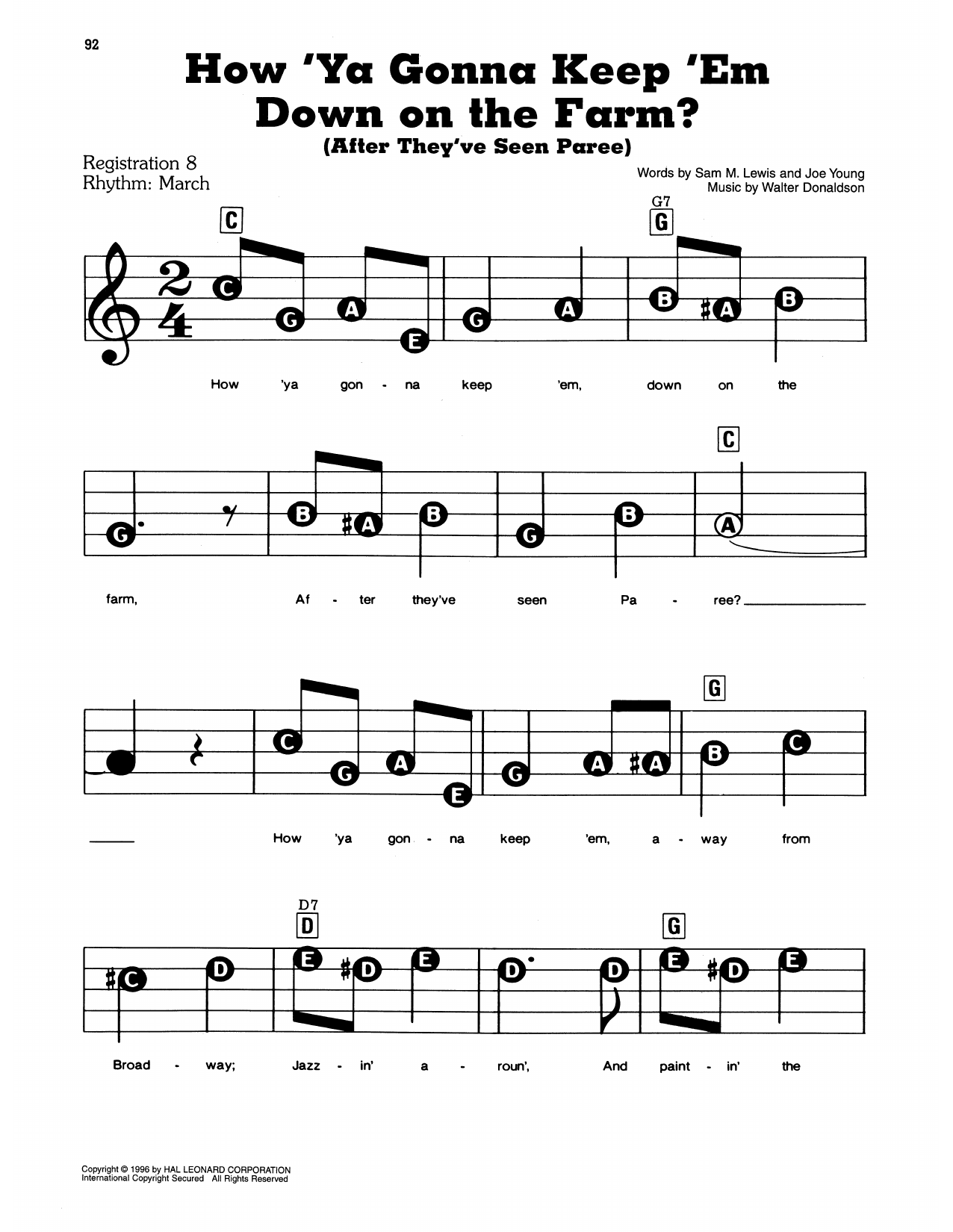
How 'Ya Gonna Keep 'em Down On The Farm? (After They've Seen Paree) Sheet Music Preview

How 'Ya Gonna Keep 'em Down On The Farm? (After They've Seen Paree): E-Z Play Today

As performed by Nora Bayes

Item: 35-DS01414921

Digital Download
$4.99
Description

How 'Ya Gonna Keep 'em Down On The Farm? (After They've Seen Paree): E-Z Play Today isn't in MakeMusic Cloud just yet...but it could be. Let us know you'd like to see it, and you'll help shape what comes next. In the meantime, start a free trial and dive into thousands of interactive titles your students can play along with today.

Sample Audio
No sample audio found.
Sample Video
Additional Details
Publisher: Hal Leonard
Page Count: 3
SKU: 35-DS01414921

More about this title

About the Artist: Nora Bayes

Nora Bayes (1880-1928) was a vaudeville star and recording artist whose powerful contralto voice and commanding stage presence made her one of the most celebrated entertainers of the early 20th century. She introduced numerous songs that became standards, and her recordings were among the best sellers of the 1910s and 1920s, bridging the worlds of theater, popular song, and early commercial music.

Why we love this

This E-Z Play arrangement captures the charm of a song that defined a generation's nostalgia and humor, bringing early 20th-century popular idiom into reach for pianists who want accessible repertoire with genuine cultural weight. The straightforward voicing makes it ideal for students encountering this era's musical language without the technical barriers of a concert grand arrangement.

What to expect

Nostalgic and wry, with the gentle humor of a soldier's lament wrapped in a bright, forward-moving melody. The harmonic language carries warmth and a touch of sophistication beneath its singable surface.

Who it's for

Piano students and teachers seeking accessible early American popular song, particularly those studying the transition from vaudeville to recorded music or exploring how piano arrangements preserve period style. It works equally well for performers building a recital program that spans popular and classical traditions.

How to get the most out of it

  • Balance the melody clearly against the accompaniment so the lyrics (if sung) land with character rather than getting buried in the texture.
  • Pay attention to the harmonic language characteristic of the 1910s: seventh chords and unexpected chromatic movement deserve slight emphasis to let listeners hear the song's sophistication.
  • Shape the phrasing in short, song-like phrases rather than long, Romantic curves; the vernacular style rewards clarity and directness.

How to use it

Pair this with other early 20th-century popular songs or use it to open a conversation about how sheet music democratized music in American homes. It also works as a delightful palate cleanser in a recital mixing periods and styles.

Skills your students will build

  • Reading and interpreting early popular song style and idiom
  • Balancing melody and accompaniment in lead-sheet arrangements
  • Understanding harmonic language of the 1910s-1920s (seventh chords, chromatic voice leading)

You May Also Like