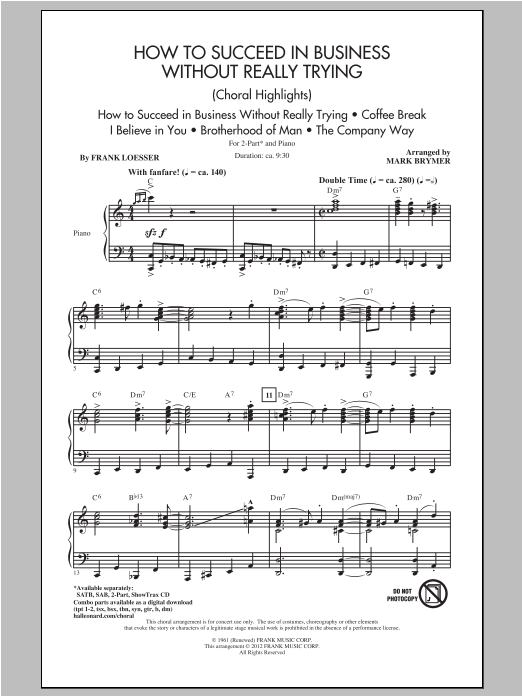
How to Succeed In Business Without Really Trying (Medley) Sheet Music Preview

How to Succeed In Business Without Really Trying (Medley): 2-Part Choral Octavo

By Frank Loesser / Arranged by Mark Brymer

Item: 35-DS00249167

Digital Download
$3.25
Description

How to Succeed In Business Without Really Trying (Medley): 2-Part Choral Octavo isn't in MakeMusic Cloud just yet...but it could be. Let us know you'd like to see it, and you'll help shape what comes next. In the meantime, start a free trial and dive into thousands of interactive titles your students can play along with today.

Sample Audio
No sample audio found.
Sample Video
Additional Details
Publisher: Hal Leonard
Page Count: 5
SKU: 35-DS00249167

More about this title

About the Composer: Frank Loesser

Frank Loesser (1910-1969) shaped the American musical theater landscape with his gift for memorable melodies paired to witty, character-driven lyrics. A versatile composer who moved fluidly between Broadway and Hollywood, Loesser earned four Academy Award nominations and created some of the twentieth century's most enduring songs, from the wartime standard "Praise the Lord and Pass the Ammunition" to the holiday perennial "Baby, It's Cold Outside."

In the classroom and rehearsal room, Loesser's work remains invaluable. His tunefulness makes pieces accessible to singers of all levels, while his theatrical sensibility engages students with material that feels alive and purposeful. How to Succeed in Business Without Really Trying, his 1961 Pulitzer Prize-winning musical, exemplifies his talent for creating singable, character-rich music that builds ensemble skills while delivering genuine entertainment.

Why we love this

Loesser's best melodies are irresistible, and this medley captures the infectious spirit of the show without demanding a large vocal ensemble or complex orchestration. Mark Brymer's arrangement opens the score to developing singers while preserving the satirical energy and charm that made the original such a theatrical success. For programs seeking material that's approachable yet musically substantial, this hits the sweet spot.

What to expect

Effervescent and slyly comedic, the music radiates the confidence and swagger of the show's satirical take on American business culture. Loesser's melodies sparkle with wit; they're designed to make singers smile even in rehearsal. There's a lightness and forward momentum here that carries singers through the piece and leaves audiences wanting more.

Who it's for

This medley works well for two-part choirs at the middle school level and up. The limited range and straightforward harmonic language make it accessible to developing singers, while the sophisticated subject matter and theatrical flair appeal to singers looking for material with personality and comedic potential.

How to get the most out of it

  • Anchor the text. Loesser wrote comedy into his lyrics; clarity and conversational phrasing will land the humor and make the piece more engaging for your audience.
  • Shape phrases toward the natural stresses of the language rather than forcing even phrasing. This keeps the melody sounding like speech set to music, which is Loesser's signature approach.
  • Balance the two-part texture so that neither line disappears. In choral octavos, the second part often gets underbalanced; listen actively during rehearsal to ensure both voice groups carry equal weight.

How to use it

This medley fits naturally into a show tune or Broadway-themed concert, where it can anchor a set of contemporary musical theater selections. It also works as a standalone number in a broader choral concert, offering a change of pace from classical repertoire and giving audiences a reminder that choir music can be genuinely fun. Consider programming it in the second half when audiences are most receptive to theatrical material.

Skills your students will build

  • Clear diction and rhythmic precision in syncopated passages
  • Maintaining musical line and phrasing in two-part texture
  • Stylistic singing appropriate to musical theater idiom
  • Balancing comedy and musicality in performance

You May Also Like