
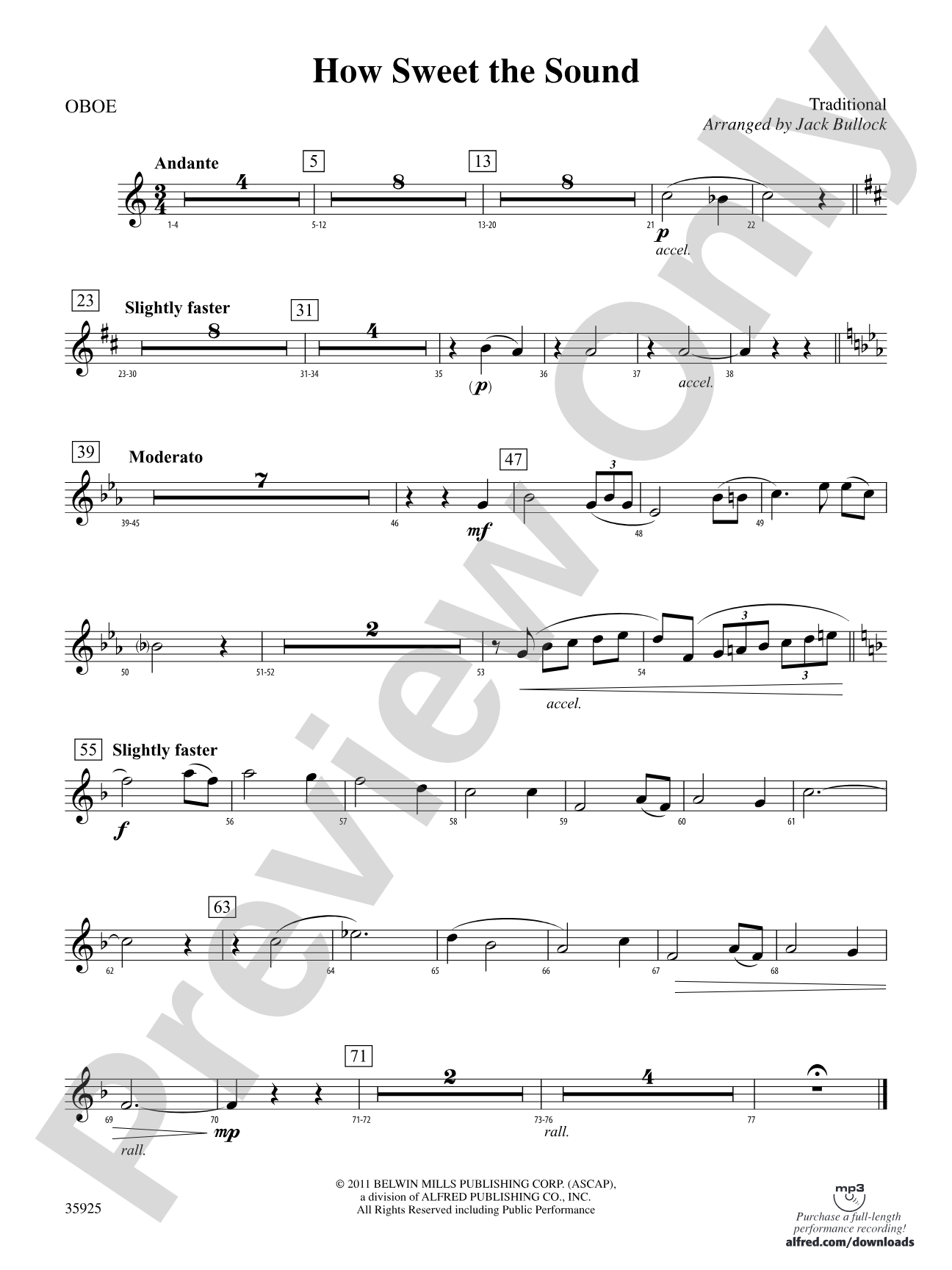

How Sweet the Sound: Oboe
Traditional / arr. Jack Bullock
Grade: 3
Item: 00-PC-0015009_O1
$3.00
Pickup currently not available
Description
One of the most beloved melodies ever written! It has a special meaning to every listener and has endured throughout the years. It is a simple melody and has great elegance. Even though this title may not be one you will recognize, the melody will be one you will know instantly.


Don't just read it, hear it, play along with it, and watch your students grow with it. In MakeMusic Cloud, How Sweet the Sound: Oboe comes alive with professional accompaniment, adjustable tempo, and built-in practice tools that turn solo practice into real progress.
Open in the Player
Jump straight in and assign it today.
Start Your Free Trial
Open this title and explore the full library in minutes.
Sample Audio
1
Audio File
--:--
0:00
0:00
Sample Video
No sample videos found.
Additional Details
Series:
Belwin Intermediate Full Orchestra
Publisher:
Alfred Music
Page Count:
122
SKU:
00-PC-0015009_O1
Instrumentation:
full (chimes, bells, timp, sus cymbal, pno (opt), vln3)
More about this title
About the Arranger: Jack Bullock

Jack Bullock brings decades of practical experience across performance, composition, and education to his arranging work. A trumpet performer who played with the Miami Philharmonic Orchestra and Miami Opera Company, he studied with prominent teachers including Harry Glantz and James Ode, and performed regionally and nationally with show bands and dance orchestras. His formal training includes undergraduate, graduate, and doctoral degrees in music education.
As a prolific arranger and composer, Bullock has created over 600 publications for concert band, orchestra, jazz ensemble, and marching band. He taught instrumental music in K-12 classrooms for 20 years and served as an assistant band director at Ithaca College's School of Music, where he also chaired the Music Education Department. His work includes co-authoring the Belwin 21st Century Band Method and contributing to Music Expressions, Alfred Music's school curriculum. Since 1980, he has held ASCAP membership and has conducted clinics and workshops across North America and England.
Why we love this
This arrangement takes one of music's most universally recognized melodies and presents it with both simplicity and grandeur, making it equally effective for concert programming or festival performance. Bullock's orchestration respects the hymn's inherent dignity while providing Grade 3 orchestras the chance to balance ensemble cohesion with the individual voice writing that keeps each section engaged. The scoring is neither overblown nor sparse; it allows young musicians to experience how a beloved melody can sound rich and complete without requiring advanced technique.
What to expect
Profound yet accessible. The melody unfolds with the quiet authority of something that has moved generations of listeners, yet the Grade 3 orchestration remains transparent and approachable. There is dignity in simplicity here—no flourish or unnecessary complication, just an instrument of music speaking clearly.
Who it's for
Grade 3 full orchestras ready to tackle a meaningful, concert-quality arrangement with clear pedagogical rewards. This score works well for conductors seeking a piece that builds musicianship through a universally respected melody, giving young orchestral musicians a genuine sense of purpose and accomplishment.
How to get the most out of it
- Shape the melody with careful attention to phrase length and breath points, even in an instrumental setting; the hymn's singing quality should come through in how the orchestra voices the line.
- Balance the full ensemble so that the primary melody rises clearly over accompaniment and harmonic support, particularly in passages where multiple instrumental families play simultaneously.
- Approach tempo as a steady, reverent pulse rather than a dirge; this melody deserves clarity and presence, not drag.
- Use the optional piano part to reinforce harmonic foundation during rehearsal if needed, but consider the full orchestral sonority without it in performance to let the individual instruments shine.
How to use it
This arrangement fits naturally into a concert program where you want an emotional anchor, whether programmed as a centerpiece, an opener that sets a reflective tone, or a closer that sends the audience out moved. It pairs well alongside other Grade 3 orchestral works and works especially effectively in settings where sacred music programming is valued. For festival play, the piece demonstrates musicality and control over technical complexity, qualities that adjudicators reward.
Skills your students will build
- Ensemble balance and blend across multiple instrumental sections
- Sustaining a singing tone quality on instruments designed for it
- Phrase shaping and phrasing across a longer formal structure
- Part independence while maintaining collective cohesion
- Dynamic control and expression within a reverent, contemplative musical context