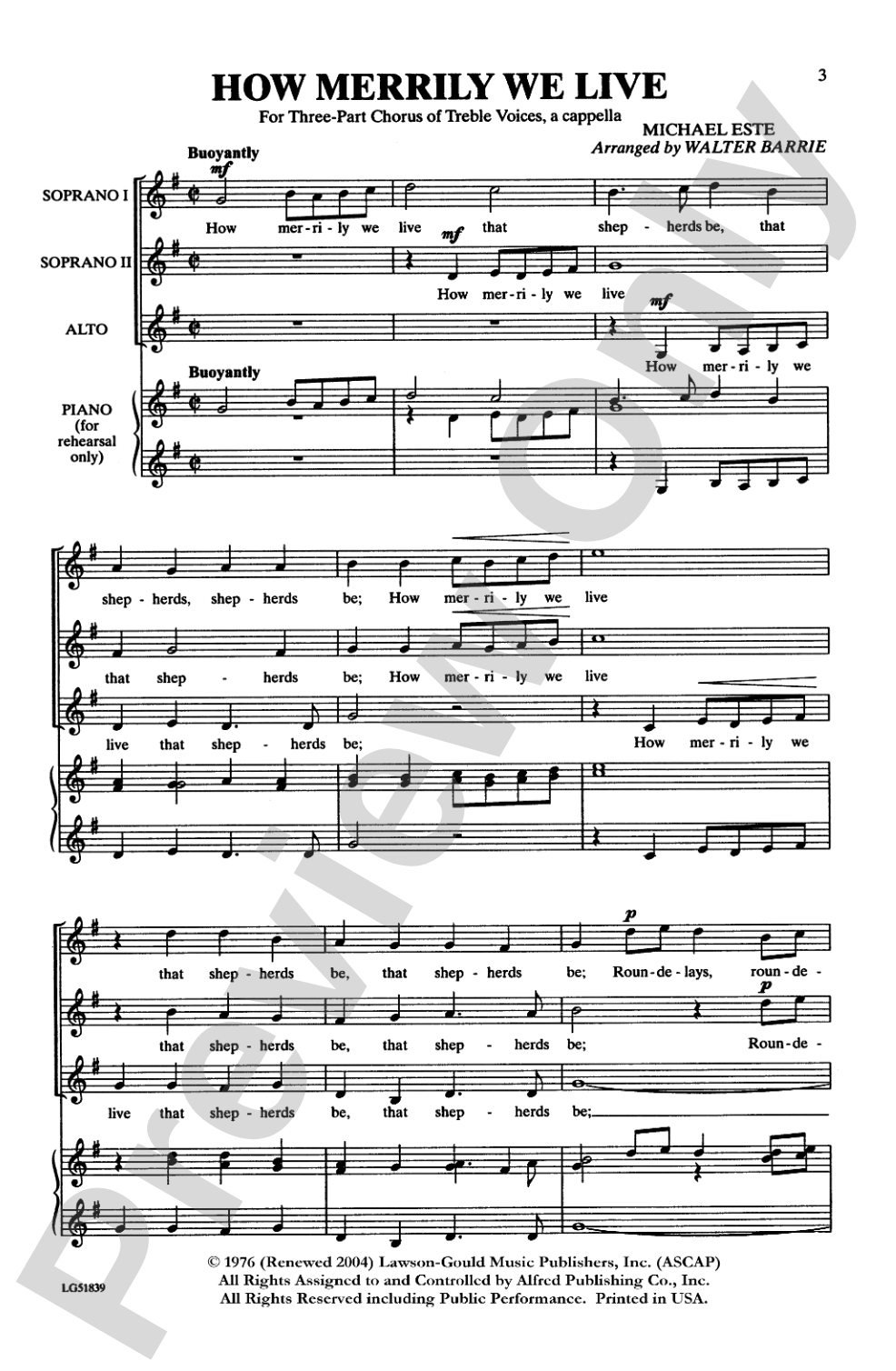
How Merrily We Live Sheet Music Preview

How Merrily We Live: SSA Choral Octavo

By Michael Este / arr. Walter Barrie

Item: 00-PO-0003022

Digital Download
$2.25

Minimum order quantity: 20 copies

Description

How Merrily We Live: SSA Choral Octavo isn't in MakeMusic Cloud just yet...but it could be. Let us know you'd like to see it, and you'll help shape what comes next. In the meantime, start a free trial and dive into thousands of interactive titles your students can play along with today.

Sample Audio
No sample audio found.
Sample Video
Additional Details
Series: Alfred Archive Edition: Lawson-Gould Music Publishers
Publisher: Alfred Music
Page Count: 8
SKU: 00-PO-0003022

More about this title

About the Composer: Michael Este

Michael Este was an English composer and lutenist of the Renaissance period, active during the late 16th and early 17th centuries. He contributed significantly to the secular vocal repertoire of his era, composing madrigals and part songs that balanced lyrical melody with clear harmonic structure, making his music accessible to amateur singers while maintaining musical sophistication.

Why we love this

Este's "How Merrily We Live" captures the lighthearted spirit of Renaissance secular song without demanding elaborate vocal gymnastics from your singers. Walter Barrie's SSA arrangement honors the original's character while opening it to treble choirs, making this a rewarding choice for programs that need genuine period repertoire with immediate musical payoff.

What to expect

Bright and conversational, with a melodic line that feels like a well-crafted song rather than a formal composition. The harmonic movement creates moments of gentle surprise without ever losing the piece's fundamental warmth and straightforward charm.

Who it's for

SSA and SSAA choirs looking for authentic Renaissance secular music in an accessible arrangement. This works equally well for high school ensembles, community choirs, and college groups seeking to expand beyond the standard choral repertoire.

How to get the most out of it

  • Shape phrases by listening for the natural arc of the text; the melody should breathe with the words rather than follow rigid bar lines
  • Balance the three voices so no single line dominates; Este wrote these parts as equals, and clarity comes from ensemble blend, not soloists
  • Approach the harmonic language with lightness; these chords work best when singers stay buoyant rather than weighted

How to use it

Pair this with other Renaissance madrigals or lighter secular works to create a period-specific concert segment, or use it as a palate-cleanser between more complex contemporary pieces. Its modest length and cheerful character make it ideal for spring concerts or informal performance settings.

Skills your students will build

  • Blending three equal vocal lines with attention to harmonic balance
  • Singing Renaissance-era melodic phrasing and text declamation
  • Reading in C clefs and navigating moderate chromatic movement
  • Ensemble independence while maintaining unified musicality

You May Also Like