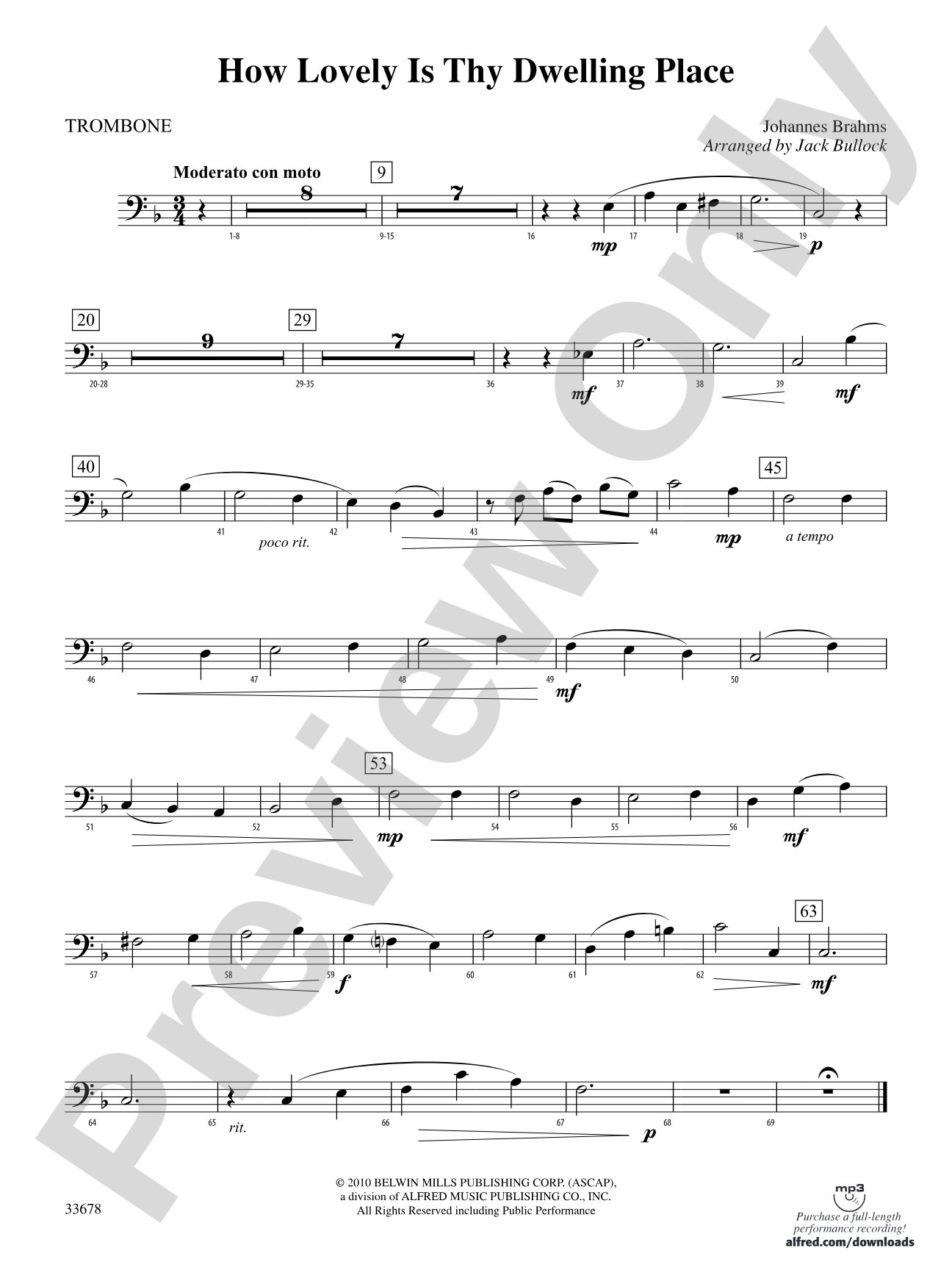
How Lovely Is Thy Dwelling Place: 1st Trombone Sheet Music Preview

How Lovely Is Thy Dwelling Place: 1st Trombone

By Johannes Brahms / arr. Jack Bullock

Grade: 3

Item: 00-PC-0014469_TN1

Digital Download
$3.00
Description
A musical treasure for young players. This enchanting work for chorus and orchestra is transcribed for full or string orchestra.

Don't just read it, hear it, play along with it, and watch your students grow with it. In MakeMusic Cloud, How Lovely Is Thy Dwelling Place: 1st Trombone comes alive with professional accompaniment, adjustable tempo, and built-in practice tools that turn solo practice into real progress.

Sample Audio
0:00
0:00
Sample Video
Additional Details
Series: Belwin Intermediate String/Full Orchestra
Publisher: Alfred Music
Page Count: 112
SKU: 00-PC-0014469_TN1

More about this title

About the Composer: Johannes Brahms

Johannes Brahms (1833–1897) stands among the most significant composers of the Romantic era, bridging Classical form with Romantic expression. His mastery of orchestration, harmonic language, and structural architecture made him a towering figure in concert halls across Europe, and his works remain central to the orchestral and choral repertoire today.

Why we love this

This arrangement brings one of Brahms's most profound choral works within reach of young orchestras, preserving the original's spiritual weight while offering manageable ranges and part writing. Grade 3 orchestras gain access to genuine masterwork repertoire that sounds substantial and rewarding without requiring advanced technical facility. The pairing of chorus and orchestra creates a ceremonial quality that elevates any concert program.

What to expect

Serene and contemplative, with an underlying architectural clarity that reflects Brahms's Classical training. The work unfolds with quiet confidence, allowing moments of gentle warmth to emerge from carefully balanced harmonic progressions.

Who it's for

Conductors of young orchestras and choirs seeking repertoire that feels substantial and musically coherent at an accessible level. Musicians benefit from experience with Brahms's orchestral textures and choral writing without confronting the technical demands of his original scoring.

How to get the most out of it

  • Balance the chorus against the orchestra carefully; the accompaniment should support rather than overshadow the sung text, especially in the opening phrases where harmonic clarity matters most.
  • Shape the phrasing in long lines rather than stopping at barlines; Brahms's vocal writing benefits from singers who understand the architectural span of each section.
  • Establish a confident but unhurried tempo that allows the harmonic progressions to settle and resonate; this is not a piece that rushes.
  • Attend to dynamic contrasts between sections; the score's expressive range relies on the conductor's shaping and the orchestra's responsiveness to subtle shifts in sonority.

How to use it

This work suits spring or fall concerts centered on choral and orchestral repertoire, particularly those honoring sacred or ceremonial occasions. Its liturgical character makes it appropriate for All Saints Day or Ascension programming, and its meditative quality provides a meaningful contrast to more dramatic or virtuosic works.

Skills your students will build

  • Balancing choral and orchestral timbres
  • Phrasing extended melodic lines across multiple measures
  • Understanding harmonic progression and voice leading in Romantic-era composition
  • Reading and executing dynamic and expressive nuance from a full conductor score
  • Coordinating parts across a multi-section ensemble

You May Also Like