How Lovely Are Thy Dwellings Sheet Music Preview

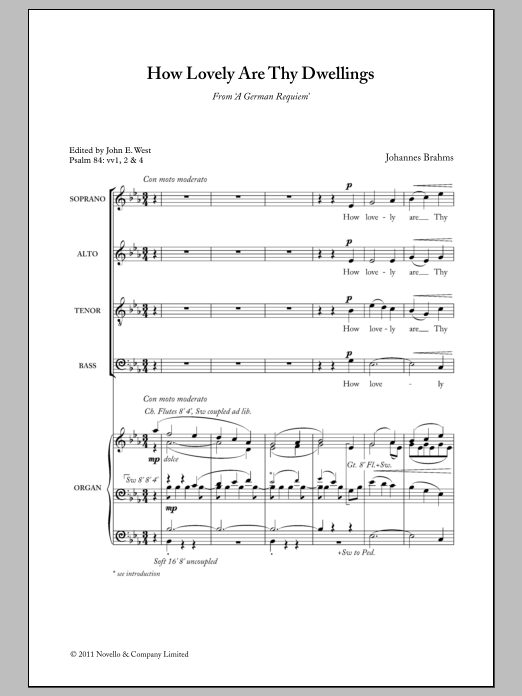
How Lovely Are Thy Dwellings: SATB Choral Octavo

As performed by Johannes Brahms / Edited by John E. West

Item: 35-DS00200214

Digital Download
$2.99
Description

How Lovely Are Thy Dwellings: SATB Choral Octavo isn't in MakeMusic Cloud just yet...but it could be. Let us know you'd like to see it, and you'll help shape what comes next. In the meantime, start a free trial and dive into thousands of interactive titles your students can play along with today.

Sample Audio
No sample audio found.
Sample Video
Additional Details
Publisher: Hal Leonard
Page Count: 16
SKU: 35-DS00200214

More about this title

About the Artist: Johannes Brahms

Johannes Brahms (1833-1897) was a German composer whose choral works shaped the sound of the nineteenth-century choir. Though famous for his symphonies and concertos, Brahms devoted significant energy to vocal music, particularly the German Requiem and numerous secular partsongs that remain core repertoire for ambitious amateur and professional ensembles. His choral writing combines harmonic sophistication with accessibility, making his pieces both musically substantial and genuinely playable.

Brahms approached text setting with profound care, treating poetry as a structural partner rather than mere decoration. His secular chorales and part-songs reveal a composer equally at home with intimate part-writing and broad expressive gestures. For music educators, Brahms offers a pathway to teaching genuine musical architecture through human voices.

Why we love this

Brahms' harmonic language here unfolds with the kind of organic inevitability that makes singers feel like they're discovering musical truth rather than executing a score. The piece sits in a genuinely singable range for mixed voices while never sacrificing the contrapuntal and harmonic richness that distinguishes Brahms from lighter choral fare. Your singers will encounter real compositional craft without the text underlay becoming an afterthought.

What to expect

This music inhabits a reflective, almost reverent space. The harmonic language is warm and grounded, with moments of unexpected harmonic color that draw listeners in. Brahms' texture balances clarity of line with supportive part-writing, creating a sense of quiet inevitability that settles over a room.

Who it's for

Directors programming concert fare that demands real musicianship from singers without frontloading difficulty. Your ensemble needs solid score literacy and four-part confidence, making this ideal for community choirs, university choruses, and church programs with strong fundamentals.

How to get the most out of it

  • Establish the harmonic progression clearly in rehearsal by isolating individual voices and having them sing the roots and chord tones aloud. Brahms' voice-leading rewards this kind of structural awareness.
  • Shape phrases around natural language stress and breathing, resisting the urge to subdivide measures mechanically. The text rhythm should guide phrasing, not fight it.
  • Balance the soprano line against a cohesive alto-tenor-bass foundation. This piece works only when lower voices lock in tonally, giving the sopranos room to breathe.
  • Explore dynamic contrast conservatively. Brahms achieves great expressive effect through harmonic color, so let subtle shifts in intensity serve the harmony rather than imposing arbitrary volume changes.

How to use it

Position this on a concert where you want to demonstrate your choir's interpretive maturity without veering into avant-garde or contemporary idiom. It pairs beautifully after or before other German Romantic-era part-songs, or as a quieting moment in a mixed season program that includes lighter or more dramatic selections.

Skills your students will build

  • Reading and sustaining harmonic progressions across voices
  • Balancing independent line-singing with ensemble blend
  • Interpreting text expression within a sophisticated harmonic framework
  • Four-part writing literacy and voice-leading awareness
  • Maintaining pitch security in dissonant or chromatic moments

You May Also Like