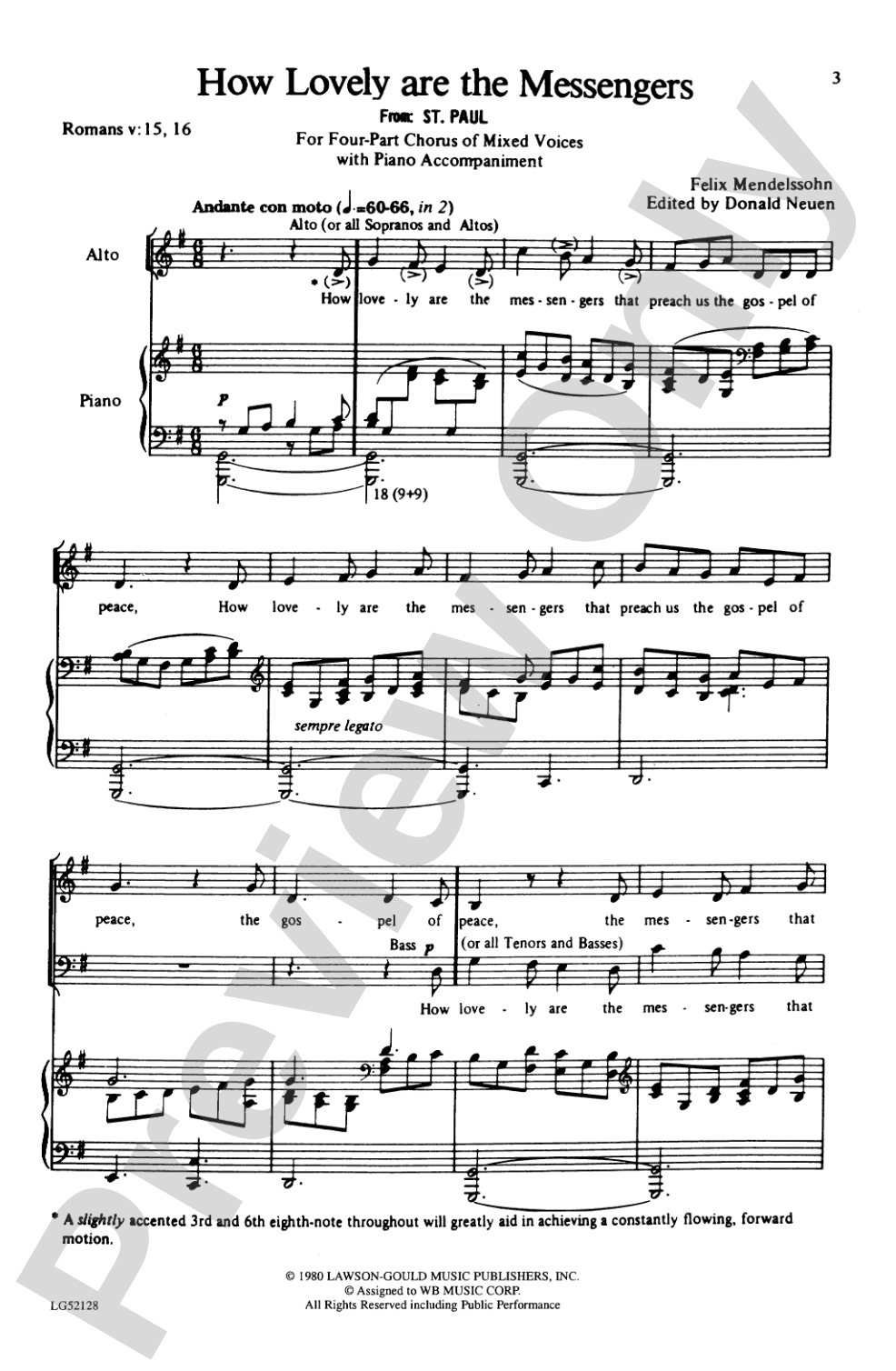
How Lovely Are the Messengers Sheet Music Preview

How Lovely Are the Messengers: SATB Choral Octavo

By Felix Mendelssohn / ed. Donald Neuen

Item: 00-PO-0002674

Digital Download
$2.25

Minimum order quantity: 20 copies

Description

How Lovely Are the Messengers: SATB Choral Octavo isn't in MakeMusic Cloud just yet...but it could be. Let us know you'd like to see it, and you'll help shape what comes next. In the meantime, start a free trial and dive into thousands of interactive titles your students can play along with today.

Sample Audio
No sample audio found.
Sample Video
Additional Details
Series: Alfred Archive Edition: Lawson-Gould Music Publishers
Publisher: Alfred Music
Page Count: 12
SKU: 00-PO-0002674

More about this title

About the Composer: Felix Mendelssohn

Felix Mendelssohn (1809-1847) shaped the choral landscape of the nineteenth century through works that blend Romantic expression with structural clarity. His sacred choral music draws deeply from Lutheran hymn traditions while embracing the harmonic richness and emotional depth that define the Romantic era.

Why we love this

Mendelssohn's setting radiates warmth without sacrificing musical substance. The piece moves with natural elegance across all four voice parts, making it accessible for intermediate ensembles while offering interpretive depth that advanced choirs will appreciate and explore.

What to expect

The music unfolds with quiet confidence, anchored by Mendelssohn's gift for blending homophonic clarity with moments of gentle contrapuntal movement. There's an intimate quality here, almost conversational, that invites listeners into a moment of reflection rather than spectacle.

Who it's for

This octavo works well for intermediate to advanced SATB choirs seeking sacred repertoire that combines accessibility with artistic substance. It suits community choirs, church choirs during liturgical seasons, and school ensembles ready for post-secondary repertoire standards.

How to get the most out of it

  • Balance the soprano line so its lyrical melody sits clearly above the harmonic foundation without forcing the other voices to recede entirely.
  • Shape phrases with gentle rubato in the slower sections; let the text and harmonic rhythm guide natural breathing and slight tempo flexibility.
  • Pay attention to Mendelssohn's voice leading in the inner parts. Alto and tenor lines often carry important melodic fragments that deserve audible definition.
  • Use dynamics thoughtfully to highlight harmonic progressions rather than adding arbitrary swells; the piece builds its own momentum through structure.

How to use it

Pair this with other Mendelssohn choral works for a thematic concert, or use it as a centerpiece within a broader sacred choral program. Its moderate length and character make it an excellent choice for services, sacred concert settings, or festival programming where substantive but undemanding music serves the overall program arc.

Skills your students will build

  • Balancing soprano melody with harmonic support across four voices
  • Interpreting Romantic-era phrasing and dynamic shaping in sacred music
  • Executing clear voice leading through transitional passages
  • Sustaining legato vocal tone across longer phrases
  • Reading and responding to subtle harmonic movement as an expressive tool

You May Also Like