
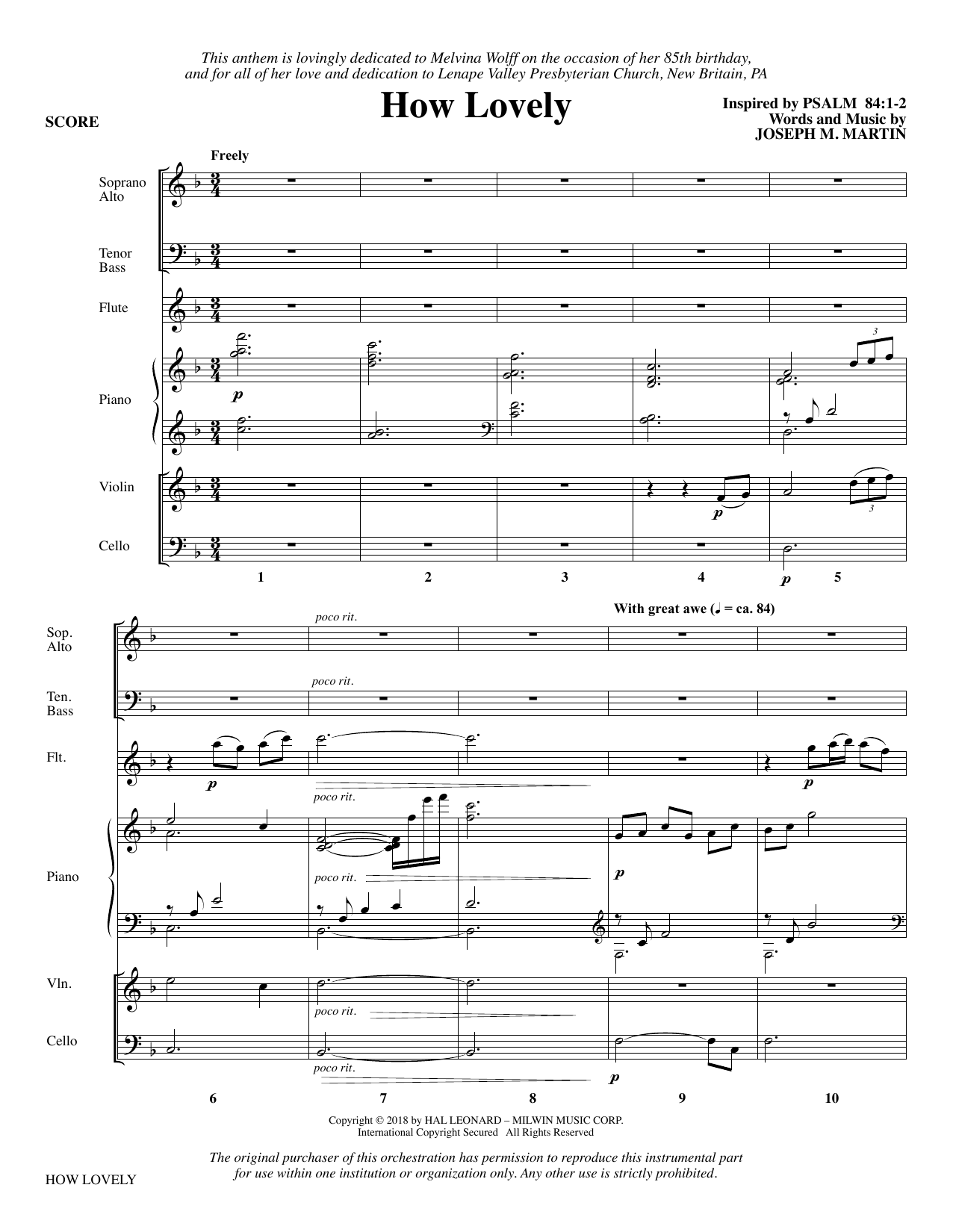

How Lovely: Choral Instrumental Pak
By Joseph M. Martin
Item: 35-PK00427526
$20.00
Pickup currently not available
Buy Extra Parts (Digital PDF Download)
| Product | Price | Quantity |
|---|---|---|
| How Lovely - Full Score: Choral Instrumental Pak | $7.00 | |
| How Lovely - Flute: Choral Instrumental Pak | $7.00 | |
| How Lovely - Violin: Choral Instrumental Pak | $7.00 | |
| How Lovely - Cello: Choral Instrumental Pak | $7.00 |
Parts Added to Cart!
Description
In this adaptation of a beloved scripture passage, a stunning melody arches with earnest expression. A portrait of God's beauty and majesty, the anthem flows with attractive, easily sung harmonies and melodic patterns. An excursion to minor offers variety as the text speaks to our "wandering spirit" and a prayer for renewal and healing. This anthem is a heartfelt and hopeful moment for any worship gathering.


How Lovely: Choral Instrumental Pak isn't in MakeMusic Cloud just yet...but it could be. Let us know you'd like to see it, and you'll help shape what comes next. In the meantime, start a free trial and dive into thousands of interactive titles your students can play along with today.
Request This Title
Tell us you want it.
Start Your Free Trial
Explore everything that's ready to play right now.
Sample Audio
No sample audio found.
Sample Video
No sample videos found.
Additional Details
Publisher:
Hal Leonard
SKU:
35-PK00427526
More about this title
About the Composer: Joseph M. Martin

Joseph M. Martin studied piano performance at Furman University and later earned his master's degree from the University of Texas at Austin, where he subsequently taught in the Piano Pedagogy Department for five years. A performing artist in his own right, he has given solo recitals across the United States and Mexico, appeared as a featured soloist with symphony orchestras, and won the Nina Plant Wideman Competition, which led to performances with the Guadalajara Symphony Orchestra. His concert work has taken him from Carnegie Hall to churches throughout North America, and his solo recital in Mexico was broadcast nationally.
Martin has shifted his compositional focus toward sacred music and worship settings in recent years, creating works that serve both concert halls and congregational gatherings. He continues to compose and arrange across a wide range of styles, drawing on his extensive background as both a pianist and educator. Based in Austin, Texas, he remains active in performances for churches and musician conferences.
Why we love this
Martin's gift for writing singable, expressive lines shines here without sacrificing musical depth. The minor key excursion creates genuine textural interest while the overall harmonic language remains accessible for volunteer choirs, and the Choral Instrumental Pak format gives you flexibility in instrumentation depending on your rehearsal space and ensemble size.
What to expect
A moment of quiet contemplation that builds to genuine expression of faith. The harmonic language is warm and inviting, and the minor key section introduces vulnerability as the text acknowledges spiritual struggle before resolving toward hope and restoration.
Who it's for
Worship directors and choir leaders seeking a service anthem that feels both devotional and well-crafted. This works for volunteer church choirs, semi-professional ensembles, and musicians who want a piece that speaks meaningfully without overwhelming preparation demands.
How to get the most out of it
- Shape the opening phrases to emphasize the natural arch of the melody; resist the urge to rush the longer note values, which carry the emotional weight of the text.
- Balance the move to minor carefully so it feels like a natural reflection rather than a jarring shift. Prepare singers for the tonal change in sectionals.
- Let the accompaniment breathe with the vocal lines rather than driving underneath them. The instrumental parts support and frame the sung message.
- Feature your strongest singers on exposed moments, especially if ensemble confidence wavers in the minor section.
How to use it
This fits naturally into a worship service as a reflective anthem during the main musical moment, or it can anchor a concert program around themes of healing and renewal. Position it where the congregation has settled into listening mode, allowing the earnest quality of the melody to resonate fully.
Skills your students will build
- Shaping phrase arcs across longer melodic lines
- Singing in parallel harmony with rhythmic independence
- Transitioning between major and minor tonalities
- Balancing solo vocal line with instrumental accompaniment
- Building dynamic expression through tonal color change