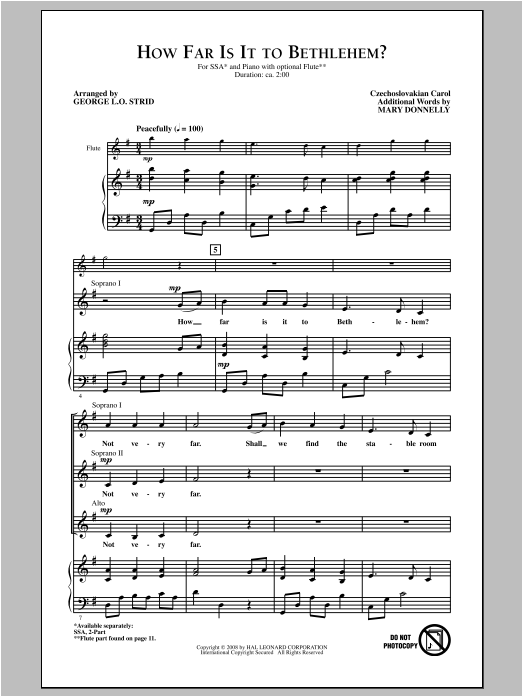
How Far Is It To Bethlehem? Sheet Music Preview

How Far Is It To Bethlehem?: SSA Choral Octavo

Arranged by Mary Donnelly / Arranged by George L.O. Strid

Item: 35-DS00262465

Digital Download
$2.99
Description

How Far Is It To Bethlehem?: SSA Choral Octavo isn't in MakeMusic Cloud just yet...but it could be. Let us know you'd like to see it, and you'll help shape what comes next. In the meantime, start a free trial and dive into thousands of interactive titles your students can play along with today.

Sample Audio
No sample audio found.
Sample Video
Additional Details
Publisher: Hal Leonard
Page Count: 11
SKU: 35-DS00262465

More about this title

About the Arranger: Mary Donnelly

Mary Donnelly

Mary Donnelly spent three decades teaching general music and choir in the Washoe County schools of Reno, Nevada, where she earned a Master's Degree in Education from Lesley College with a focus on integrating the arts across curricula. Her background includes a bachelor's degree from the University of Nevada, Reno with majors in English and French, and early experience organizing children's choruses while still in college.

In 1985, Donnelly partnered with George L.O. Strid during a sixth grade general music class, and their principal's request to write a Reading Week musical launched a prolific creative partnership. Over the decades, the pair have composed more than two hundred songs and twenty-five musicals, establishing themselves as trusted voices in educational and choral music. Donnelly holds membership in ACDA, NEA, and ASCAP.

Why we love this

Donnelly and Strid bring the ear of classroom teachers to their arrangements, which means this setting works for real ensembles with mixed ability levels. The SSA voicing keeps the piece accessible while the melodic writing has genuine character, avoiding the thin, generic feel of many holiday octavos. Programming a Donnelly/Strid arrangement means you're choosing music that directors have trusted for decades.

What to expect

Warm and inquiring, with the gentle questioning of a carol that invites reflection rather than bombast. The arrangement honors the tune's folk roots while adding harmonic support that feels natural and unfussy, letting voices blend without getting lost in thick textures.

Who it's for

Middle and high school choirs, church choirs, and community ensembles looking for a Christmas piece that sits comfortably for SSA voices. This works equally well as a concert closer or as part of a holiday program where you need something that feels fresh without demanding extensive rehearsal time.

How to get the most out of it

  • Let the text drive the phrasing rather than forcing symmetrical breathes at bar lines. This carol benefits from storytelling that feels conversational.
  • Balance the harmony carefully in the inner voices; SSA voicing can muddy quickly if the second soprano and alto aren't listening to each other.
  • Consider how your soloists will shape the melody line. The arrangement gives singers room to breathe and inflect without needing heavy interpretive licenses.
  • Maintain clarity in any divisi sections by assigning singers intentionally; don't assume range alone will keep parts separated.

How to use it

Pair this with a cappella madrigals or other secular holiday fare to build a concert program that avoids the sacred/secular divide. It also serves as an excellent opener or closer for a mixed repertoire concert, offering accessibility without sacrificing musical substance. The 11-page score is manageable for winter rehearsal schedules when time is tight.

Skills your students will build

  • Blending across parts in SSA harmony
  • Text-driven phrasing in carol arrangements
  • Reading and sustaining independent vocal lines
  • Balancing melody and harmonic support

You May Also Like