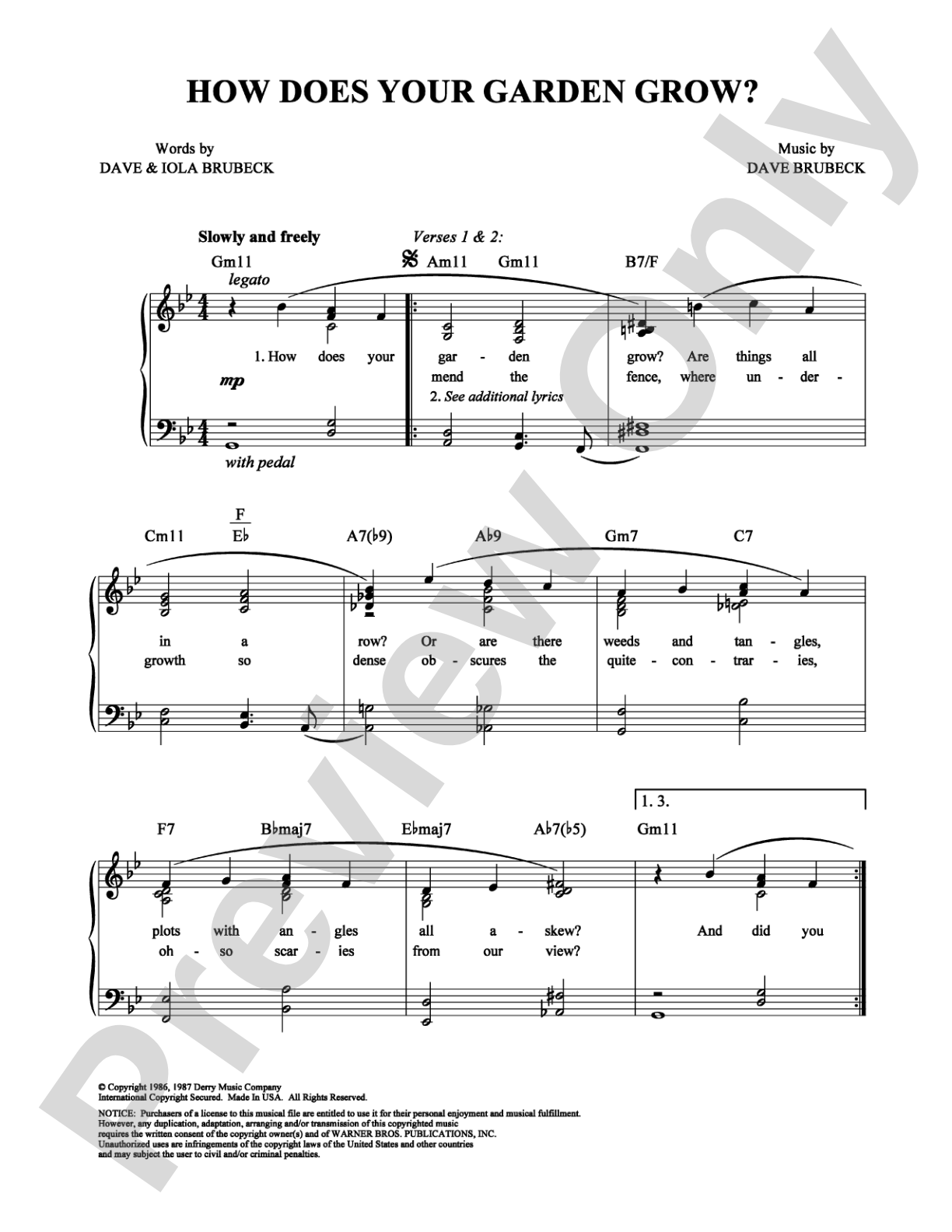
How Does Your Garden Grow?: Piano/Vocal/Chords Digital Sheet Music

How Does Your Garden Grow?: Piano/Vocal/Chords Digital Sheet Music

Dave Brubeck

Item: 00-PS-0000924

Digital Download
$3.99
Description

How Does Your Garden Grow?: Piano/Vocal/Chords Digital Sheet Music isn't in MakeMusic Cloud just yet...but it could be. Let us know you'd like to see it, and you'll help shape what comes next. In the meantime, start a free trial and dive into thousands of interactive titles your students can play along with today.

Sample Audio
No sample audio found.
Sample Video
Additional Details
SKU: 00-PS-0000924

More about this title

About the Artist: Dave Brubeck

Dave Brubeck

Dave Brubeck brought the language of jazz into concert halls and sacred spaces with equal conviction. A pianist whose improvisational gift was matched by his skill as a composer, he created works spanning choral pieces, hymns, orchestral compositions, chamber music, and large-scale works for chorus and orchestra. His study with Darius Milhaud at Mills College after World War II shaped his philosophy of blending jazz idioms with classical forms, a fusion he pursued throughout his career.

Brubeck's influence extended far beyond the bandstand. His album "Time Out" became the first jazz recording to sell over a million copies, and the iconic "Take Five" remains a standard in the jazz repertoire. He received the Grammy Lifetime Achievement Award for his contributions to jazz, was honored with the Presidential Medal of the Arts, and was elected to the American Classical Music Hall of Fame in 2003. His sacred works, including the mass "To Hope!" and oratorios like "The Voice of the Holy Spirit," have been recorded by major orchestras and performed worldwide.

Why we love this

Brubeck's ability to write a singable, memorable melody without sacrificing harmonic sophistication makes this piece accessible to singers at various levels while still rewarding careful interpretation. The jazz idiom brings freshness to a standard programming slot, and pairing piano with voice taps into Brubeck's gift for intimate, conversational musical writing. Directors appreciate that his compositions feel genuinely composed (not generic accompaniment writing) while remaining performable in modest venues.

What to expect

The garden metaphor unfolds through a melody that grows and blooms, supported by the kind of lush, unexpected chord progressions Brubeck was famous for. There's both intimacy and spaciousness here, as if the song invites you to pause and notice the small, detailed things while the harmony swells around you.

Who it's for

Singer-pianists preparing a recital program, vocalists seeking jazz standards with compositional integrity, and accompanists who want a piece that showcases both musical partnership and Brubeck's sophisticated harmonic language. This suits classical singers comfortable with jazz inflection as well as jazz vocalists wanting to explore notated interpretation.

How to get the most out of it

  • Balance the vocal line against the piano accompaniment by keeping the melody projected and clear; the harmonic richness of Brubeck's voicings can easily overshadow a singer who pulls back
  • Observe the jazz rhythmic feel carefully, particularly where swing or triplet interpretations apply; this is notated music but it breathes like improvisation
  • Allow space for the pianist to shape the chords with sensitivity; Brubeck's harmonic language depends on subtle voice leading and touch differentiation

How to use it

Pair this with other Brubeck vocal works to create a mini-retrospective of his song writing, or use it as a bridge between classical vocal standards and jazz repertoire in a mixed recital. It's equally at home in a chamber recital context or as an encore that shows a vocalist's range beyond their primary genre.

Skills your students will build

  • Interpreting jazz harmony and voice leading in a notated context
  • Balancing melodic projection with accompaniment texture
  • Singing with swing inflection and rhythmic flexibility in written notation
  • Collaborating with an accompanist to achieve musical conversation rather than mere support

You May Also Like