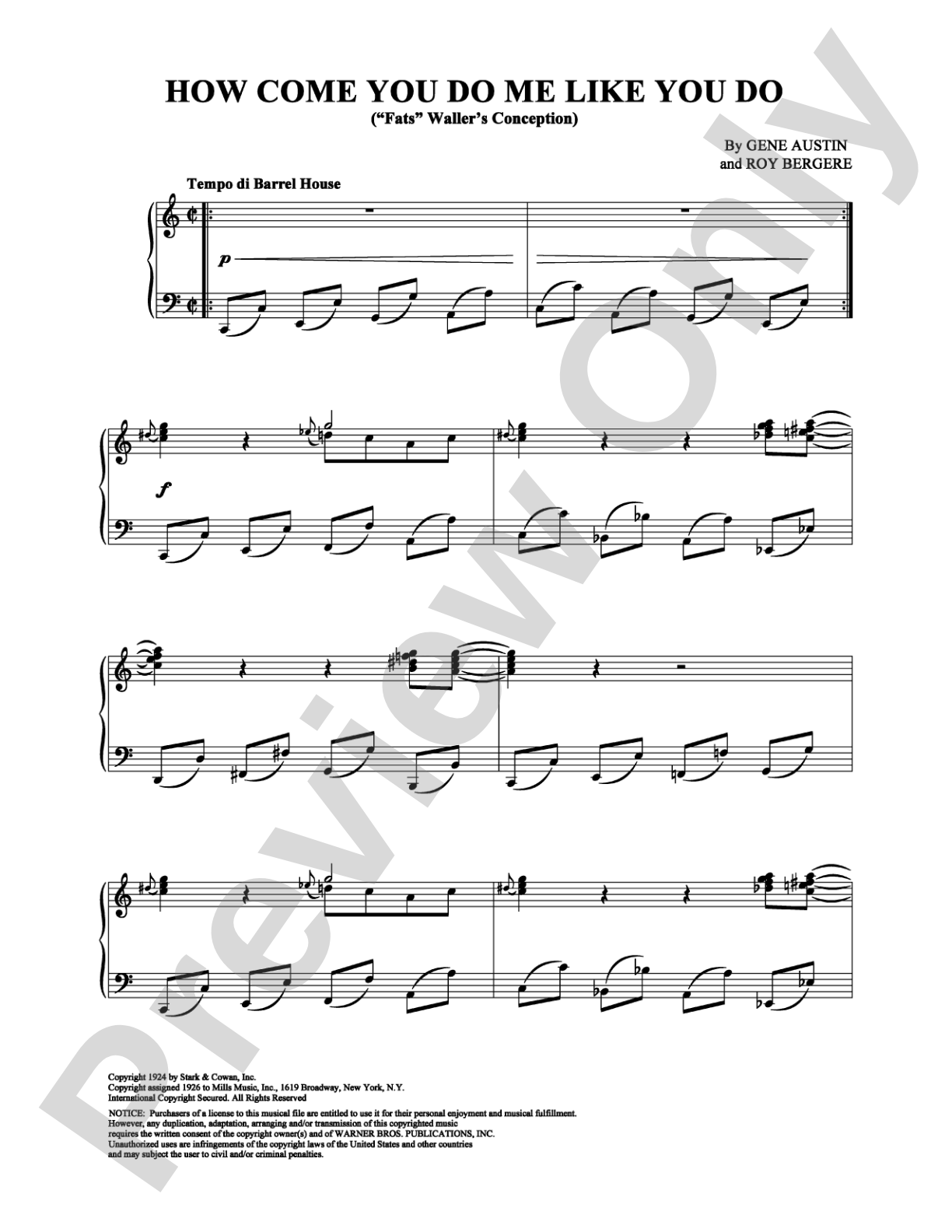
How Come You Do Me Like You Do (''Fats'' Waller's Conception): Piano Digital Sheet Music

How Come You Do Me Like You Do (''Fats'' Waller's Conception): Piano Digital Sheet Music

Gene Austin, Roy Bergere

Item: 00-PS-0002582

Digital Download
$3.99
Description

How Come You Do Me Like You Do (''Fats'' Waller's Conception): Piano Digital Sheet Music isn't in MakeMusic Cloud just yet...but it could be. Let us know you'd like to see it, and you'll help shape what comes next. In the meantime, start a free trial and dive into thousands of interactive titles your students can play along with today.

Sample Audio
No sample audio found.
Sample Video
Additional Details
SKU: 00-PS-0002582

More about this title

About the Creator: Thomas "Fats" Waller

Thomas "Fats" Waller (1904-1943) was a pianist, organist, and composer whose virtuosity and wit made him one of the most influential jazz musicians of the 1920s and 1930s. His ability to blend stride piano technique with sophisticated harmonic invention shaped the sound of American jazz and popular music for generations. Beyond his work as a performer, Waller was a prolific composer and arranger whose catalog includes some of the era's most enduring standards.

Why we love this

This arrangement captures the stride piano tradition that defined Waller's style, giving pianists direct access to one of jazz's most swinging standards. The digital format means you can have this rehearsal-ready immediately, with no shipping delays interrupting your preparation.

What to expect

Bouncy and good-natured, with the kind of rhythmic swing that makes listeners want to move. The Waller conception balances bluesy warmth with nimble fingerwork, maintaining a conversational lightness throughout.

Who it's for

Pianists developing their jazz vocabulary and jazz ensemble accompanists looking to add a canonical standard to their working repertoire. This is ideal for students moving beyond simple lead sheets into arranged, idiomatic jazz piano.

How to get the most out of it

  • Lock into a steady stride left hand before adding the right-hand comping. The groove depends on that rhythmic foundation staying solid.
  • Lean into the syncopation without rushing. Let the swing feel breathe; these note groupings need space to land naturally.
  • Experiment with dynamic contrast between the melody statements and the improvised passages. A lighter touch on the walking sections keeps energy moving forward.
  • Listen closely to how the original recording handles phrasing in the bridge. Small details in articulation make the difference between playing the changes and truly swinging them.

How to use it

Pair this with other stride-era standards in a jazz recital or ensemble showcase. It works equally well as a solo feature or in a set that traces the development of jazz piano from early swing through modern small-group contexts.

Skills your students will build

  • stride piano technique (left-hand patterns and independence)
  • jazz comping and melody harmonization
  • syncopated rhythmic reading and swing interpretation
  • navigating jazz chord changes and turnarounds

You May Also Like