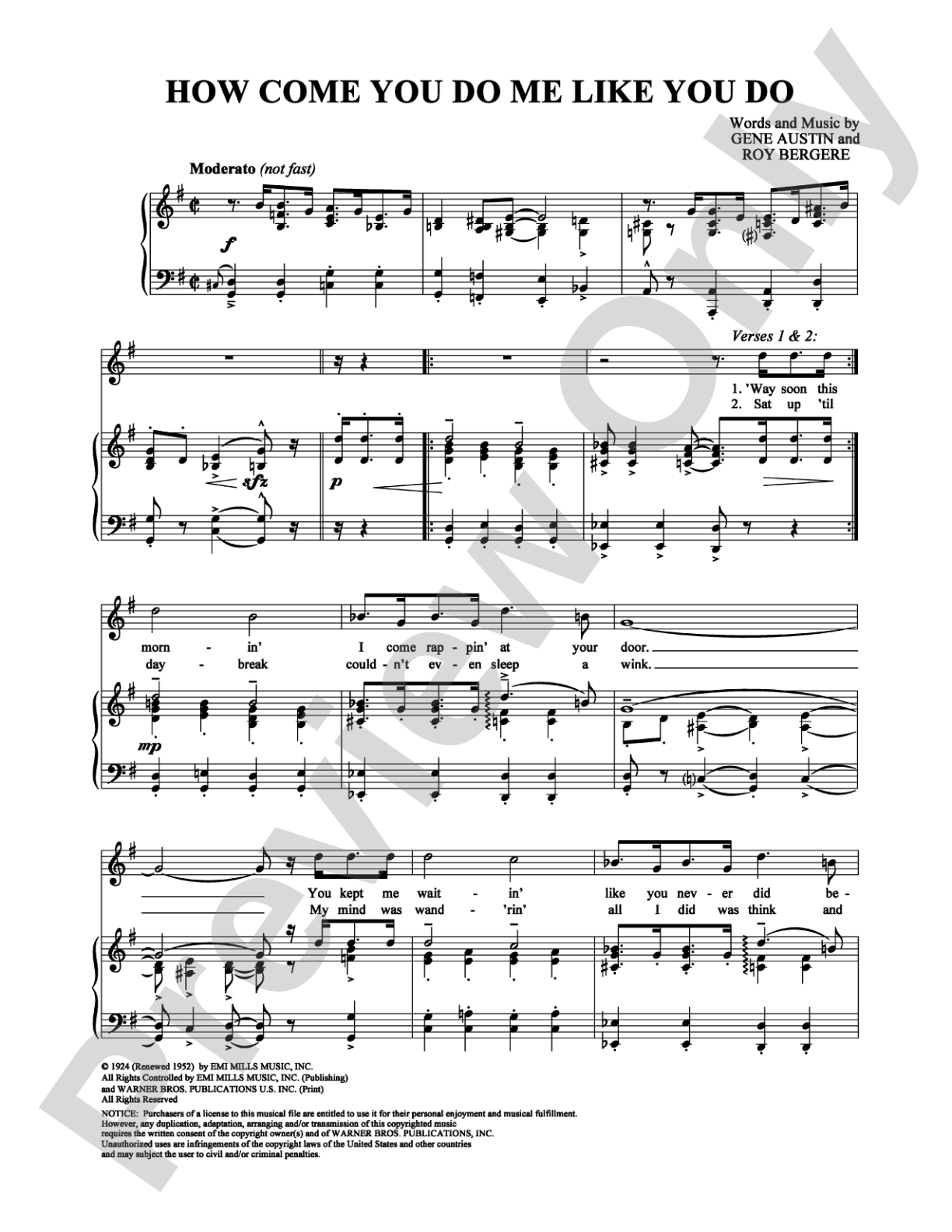
How Come You Do Me Like You Do: Piano/Vocal/Chords Digital Sheet Music

How Come You Do Me Like You Do: Piano/Vocal/Chords Digital Sheet Music

Gene Austin, Roy Bergere, Rosa Henderson

Item: 00-PS-0003584

Digital Download
$3.99
Description

How Come You Do Me Like You Do: Piano/Vocal/Chords Digital Sheet Music isn't in MakeMusic Cloud just yet...but it could be. Let us know you'd like to see it, and you'll help shape what comes next. In the meantime, start a free trial and dive into thousands of interactive titles your students can play along with today.

Sample Audio
No sample audio found.
Sample Video
Additional Details
SKU: 00-PS-0003584

More about this title

About the Artist: Rosa Henderson

Rosa Henderson was a blues and jazz vocalist active in the 1920s and 1930s, recording prolifically during the early jazz era. Known for her expressive delivery and command of both blues and jazz idioms, Henderson became a fixture in the African American entertainment scene and recorded numerous sides that captured the spirit of the jazz age.

Why we love this

This standard sits perfectly in a jazz repertoire course or vocal jazz elective, offering students direct access to a piece shaped by an influential early jazz vocalist. The piano/vocal/chords format makes it ideal for both solo recital work and ensemble exploration, giving singers multiple entry points into the jazz standard tradition.

What to expect

A conversation between two musicians, full of give and take. The tune has the playful warmth of early jazz, with rhythmic flexibility and harmonic sophistication that rewards careful listening and responsive playing.

Who it's for

Jazz singers preparing a standard for recital or ensemble performance, pianists building jazz accompaniment skills, and vocal jazz classes studying the repertoire canon. This digital resource works well for singers seeking accessible arrangements of foundational jazz literature.

How to get the most out of it

  • Treat the chord symbols as a roadmap for harmonic interpretation rather than strict voicings; this encourages pianists to voice chords in a way that supports the vocalist's phrasing and style.
  • Work with your pianist to establish the swing feel before drilling lyrics; the rhythmic conversation between voice and piano is central to how this piece breathes.
  • Explore the lyrical content for emotional subtext; early jazz standards often contained double meanings and social commentary worth excavating with your students.

How to use it

Feature this in a jazz standards showcase or cabaret setting where solo vocalists can perform with piano accompaniment. It also works as a teaching piece in a jazz history unit focused on the blues-influenced pop standards of the 1920s and 1930s.

Skills your students will build

  • Reading and interpreting chord symbols in a jazz context
  • Phrasing with rhythmic flexibility and swing feel
  • Vocal jazz interpretation and stylistic authenticity
  • Piano accompaniment technique for jazz standards
  • Collaboration between voice and instrumental accompaniment

You May Also Like