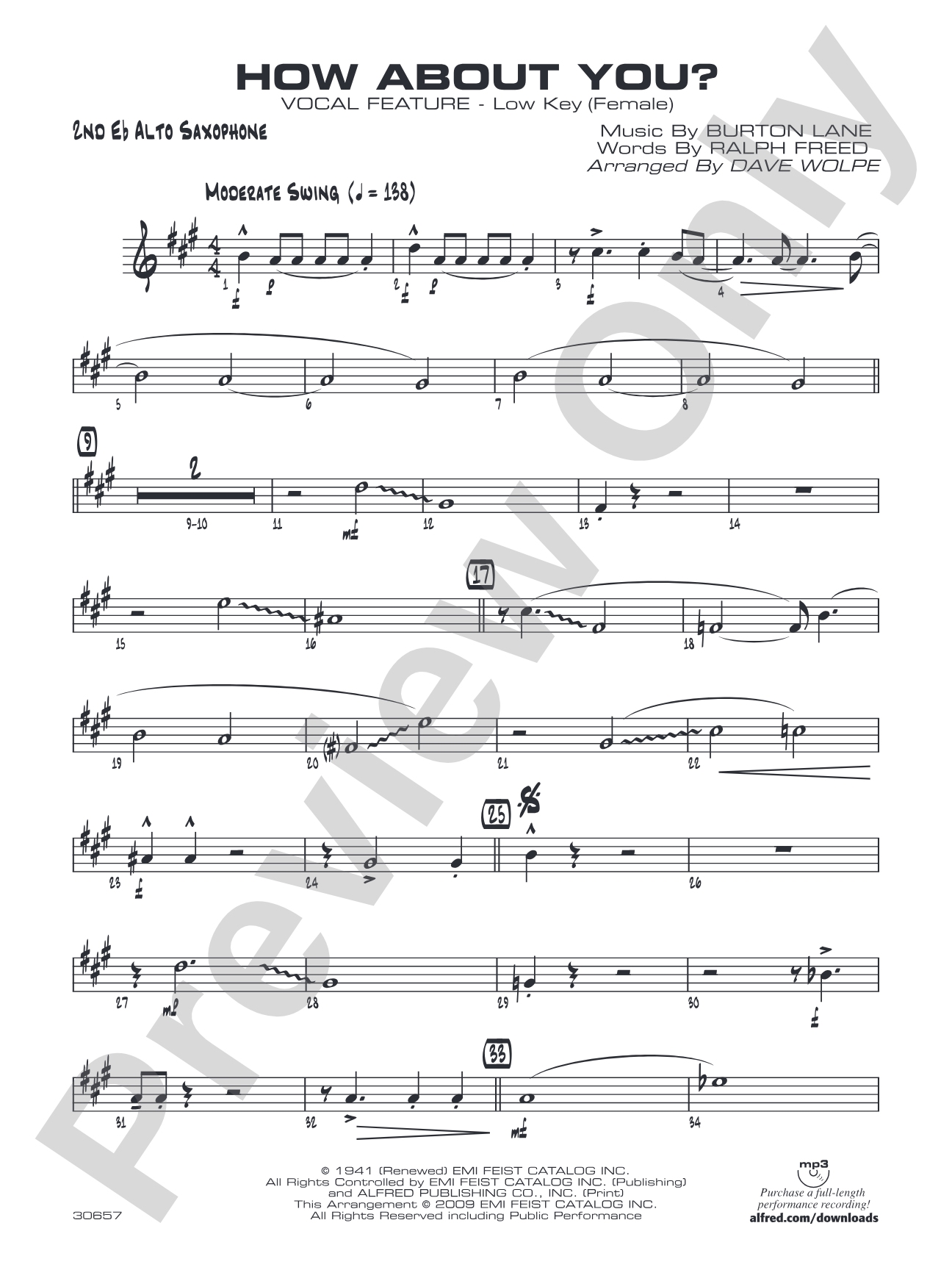
How About You?: 2nd E-flat Alto Saxophone Sheet Music Preview

How About You?: 2nd E-flat Alto Saxophone

Music by Burton Lane, words by Ralph Freed / arr. Dave Wolpe

Grade: 3 (Medium)

Item: 00-PC-0017160_AX2

Digital Download
$3.00
Description
This swingin' standard is arranged by the great Dave Wolpe in two keys---your choice of F (high) or C (low) depending on the vocalist's range. Includes two scores---the different key versions are on reverse sides of the parts; just flip the page. Vocal range in two keys: Female (low) key range is A below middle C to second space A. Male (high) key range is D below the staff to fourth line D, treble clef. (2:09)

Don't just read it, hear it, play along with it, and watch your students grow with it. In MakeMusic Cloud, How About You?: 2nd E-flat Alto Saxophone comes alive with professional accompaniment, adjustable tempo, and built-in practice tools that turn solo practice into real progress.

Sample Audio
0:00
0:00
Sample Video
Additional Details
Series: Jazz Vocal Series
Publisher: Alfred Music
Page Count: 78
SKU: 00-PC-0017160_AX2

More about this title

About the Composer: Burton Lane

Burton Lane composed for stage and screen during the golden age of American songwriting, creating melodies that balance sophistication with immediate memorability. His songs became standards precisely because they sit comfortably in the voice while rewarding thoughtful harmonic interpretation, making them ideal vehicles for both emerging and seasoned jazz singers.

Why we love this

Dave Wolpe's arrangement captures the ease and swing of the original while giving ensemble players meaningful musical lines that lock with the vocalist. The two-key format eliminates the usual transposition headache, and the reverse-printed parts mean your musicians stay focused on one key per rehearsal.

What to expect

Smooth, conversational, and grounded in swing language. The tune invites playful melodic interpretation while the ensemble's supportive voicings keep the whole thing light and propulsive rather than heavy.

Who it's for

Jazz ensemble directors building a vocal-feature program, or singers preparing for auditions and recitals who want a professional-level arrangement without the cost of custom orchestration. This works equally well in a learning ensemble or a polished performance setting.

How to get the most out of it

  • Balance the vocalist's intimate delivery against the ensemble's swing groove; the rhythm section should sit slightly behind the beat to create forward momentum without rushing.
  • Work the rubato sections (if marked) to allow the singer breathing space on key phrases; lock the ensemble's pocket tightly on the straight swing sections.
  • Use the conductor score to cue ensemble entries clearly, especially if the vocalist takes liberties with phrasing in the intro or bridge.

How to use it

Feature this as a solo spotlight on a jazz concert, or pair it with another vocal standard to create a set that showcases your ensemble's ability to accompany confidently. The manageable length (2:09) makes it perfect for formal adjudication or chamber-style performances in smaller venues.

Skills your students will build

  • Accompanying a vocalist with harmonic sensitivity and rhythmic flexibility
  • Comping and improvisation within structured jazz harmony
  • Swing articulation and groove consistency across an ensemble
  • Reading and executing fast page turns (using the reverse-printed parts efficiently)
  • Listening and balancing between solo voice and ensemble texture

You May Also Like