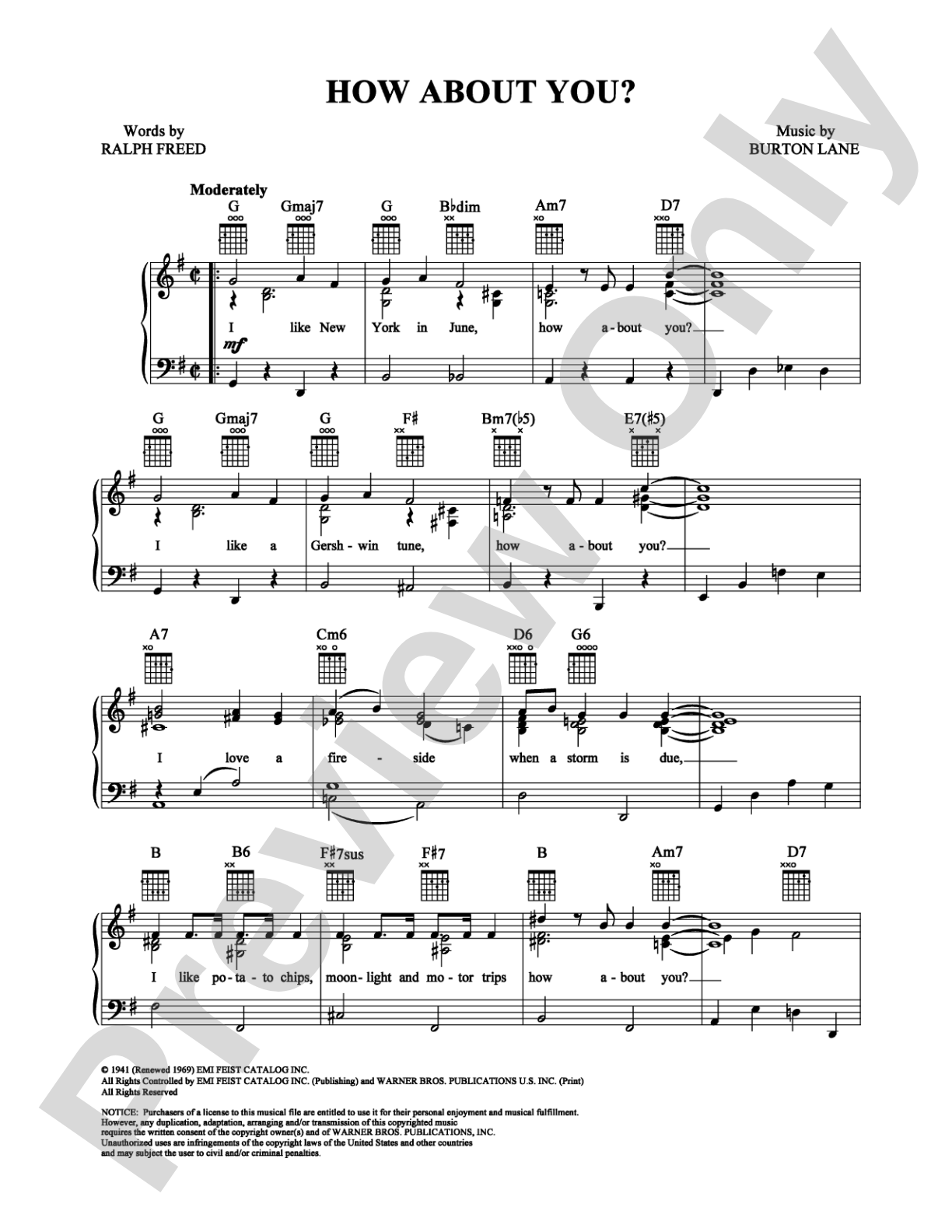
How About You?: Piano/Vocal/Chords Digital Sheet Music

How About You?: Piano/Vocal/Chords Digital Sheet Music

Burton Lane, Judy Garland, Mickey Rooney

Item: 00-PS-0009985

Digital Download
$3.99
Description

How About You?: Piano/Vocal/Chords Digital Sheet Music isn't in MakeMusic Cloud just yet...but it could be. Let us know you'd like to see it, and you'll help shape what comes next. In the meantime, start a free trial and dive into thousands of interactive titles your students can play along with today.

Sample Audio
No sample audio found.
Sample Video
Additional Details
SKU: 00-PS-0009985

More about this title

About the Artist: Judy Garland

Judy Garland (1922-1969) remains one of the most influential vocal artists of the 20th century, known for her distinctive contralto voice, emotional depth, and ability to inhabit a song completely. Her interpretations of popular standards and film music set benchmarks for phrasing, dynamics, and storytelling that continue to inform vocal pedagogy and performance practice today.

Why we love this

This duet captures the playful charm and musical sophistication of a classic Hollywood moment. The interplay between voices, combined with accessible harmony and straightforward chord changes, makes it ideal for teaching ensemble singing without sacrificing genuine musicality or historical significance.

What to expect

Warm and conversational, with a gentle swing undertone that encourages singers to trade musical ideas back and forth. The melody sits comfortably in the middle register, allowing singers to focus on connection and chemistry rather than vocal strain.

Who it's for

Vocalists preparing duets for recitals, studio singers learning standard repertoire, and choral directors seeking accessible yet musically mature material for two-part or small ensemble arrangements. Piano accompanists will find the chord structure clear and playable at various tempos.

How to get the most out of it

  • Balance the vocal lines so both singers feel equal in the texture; avoid letting one voice dominate the melody while the other fades into pure accompaniment.
  • Let the piano part breathe with the singers rather than driving it forward mechanically; the accompaniment should support the phrasing, not ignore it.
  • Shape phrases toward the lyrical moments rather than treating the entire piece as rhythmically uniform; listen to Garland's original recording to hear how she uses space and rubato.

How to use it

Pair this with other standards from the Great American Songbook for a vintage popular music concert, or use it as a lighter programming choice between more demanding classical works. The duet format makes it suitable for student recitals, informal performances, or studio showcases celebrating vocal literature beyond opera and art song.

Skills your students will build

  • Singing in parallel thirds and sixths
  • Coordinating ensemble entrances and phrase endings
  • Interpreting jazz-influenced chord changes
  • Accompanying a singer with appropriate dynamic and rhythmic flexibility

You May Also Like