
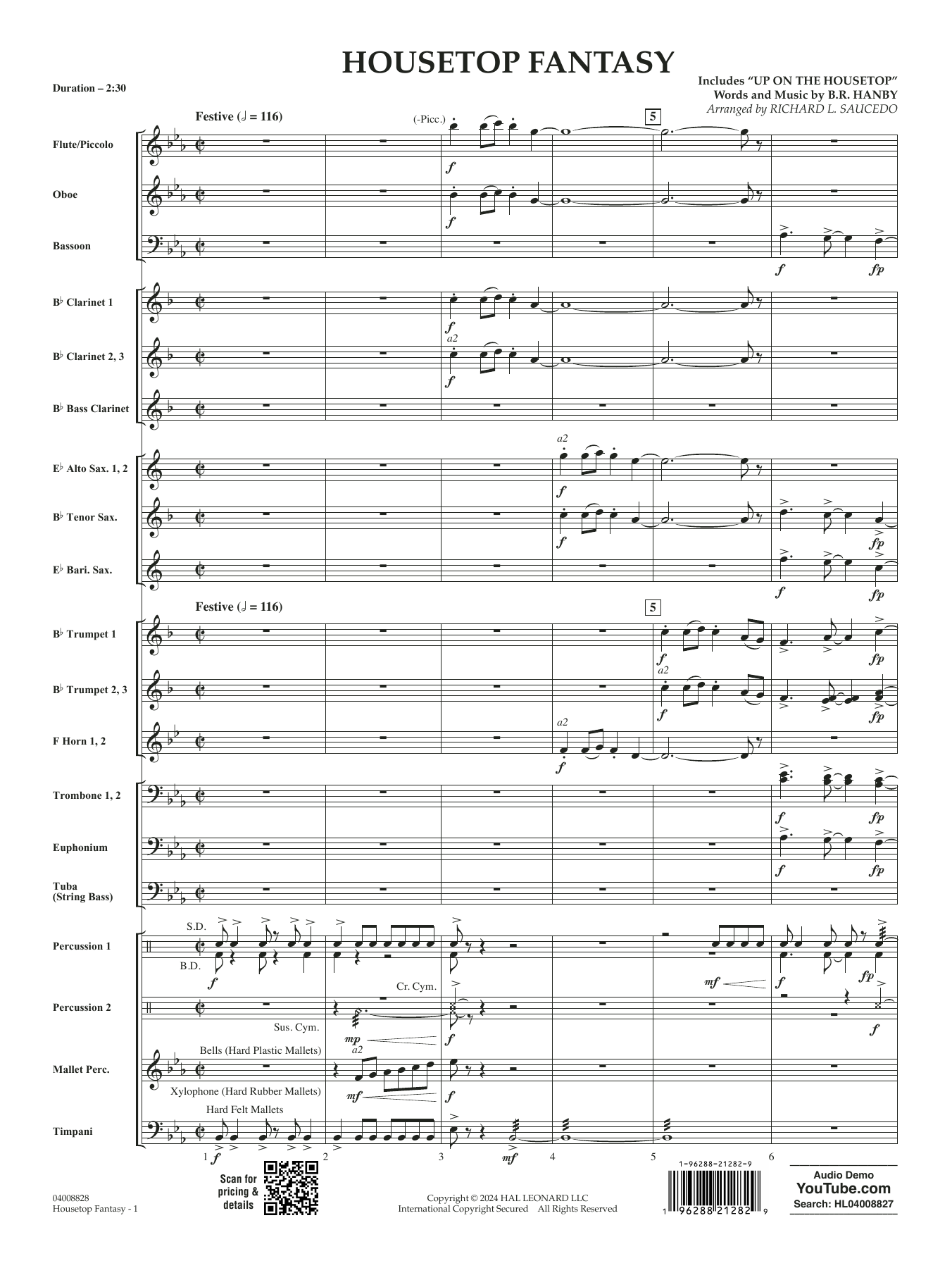

Housetop Fantasy (arr. Richard L. Saucedo): Concert Band Conductor Score & Parts
By Richard L. Saucedo
Grade: 3
Item: 35-PK01507730
$70.00
Pickup currently not available
Buy Extra Parts (Digital PDF Download)
Parts Added to Cart!
Description
Using the holiday classic "Up on the Housetop" as a point of departure, Richard Saucedo spins a masterful contemporary setting filled with clever scoring devices and unexpected dramatic moments. This unique and appealing arrangement is sure to become a favorite for winter concerts.


Housetop Fantasy (arr. Richard L. Saucedo): Concert Band Conductor Score & Parts isn't in MakeMusic Cloud just yet...but it could be. Let us know you'd like to see it, and you'll help shape what comes next. In the meantime, start a free trial and dive into thousands of interactive titles your students can play along with today.
Request This Title
Tell us you want it.
Start Your Free Trial
Explore everything that's ready to play right now.
Sample Audio
No sample audio found.
Sample Video
No sample videos found.
Additional Details
Publisher:
Hal Leonard
SKU:
35-PK01507730
More about this title
About the Composer: Richard L. Saucedo

Richard L. Saucedo spent 31 years as Director of Bands at Carmel High School in Indiana, building a program that consistently earned state, regional, and national recognition across concert, jazz, and marching ensembles. His Carmel Wind Symphony I performed at the Music for All National Concert Band Festival multiple times and claimed the Indiana State Championship in 2013, while the Carmel Marching Greyhounds secured BOA National titles in 2005 and 2012 after 17 consecutive top-ten finishes at nationals.
Beyond his classroom leadership, Saucedo has shaped competitive and educational music at the highest levels. He served as Brass Arranger/Composer for the Cavaliers Drum and Bugle Corps (five DCI world championships), currently serves as music ensemble coordinator for the Blue Devils, and holds positions as Senior Educational Consultant for Music for All and Chief Judge Team Leader for Bands of America competitions. His contributions to music education earned him Indiana's Bandmaster of the Year (1998-99), Outstanding Music Educator (2010), and inductions into both the Music for All Hall of Fame (2015) and DCI Hall of Fame (2022). He is also an elected member of the American Bandmasters Association and continues to arrange and compose for marching bands, choral ensembles, concert bands, and orchestras.
Why we love this
Saucedo takes a beloved holiday melody and reimagines it with genuine compositional sophistication. Rather than simply orchestrating the tune straight, he introduces scoring choices and dramatic turns that keep audiences engaged while remaining thoroughly playable at Grade 3. This is the kind of contemporary holiday arrangement that doesn't feel generic.
What to expect
Fresh and purposeful. The arrangement honors the charm of the original while introducing unexpected harmonic colors and textural surprises that catch listeners off guard. It walks the line between accessibility and artistic substance, never talking down to the ensemble or audience.
Who it's for
Directors seeking a winter concert selection with more creative ambition than typical holiday fare. Grade 3 bands that can handle contemporary compositional language and students ready to explore how a familiar tune can transform through skilled arranging.
How to get the most out of it
- Pay attention to the details in articulation and dynamic marking. Saucedo's contemporary scoring relies on precise execution of these nuances to create his dramatic moments.
- Balance the ensemble carefully during transitions between sections. The arrangement's effectiveness depends on smooth handoffs between sections that might feature unexpected instrumental doublings.
- Allow rehearsal time for any passages featuring unconventional texture or voicing. Grade 3 bands can handle sophisticated writing when the technical demands remain accessible.
- Use the recorded accompaniment as a reference for tempo and pacing, especially in sections with rubato or expressive flexibility built into the arrangement.
How to use it
Feature this as a centerpiece of a winter concert program, ideally paired with both traditional holiday selections and other contemporary works to show the range of modern band writing. The novelty of the approach makes it strong enough to stand alone or as the closer before a more serious final piece.
Skills your students will build
- Performing contemporary compositional techniques and extended scoring devices
- Balancing ensemble texture across shifting instrumental combinations
- Executing articulation and dynamic shaping as primary expressive tools
- Responding to unexpected harmonic movement and formal structure
- Maintaining ensemble cohesion during rapid sectional transitions