
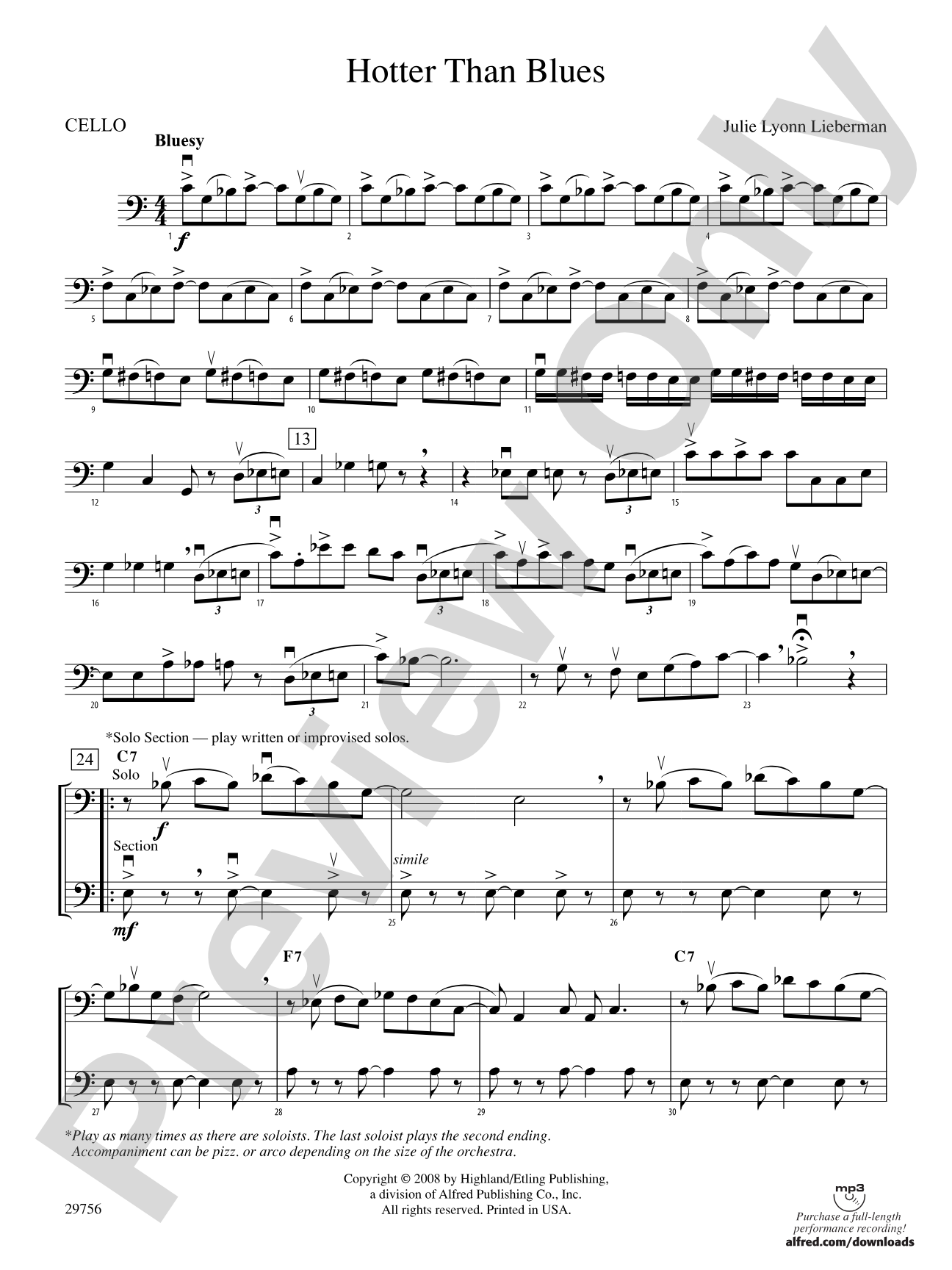

Hotter Than Blues: Cello
By Julie Lyonn Lieberman
Grade: 3.5
Item: 00-PC-0001602_VC1
$5.99
Pickup currently not available
Description
This upbeat, jazzy blues piece is based on a 12-bar, 3-chord harmonic progression in the key of C. Inspired by guitarist and violinist Remo Biondi's 1952 recording with Roosevelt Sykes, Hotter Than Blues offers composed solos, or the opportunity for students to create their own, and provides students with an important link to the music they listen to today, since the blues developed into rhythm and blues, which in turn evolved into rock 'n roll. (3:00)


Don't just read it, hear it, play along with it, and watch your students grow with it. In MakeMusic Cloud, Hotter Than Blues: Cello comes alive with professional accompaniment, adjustable tempo, and built-in practice tools that turn solo practice into real progress.
Open in the Player
Jump straight in and assign it today.
Start Your Free Trial
Open this title and explore the full library in minutes.
Sample Audio
1
Audio File
--:--
0:00
0:00
Sample Video
No sample videos found.
Additional Details
Series:
Highland/Etling String Alternatives
Publisher:
Alfred Music
Page Count:
124
SKU:
00-PC-0001602_VC1
More about this title
About the Composer: Julie Lyonn Lieberman
Julie Lyonn Lieberman is a composer and educator known for creating accessible, culturally grounded music that connects students to living musical traditions. Her work across string orchestra, band, and chamber ensembles emphasizes improvisation, cross-genre exploration, and the pedagogical power of music rooted in American vernacular traditions.
Lieberman's compositions often bridge classical training with blues, jazz, and folk idioms, helping students understand music history not as separate silos but as interconnected lineages. Her contributions to string orchestra literature have made her a valued resource for directors seeking repertoire that engages contemporary learners while building fundamental musicianship.
Why we love this
This piece does something rarely done well in the 3.5 grade range: it teaches the blues authentically without oversimplifying it. The grounding in a genuine 1952 recording gives students real historical context rather than a generic approximation, and the option to compose their own solos transforms a listening experience into active participation. It's the kind of piece that makes students realize the music they already love has deeper roots.
What to expect
Energetic and approachable, with the swagger of a real blues groove. The piece swings rather than marches; it has charm and a touch of swagger without losing the clarity that makes it teachable at this level. There's an invitation built into it, as if the orchestra is welcoming the audience into a jam session.
Who it's for
String orchestra directors at the intermediate level who want to teach blues vocabulary and harmonic literacy without pulling students out of their primary instrument studies. It works for ensembles ready to handle syncopation and stylistic nuance, and for programs that intentionally connect classical training to contemporary and historical popular music.
How to get the most out of it
- Establish a relaxed swing feel from the start. The jazz inflection matters more than metronomic precision; let your ensemble hear the groove in rehearsal before worrying about rhythmic uniformity.
- If your students are composing solos, work through at least one as a group before asking them to create individually. Model how a solo can be simple, how it repeats ideas, and how it stays within the 12-bar harmonic structure.
- Balance the written solos with the ensemble parts. These showcases need to feel like they're emerging from the group, not competing against it; adjust dynamic levels during rehearsal so featured voices sit naturally within the texture.
- Use the historical recording as a regular reference point, not a one-time introduction. Play Remo Biondi's version during sectionals and rehearsals so students internalize the idiom and understand the lineage they're joining.
How to use it
Position this on a concert that otherwise features standard classical or light-classical selections; it becomes a bridge moment that signals to your audience (and to your students) that string orchestra is alive and connected to American musical culture. It also works well as a rehearsal-to-performance piece early in the school year, since the 12-bar structure makes it accessible for quick skill building and the improvisation component keeps students engaged through multiple repetitions.
Skills your students will build
- Understanding and performing 12-bar blues harmonic progressions
- Swing rhythm and jazz articulation in a string context
- Blues improvisation and solo composition
- Listening to and analyzing a specific historical recording
- Balancing ensemble cohesion with featured solos