
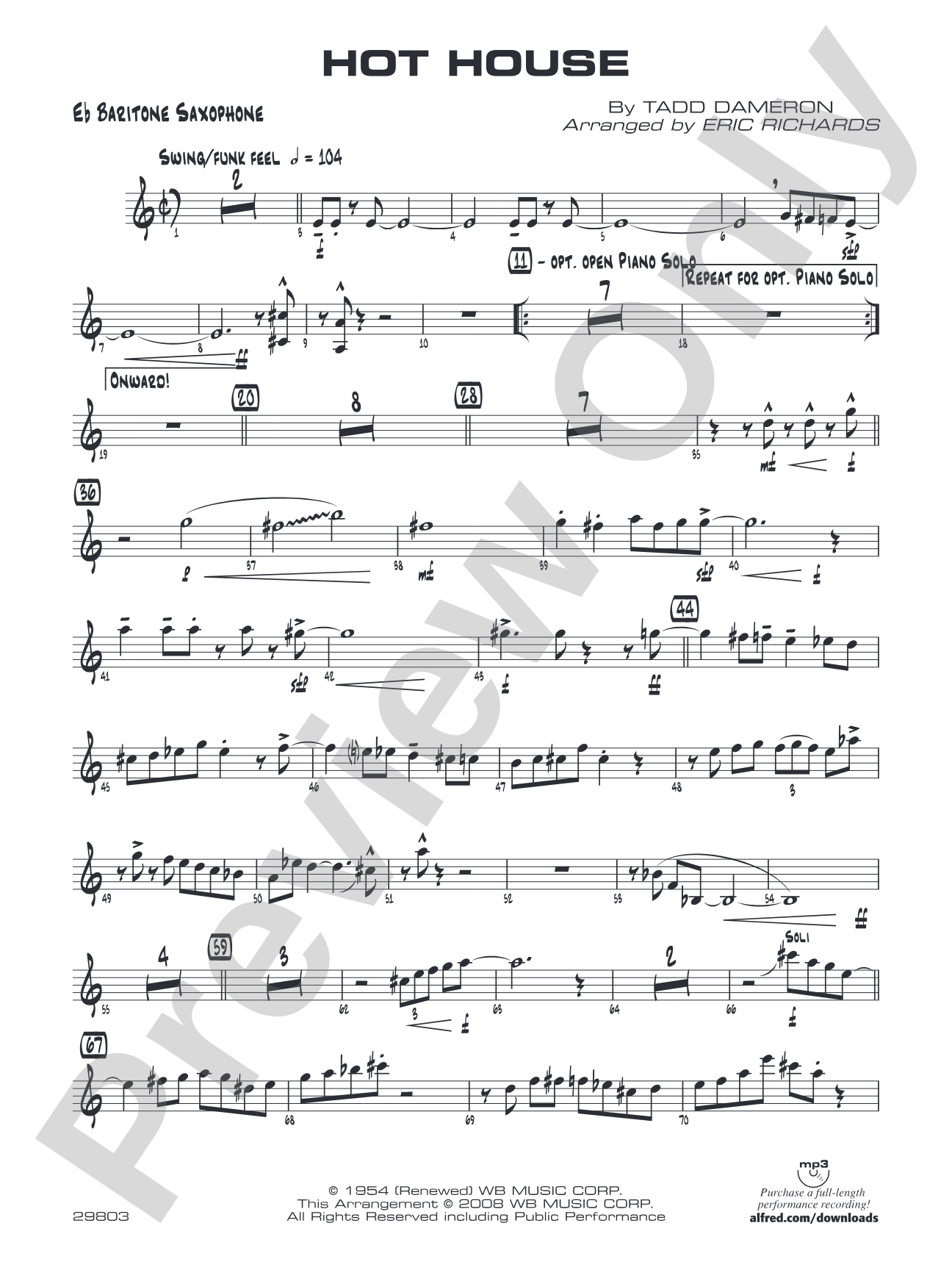

Hot House: E-flat Baritone Saxophone
By Tadd Dameron / arr. Eric Richards
Grade: 5 (Advanced / Difficult)
Item: 00-PC-0017138_BTX
$3.00
Pickup currently not available
Description
Here is a hot chart by Eric Richards. A swing-funk groove on a great bebop jazz tune loaded with energy. Features: the lead is played by alto, tenor and trumpet with some tricky lines, lead trumpet range is up to written high D (optional F-sharp), a nice soli for saxes, lead sax is soprano sax with an optional alto part included. Whew, it is a "Hot House." (4:08)


Don't just read it, hear it, play along with it, and watch your students grow with it. In MakeMusic Cloud, Hot House: E-flat Baritone Saxophone comes alive with professional accompaniment, adjustable tempo, and built-in practice tools that turn solo practice into real progress.
Open in the Player
Jump straight in and assign it today.
Start Your Free Trial
Open this title and explore the full library in minutes.
Sample Audio
1
Audio File
--:--
0:00
0:00
Sample Video
No sample videos found.
Additional Details
Series:
Premier Jazz Series
Publisher:
Alfred Music
Page Count:
98
SKU:
00-PC-0017138_BTX
More about this title
About the Composer: Tadd Dameron
Tadd Dameron (1917-1965) was a master of bebop composition and arrangement whose harmonic sophistication and melodic elegance set him apart from his contemporaries. His works became standards in the jazz repertoire, recorded by everyone from Dizzy Gillespie to John Coltrane, and his approach to orchestration influenced generations of jazz writers and bandleaders.
Dameron's gift was his ability to craft challenging yet singable melodies over complex harmonic changes. He wrote for small groups and big bands with equal facility, always prioritizing the balance between ensemble cohesion and individual voice. For jazz educators, his compositions offer a masterclass in how to write idiomatically for jazz musicians while maintaining structural integrity and genuine musical substance.
Why we love this
This arrangement captures the essence of what makes bebop sound modern and sophisticated while remaining accessible to skilled high school and college ensembles. Eric Richards has kept the harmonic and rhythmic complexity intact while smartly doubling key melodic lines and providing pragmatic part voicing that doesn't sacrifice the tune's inherent swagger. Programming this signals to your audience and your students that your ensemble is ready for genuine jazz content.
What to expect
Hot House radiates confident energy and harmonic sophistication. The bebop melody bounces with infectious logic while the swing-funk groove propels everything forward with undeniable momentum. This is a chart that sounds like the players are genuinely enjoying the challenge of playing together.
Who it's for
Advanced high school jazz ensembles and college big bands with strong lead players and section discipline. Your ensemble needs secure readers who can execute the rhythmic precision of bebop and horn players willing to lock into ensemble unison lines while maintaining individual character.
How to get the most out of it
- Establish the swing feel early in sectional rehearsals. The funky groove sits between straight and swing; lock the rhythm section into that pocket before layering the horn lines.
- Balance the lead voices carefully. With alto, tenor, and trumpet sharing the melody, each voice needs definition without one dominating. Use your rehearsal time to blend these three lines as if they're a single voice with three colors.
- Mark the optional passages clearly in parts. The lead trumpet's optional F-sharp extension and the soprano/alto sax choices should be decided before students begin learning, not discovered in performance.
- Pay attention to articulation across the sax soli section. The written figures demand precision and unified tonguing to shine; this is where the section's woodshed time becomes audible.
How to use it
Feature this in a jazz showcase concert where you want to demonstrate your ensemble's maturity and technical command. It pairs naturally with other Dameron compositions or works from the same era, building a set that traces the harmonic vocabulary of bebop. It's also ideal for festival competitions where the combination of musicality and complexity earns respect from adjudicators.
Skills your students will build
- Reading and executing bebop phrasing and articulation
- Swing-funk groove coordination between rhythm section and ensemble
- Balancing multiple lead voices in unison passages
- Navigating rapid harmonic changes with secure intonation
- Executing extended range passages (trumpet to written high D and optional F-sharp)
- Ensemble blend in saxophone soli section