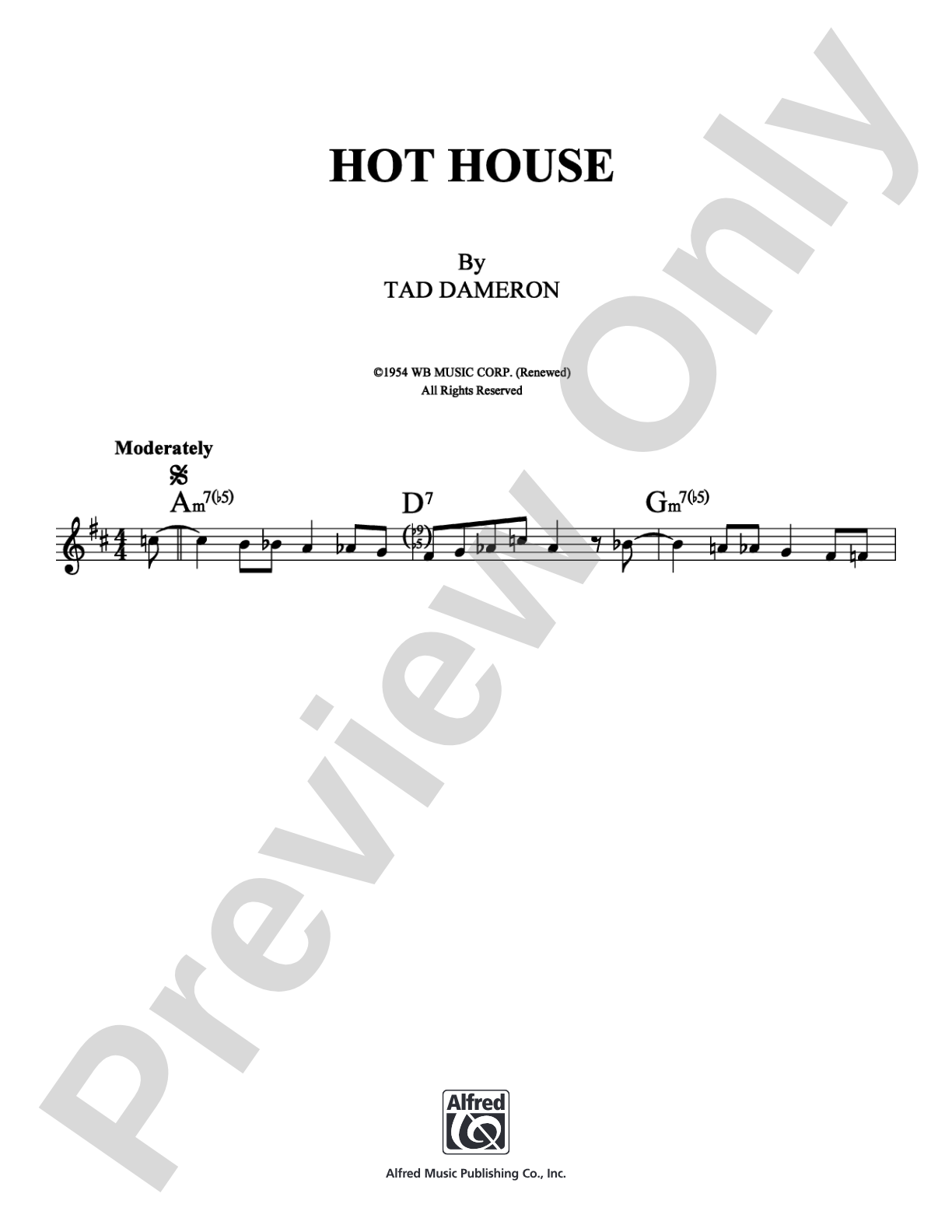
Hot House: Lead Sheet Digital Sheet Music

Hot House: Lead Sheet Digital Sheet Music

Tadd Dameron

Item: 00-PS-0006917

Digital Download
$1.99
Description

Hot House: Lead Sheet Digital Sheet Music isn't in MakeMusic Cloud just yet...but it could be. Let us know you'd like to see it, and you'll help shape what comes next. In the meantime, start a free trial and dive into thousands of interactive titles your students can play along with today.

Sample Audio
No sample audio found.
Sample Video
Additional Details
SKU: 00-PS-0006917

More about this title

About the Artist: Tadd Dameron

Tadd Dameron (1917-1965) was a pianist, composer, and arranger who shaped the sound of bebop and cool jazz through his sophisticated harmonic sensibilities and compositional craft. He worked alongside Charlie Parker, Dizzy Gillespie, and Miles Davis, bringing a melodic intelligence and structural clarity to jazz composition that influenced generations of musicians. His pieces became standards in the jazz repertoire, valued for their harmonic complexity and emotional depth.

Why we love this

Hot House showcases the kind of bebop writing that demands serious attention from jazz musicians. The changes are legit and the melody sits perfectly over its harmonic foundation, making it an ideal vehicle for studying how composers balance accessibility with sophistication. It's a piece that rewards careful listening and preparation, and players who master it develop real jazz literacy.

What to expect

Hot House burns with the energy and harmonic sophistication that defines bebop at its best. The melody jumps and pivots with angular grace, supported by rich changes that open up space for inventive soloing while maintaining structural coherence.

Who it's for

Jazz musicians working at the intermediate level and above who want to deepen their understanding of bebop composition and harmonic navigation. This lead sheet serves instrumentalists learning to improvise over sophisticated changes and vocalists developing jazz repertoire.

How to get the most out of it

  • Study the harmonic progression closely before focusing on the melody line; understanding the underlying changes will inform your phrasing and help you navigate the tune's architecture.
  • Pay attention to the contour of the melody relative to the chord changes, especially in passages where the line moves against the harmonic motion.
  • Use the lead sheet to experiment with different rhythmic interpretations during the head, then apply that sensibility to your solo construction.
  • Mark any enharmonic spellings or chromatic approaches that might trip you up at tempo.

How to use it

Program this alongside other bebop standards in a jazz recital or ensemble performance to establish the musical lineage of modern jazz. It works equally well as a solo feature or as part of a themed set exploring Dameron's compositional voice.

Skills your students will build

  • Reading and improvising over bebop changes with chromatic alterations
  • Balancing melodic shape against harmonic complexity
  • Recognizing and navigating enharmonic restatements
  • Developing solo vocabulary grounded in harmonic understanding

You May Also Like