
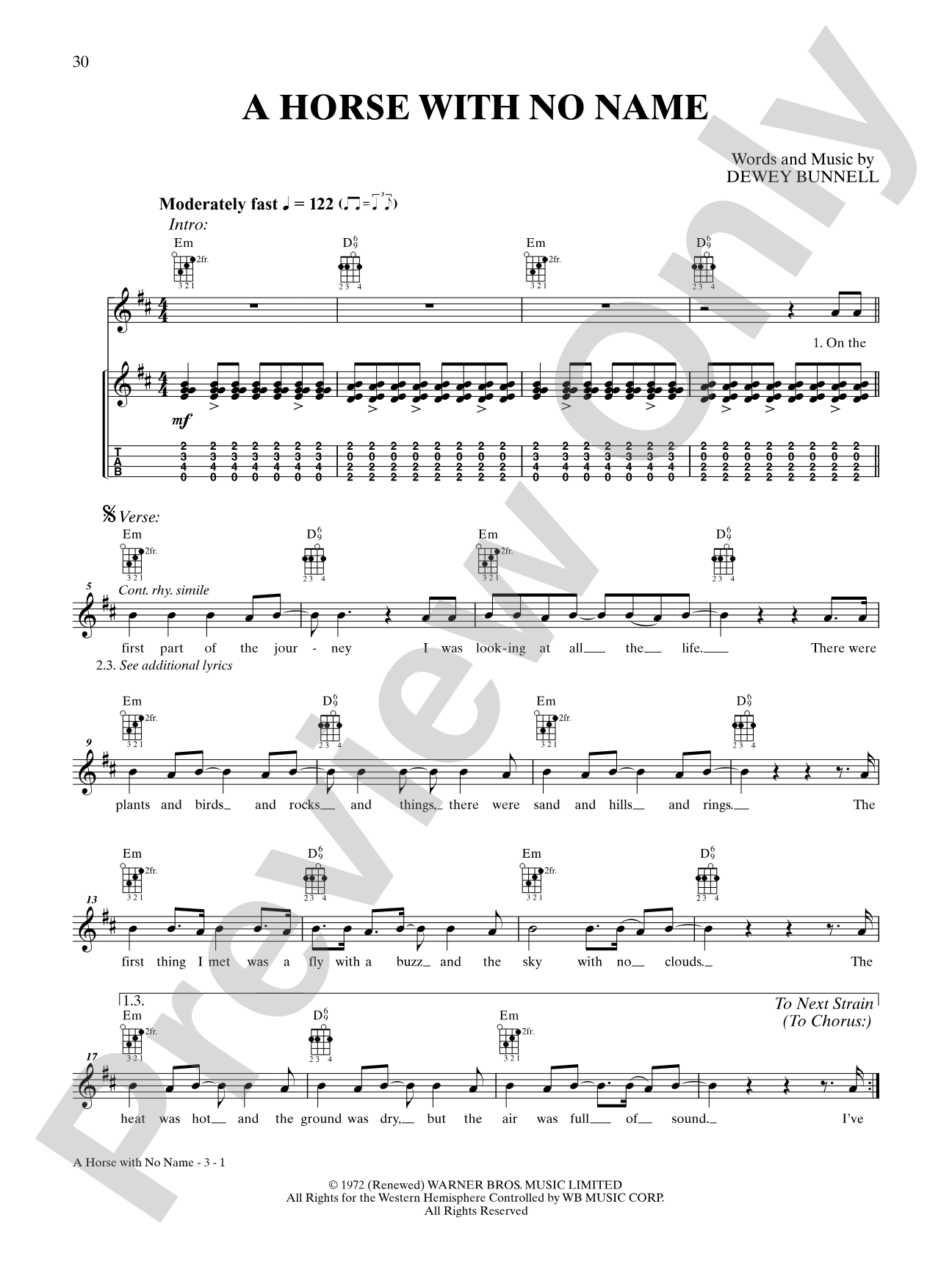

Horse With No Name: Ukulele TAB
12 Great Songs -- Just a Few Chords
Item: 00-PS-0011955
$4.99
One moment…
Related Items
Margaritaville: Ukulele TAB |
$4.99
|
View | |
Take Me Home, Country Roads: Ukulele TAB |
$4.99
|
View | |
As Tears Go By: Ukulele TAB |
$4.99
|
View | |
Gloria: Ukulele TAB |
$4.99
|
View | |
Good Riddance (Time of Your Life): Ukulele TAB |
$4.99
|
View | |
Moondance: Ukulele TAB |
$4.99
|
View | |
Big Yellow Taxi: Ukulele TAB |
$4.99
|
View | |
Peaceful Easy Feeling: Ukulele TAB |
$4.99
|
View |
Description
Easy Rock Ukulele is designed for your total enjoyment. Each featured song is inherently simple, with just a few chords. All the tunes are arranged for ukulele from the actual guitar parts, simplified just enough to keep them fun and musically satisfying. Titles: As Tears Go By (The Rolling Stones) * Big Yellow Taxi (Joni Mitchell) * Casey Jones (Grateful Dead) * Gimme Some Lovin' (The Spencer Davis Group) * Gloria (Them) * Good Riddance (Time of Your Life) (Green Day) * A Horse with No Name (America) * Margaritaville (Jimmy Buffett) * Moondance (Van Morrison) * Peaceful Easy Feeling (Eagles) * Take It Easy (Eagles) * Take Me Home, Country Roads (John Denver).


Horse With No Name: Ukulele TAB isn't in MakeMusic Cloud just yet...but it could be. Let us know you'd like to see it, and you'll help shape what comes next. In the meantime, start a free trial and dive into thousands of interactive titles your students can play along with today.
Request This Title
Tell us you want it.
Start Your Free Trial
Explore everything that's ready to play right now.
Sample Audio
No sample audio found.
Sample Video
No sample videos found.
Additional Details
Series:
Just for Fun
Publisher:
Alfred Music
Page Count:
56
SKU:
00-PS-0011955
More about this title
About the Composer: Dewey Bunnell
Dewey Bunnell is a founding member and primary songwriter of America, the folk-rock band formed in 1970. Born in London to American parents serving in the U.S. Air Force, Bunnell grew up surrounded by diverse musical influences that shaped the band's signature sound. He wrote "A Horse with No Name," the group's debut single and first number-one hit, which remains one of the most recognizable songs of the 1970s.
Bunnell's songwriting draws from accessible melodies and straightforward chord structures, making his work particularly suited to music education. His compositions have taught generations of students the fundamentals of songwriting and arrangement, demonstrating how simplicity and emotional clarity can create enduring music.
Why we love this
This collection captures the DNA of 1970s rock stripped down to its essence. Each song is genuinely musical despite minimal chord changes, proving that limited technical demands do not equal limited artistry. Students learn legitimate repertoire rather than exercises, building confidence through songs they recognize and enjoy.
What to expect
Summery, nostalgic, and utterly approachable. These songs carry the warmth of the 1970s without pretension, inviting players to relax into the music rather than struggle through it. The arrangements preserve the melodic charm of the originals while respecting the ukulele's natural voice.
Who it's for
Ukulele students in their first year of playing who need materials that sound accomplished without overwhelming technical demands. Teachers building confidence in developing players through recognizable, radio-friendly repertoire.
How to get the most out of it
- Focus on rhythmic consistency rather than speed. The power of these arrangements lies in steady strumming and clear chord changes, not flashy playing.
- Listen closely to the original recordings for phrasing and dynamics. Even simple songs benefit from attention to how melody sits against the changes.
- Dampen strings cleanly between chord shifts. Quick, quiet transitions will make even the easiest changes feel polished.
How to use it
Assign individual songs as weekly homework assignments throughout the year, letting students progress through accessible repertoire at their own pace. Program a "Songwriting Through the Decades" recital where students perform these hits alongside other era-defining pieces. Use as core material in beginner ensemble classes where everyone can participate regardless of experience level.
Skills your students will build
- Reading chord charts and tablature simultaneously
- Transitioning between common major and minor chords (Am, C, G, D, Em)
- Maintaining steady rhythm patterns during chord changes
- Interpreting rock song structure (verse, chorus, bridge)
- Listening for and reproducing phrasing from recorded performances