
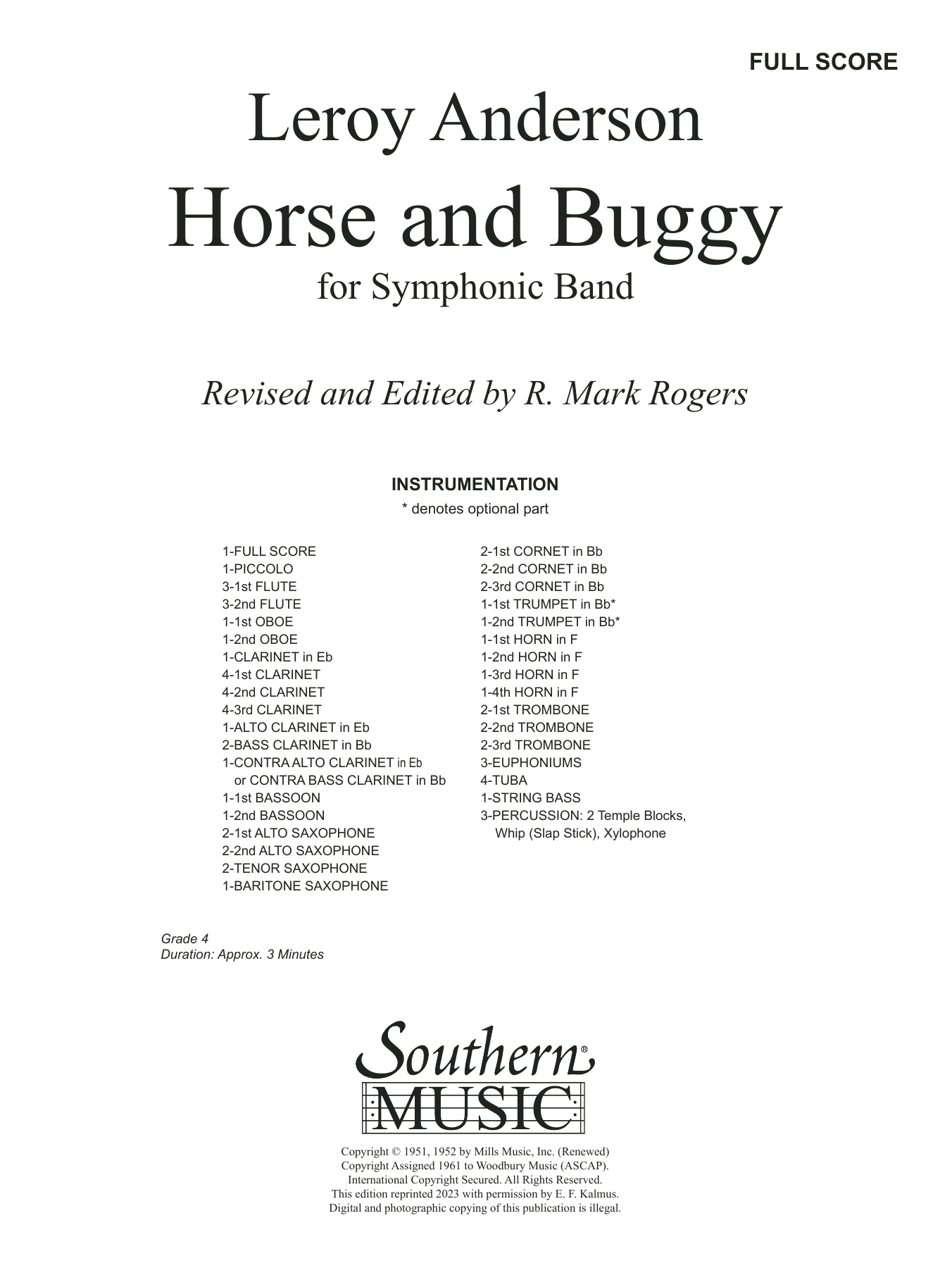

Horse And Buggy - Second Edition (arr. R. Mark Rogers): Concert Band Conductor Score & Parts
By Leroy Anderson / Arranged by R. Mark Rogers
Grade: 4
Item: 35-PK01424784
$70.00
Pickup currently not available
Buy Extra Parts (Digital PDF Download)
Parts Added to Cart!
Description
Like Andersons signature piece Sleigh Ride, Horse and Buggy is another example of his extraordinary ability to sketch a nostalgic scene in sound on a small canvas without a wasted motion. Here, a different horse pulls a different vehicle through a vanished landscape of long ago. This exclusive Southern band edition by Mark Rogers reintroduces Andersons enchanting work to new generations of audiences.


Horse And Buggy - Second Edition (arr. R. Mark Rogers): Concert Band Conductor Score & Parts isn't in MakeMusic Cloud just yet...but it could be. Let us know you'd like to see it, and you'll help shape what comes next. In the meantime, start a free trial and dive into thousands of interactive titles your students can play along with today.
Request This Title
Tell us you want it.
Start Your Free Trial
Explore everything that's ready to play right now.
Sample Audio
No sample audio found.
Sample Video
No sample videos found.
Additional Details
Publisher:
Hal Leonard
SKU:
35-PK01424784
More about this title
About the Composer: Leroy Anderson
Leroy Anderson (1908-1975) composed light orchestral works that became staples of American concert life. His gift was immediate melodic appeal paired with meticulous orchestration; every note served the whole, nothing was extraneous. Anderson's catalog of pops repertoire and short concert pieces earned him a devoted following among both professional orchestras and school bands seeking accessible yet musically substantial material.
Why we love this
Rogers has crafted an arrangement that honors Anderson's compositional restraint while giving concert band the textural clarity it needs to shine. The piece sits comfortably at Grade 4, making it genuinely achievable without sacrificing the harmonic sophistication and orchestral detail that make Anderson's music rewarding to teach. Directors appreciate it as programming material that engages audiences without demanding a virtuosic ensemble.
What to expect
A gentle journey backward in time, painted in soft pastels. The music moves with purposeful ease, evoking the creak of leather, the gentle motion of wheels on a quiet road, and the contentment of a simpler era. There's warmth without sentimentality, charm without condescension.
Who it's for
Concert bands at the intermediate level looking for repertoire that audiences recognize and enjoy without requiring exceptional technical demands. Music directors who want to program genuine concert music, not arrangements that substitute novelty for substance.
How to get the most out of it
- Shape the opening figures with clarity in the woodwind choir; Anderson's economy of gesture means every articulation choice matters, so coordinate tonguing across sections to maintain phrase integrity.
- Balance the picturesque details (bells, xylophone, triangle) so they register without overwhelming the melodic line; these colors should evoke a scene, not distract from it.
- Let the accompaniment figures breathe naturally rather than mechanically; the rhythmic motion should feel like the steady clip of hoofbeats and carriage wheels, not metronomic.
How to use it
This works beautifully in a holiday concert or a program themed around Americana and nostalgic Americana. Consider pairing it with other Anderson selections or positioning it as a contrasting lighter moment between more substantial concert pieces. It's also ideal for community concerts where accessibility matters as much as musicianship.
Skills your students will build
- Balancing solo lines against accompanimental textures
- Executing articulations that shape melodic character rather than merely mark rhythm
- Maintaining rhythmic stability through understated but consistent motion
- Listening across sections to achieve transparency in light orchestration
- Responding to nuanced dynamic shaping in popular and light concert repertoire