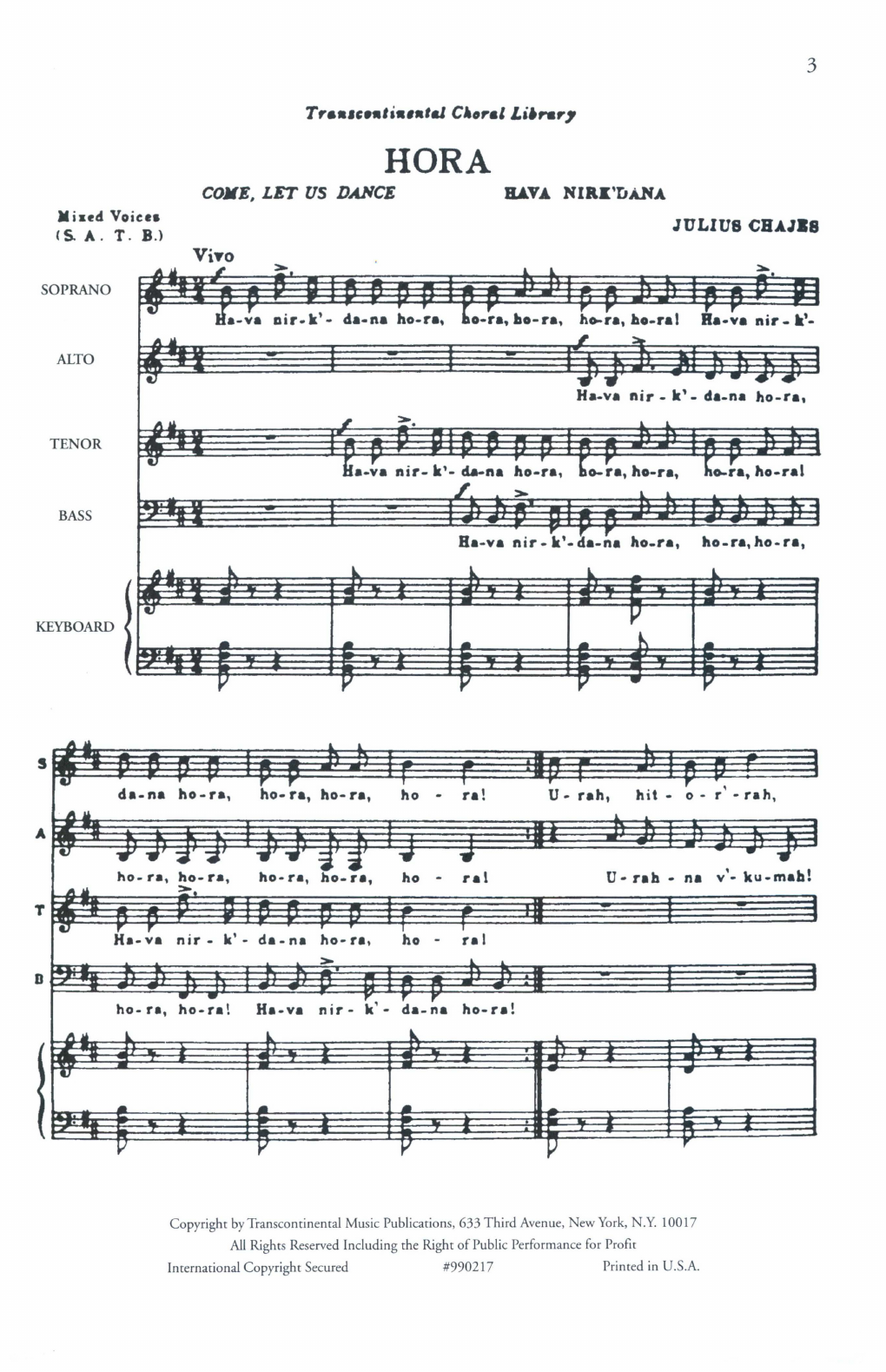
Hora (Come Let Us Dance) Sheet Music Preview

Hora (Come Let Us Dance): SATB Choral Octavo

By Julius Chajes

Item: 35-DS01134746

Digital Download
$2.99
Description

Hora (Come Let Us Dance): SATB Choral Octavo isn't in MakeMusic Cloud just yet...but it could be. Let us know you'd like to see it, and you'll help shape what comes next. In the meantime, start a free trial and dive into thousands of interactive titles your students can play along with today.

Sample Audio
No sample audio found.
Sample Video
Additional Details
Publisher: Hal Leonard
Page Count: 6
SKU: 35-DS01134746

More about this title

About the Composer: Julius Chajes

Julius Chajes (1910–1981) was an American composer and cantor who bridged liturgical and secular choral traditions. His work frequently drew on Jewish folk idioms and Eastern European musical language, which he integrated into accessible, performable scores for both professional and amateur ensembles.

Chajes's catalog includes settings for synagogue use as well as secular choral works designed for concert performance. His approach to text setting was direct and word-focused, making his pieces effective vehicles for clear communication and emotional resonance.

Why we love this

The energy here is infectious without being superficial. Chajes captures the spirit of communal dance and celebration in music that sounds joyful but never trivial, giving your singers genuine material to invest in rather than a novelty piece. The six-page length makes it substantial enough to matter on a program while remaining manageable for groups with moderate rehearsal time.

What to expect

Hora radiates warmth and communal joy. The writing invites singers into a shared space, with clear harmonic language and rhythmic patterns that feel both familiar and slightly exotic, suggesting movement and gathering without requiring staging or choreography.

Who it's for

SATB choirs at the intermediate level and above will find this piece accessible without being elementary. It works equally well for concert programs, cultural celebrations, or sacred contexts where secular folk material fits your season's themes.

How to get the most out of it

  • Keep the rhythmic pulse buoyant and slightly forward; the hora's character depends on feeling the momentum rather than sitting heavily on the beat.
  • Balance the voices so the text remains audible through homophonic sections. Chajes writes clearly, but diction work pays dividends for projection.
  • Shape phrases with attention to the natural breathing points in the text rather than strictly at barlines; this makes the dance-like quality feel organic.

How to use it

Position this as a mid-program energizer that breaks up heavier material, or pair it with other world music and folk-rooted works to explore cultural expressions of celebration. Its approachable style also makes it ideal for community performances or interfaith concert contexts.

Skills your students will build

  • Sustaining rhythmic precision in a dance context
  • Clear text projection in homophonic writing
  • Sensitivity to folk-influenced harmonic language
  • Ensemble awareness through synchronized rhythmic figures

You May Also Like