
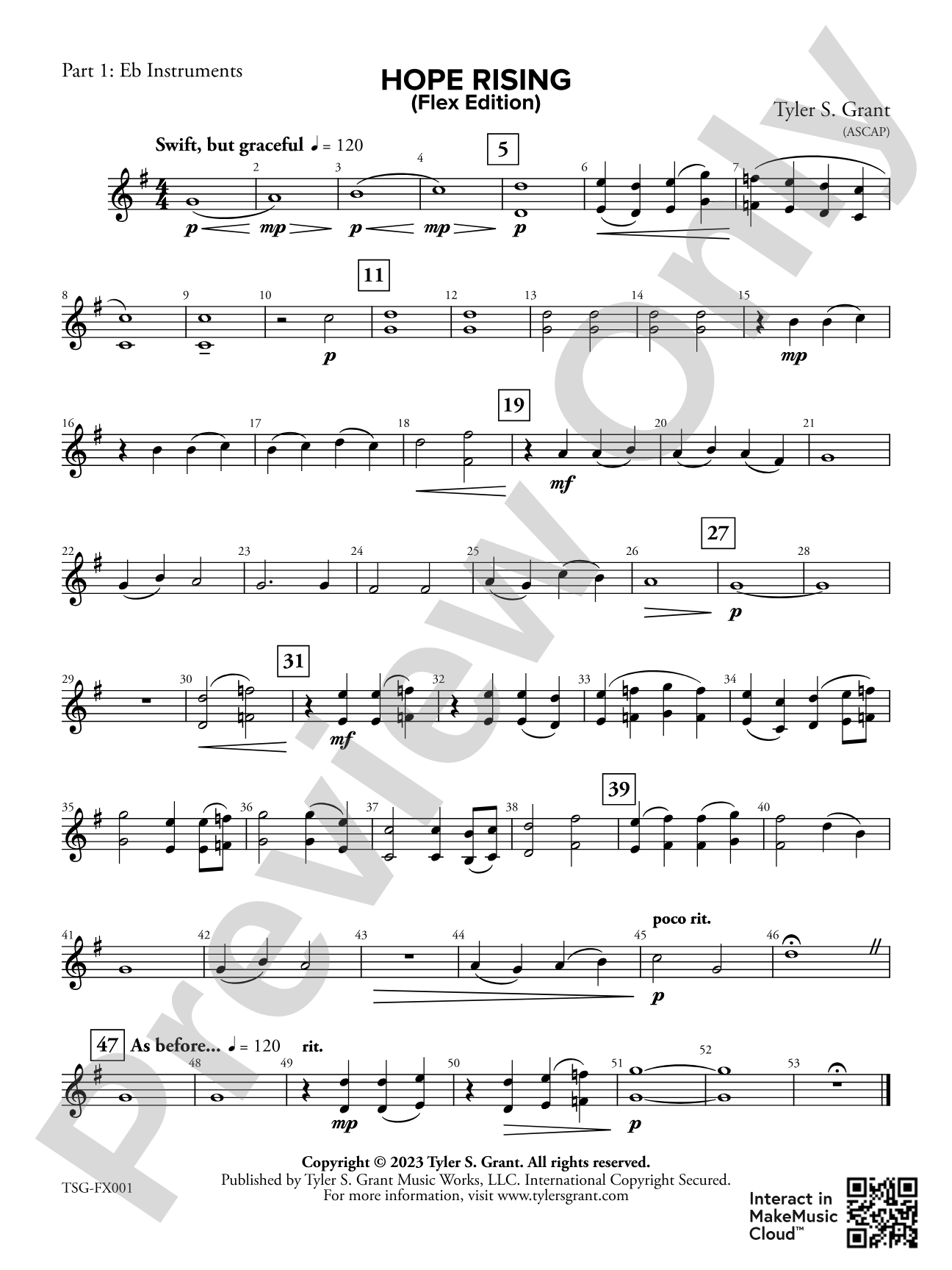

Hope Rising: Part 1 - E-flat Instruments
Flex Concert Band Edition
By Tyler S. Grant
Grade: 1
Item: 98-PC-TGFX001_PART1_EFLAT
$4.50
Pickup currently not available
Description
Develop your ensemble's tone, phrasing, and overall musicianship with this beautifully lyrical work. This version of Hope Rising by Tyler S. Grant is for flexible ensemble. Only 4 voices required, and playable with winds, strings, or a combination of the two! Percussion is recommended, but not required. Piano accompaniment included! (2:15)


Hope Rising: Part 1 - E-flat Instruments isn't in MakeMusic Cloud just yet...but it could be. Let us know you'd like to see it, and you'll help shape what comes next. In the meantime, start a free trial and dive into thousands of interactive titles your students can play along with today.
Request This Title
Tell us you want it.
Start Your Free Trial
Explore everything that's ready to play right now.
Sample Audio
1
Audio File
--:--
0:00
0:00
Sample Video
Additional Details
Series:
FLEX Editions
Publisher:
Tyler S. Grant Music Works, LLC.
SKU:
98-PC-TGFX001_PART1_EFLAT
More about this title
About the Composer: Tyler S. Grant

Tyler S. Grant has built a reputation as a prolific composer and arranger whose works appear regularly on honor ensemble programs and national repertoire lists. His compositions have been commissioned consistently since 2010 and performed at prestigious venues including Carnegie Hall, The Midwest Clinic, and the Meyerson Symphony Center. His piece Panoramic Fanfare won the Dallas Wind Symphony's 2014 "Call for Fanfares" Competition and has since circulated among collegiate and professional ensembles across North America.
Beyond composing, Grant maintains an active schedule as a clinician, having worked with over 100 school programs across 15 states, and as a conductor at regional and all-state events. He earned his bachelor's degree in instrumental music education from the University of Alabama, where he studied conducting with Randall Coleman. Grant has also contributed to Alfred Music's Sound Innovations: Ensemble Development series and regularly shares insights through interviews and articles in music education publications.
Why we love this
Grant has designed this work specifically for the realities of modern ensembles: limited instrumentation, mixed instrumentation levels, and the need for flexibility without sacrificing musical substance. The Grade 1 level and straightforward four-voice requirement mean you can program something genuinely musical in early autumn when your full ensemble isn't ready, or adapt it on the fly as players join and leave rehearsals. The piano accompaniment gives you sonic weight even with minimal winds or strings.
What to expect
Lyrical and flowing with a quiet earnestness, Hope Rising develops tone and phrasing through sustained, singable lines rather than technical display. The work breathes with the character of a anthem without the weight of a major ceremonial piece, making it rewarding to conduct and engaging for student musicians to shape.
Who it's for
Directors building flexible programs for mixed-instrument ensembles, beginning bands that need quality literature before full instrumentation is available, and festival-season rehearsals where perfect attendance is uncertain. This works equally well as a small ensemble piece for chamber concert programming or as an accessible opening number when your large ensemble still has gaps.
How to get the most out of it
- Balance the four essential voices rather than doubling them heavily; Grant's lyrical writing relies on clear lines even with minimal instrumentation.
- Shape the phrasing as you would in a larger ensemble, using slight tempo and dynamic flexibility to bring out the melodic arc.
- If adding both winds and strings, let the strings carry the legato foundation while the winds provide harmonic support and color.
- Rehearse the percussion and piano parts early so the ensemble has rhythmic security even before all instrumental voices are stable.
How to use it
Open a concert with this as your audience settles, or place it early in the program when ensemble focus is fresh and energy is high. It works well alongside other Grade 1 literature when you're programming around instrumentation gaps, and its brevity (2:15) makes it ideal for festivals where you need a confident, polished selection that younger or smaller groups can execute with musicianship.
Skills your students will build
- Lyrical phrasing and sustained tone production across a four-voice texture
- Ensemble balance without heavy doubling
- Listening and blend across mixed instrument combinations (winds, strings, or both)
- Ensemble cohesion with minimal instrumentation